

Trading
Explore a wide range of markets with competitive pricing, deep liquidity, and advanced trading tools.
Learn More 
Platform
Trade seamlessly with TMGM's powerful platform, built for speed, precision, and a superior trading experience.
Learn More Trading Platform
Academy
Learn the fundamentals of trading with beginner-friendly resources, including guides, webinars, and market insights.
Learn More News & Analysis
Get real-time market updates and expert analysis to stay ahead of trading opportunities
Learn More News & Analysis
About
Learn what sets TMGM apart — our global presence, regulatory strength, and commitment to innovation in trading.
Learn More Why Choose TMGM
Sponsorship
Australian Dollar pares early gains as US Dollar stages a recovery
- The Australian Dollar pares half its initial advance as the US Dollar recovers.
- Successive interest rate increases by the Fed are anticipated by financial markets.
- October inflation releases from Australia and the US are in focus for investors.
A recovering US Dollar (USD) trims the Australian Dollar’s (AUD) early advance on Monday. Having pulled back from the session high of 0.6657, the Aussie pair nevertheless trades around 0.6638 in the European session, up 0.32%.
After erasing its earlier decline, the US Dollar Index (DXY) edges into positive territory near 103.89 during European trading. The index tracks the Greenback against six major currencies.

Confidence in financial markets that the Federal Reserve (Fed) will announce a succession of interest rate increases in the near term had already supported a positive outlook for the US Dollar.
Could firm US data and inflation pressure bring three consecutive Fed hikes, as TD Securities expects?
TD Securities anticipates “a third hike in March.” Ahead of that, the bank says “most officials would support consecutive 25bp hikes in December and January,” citing persistent inflation pressures. Its economists observe that “data last week and our expectations for data this week are in line with recent trends,” and maintain that “inflation remains above target and is moving in the wrong direction.” They also highlight that “the labor market has stabilized, with some signs of strengthening, and activity data has been robust.” Their assessment is that “the economy can handle more restriction, and the Fed is likely to provide it,” while “the evolution of inflation data” will guide “the extent and pace of hikes later in the cycle.”
Wednesday’s release of the United States (US) Personal Consumption Expenditure (PCE) Price Index for October is the next focus for investors seeking further signals on the Fed’s monetary policy outlook.
Persistent supply-side constraints and sector-specific factors are likely to prolong elevated price pressures, TD Securities said. Explaining its outlook, the bank states that “with supply chains still stressed amid AI-led price pressures, we do not see room for inflation progress in the near-term,” and forecasts that “core CPI inflation [will] be 2.9% y/y in Q4 2026, higher than the end of 2025, while the core PCE version should end the year firmer.” A return to inflation outcomes consistent with the target would also be delayed by oil, as TD Securities expects that “most of the impact of higher oil prices will filter into headline inflation,” with only “gradual disinflation” expected to “resume by the middle of 2027.”
For the Australian Dollar, attention centres on October’s Consumer Price Index (CPI) release, also due on Wednesday.
An annual inflation reading of 4.8% Year-on-Year (YoY) is anticipated, up from 4.3% previously. Expectations for the Reserve Bank of Australia’s (RBA) interest rates are likely to be significantly influenced by the release.
AUD/USD Technical Analysis: Can Support Contain the Decline?
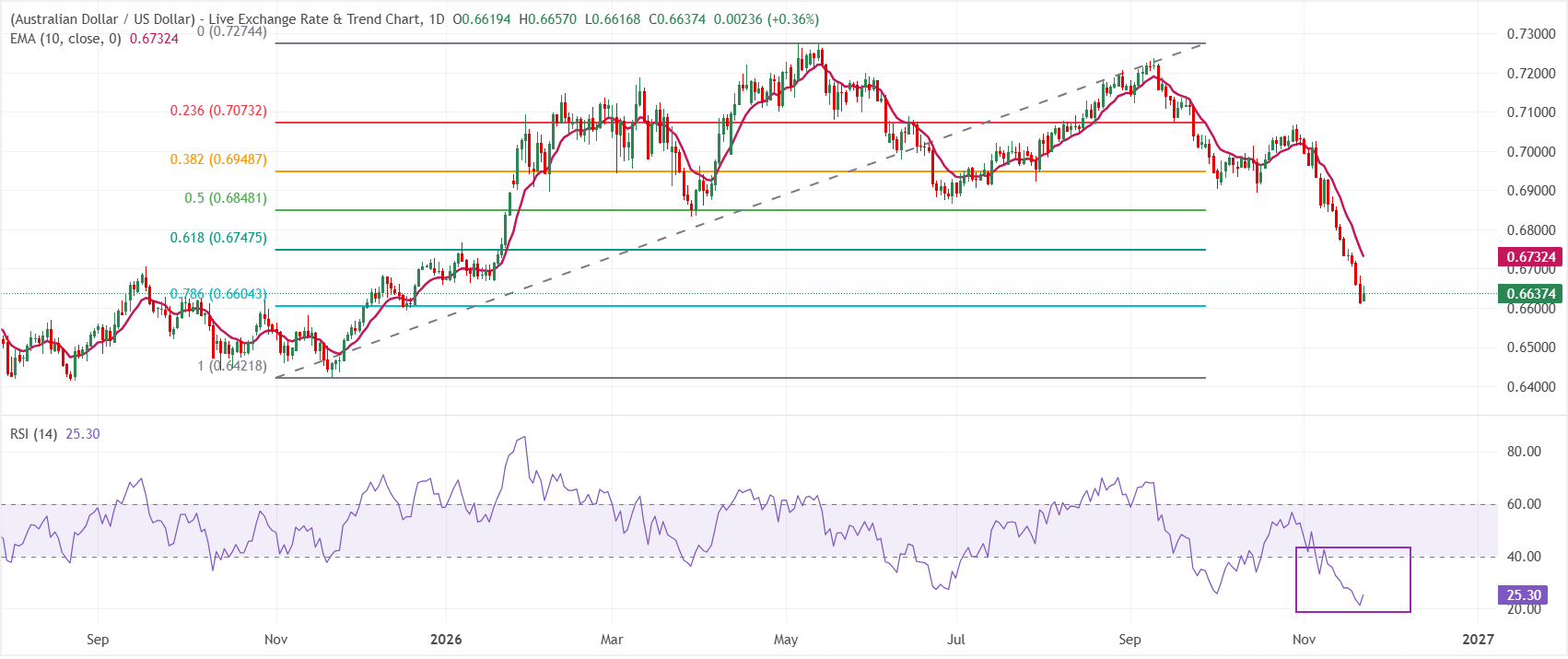
Trading at 0.6638 on the daily chart, AUD/USD retains a distinctly bearish bias. Spot remains beneath both the 10-day exponential moving average (EMA) at 0.6732 and every nearby Fibonacci retracement level. With the Relative Strength Index (14) near 25 in oversold territory, downward momentum is still strong, although the latest decline could begin to slow as the pair approaches deeper support levels.
The first downside support sits at 0.6604, the 78.6% Fibonacci retracement, followed by a stronger structural base near 0.6422 at the 100% retracement. Any recovery faces immediate resistance from the 10-day EMA at 0.6732 before the 61.8% retracement at 0.6748. Beyond these, the 50% level near 0.6848 presents another hurdle, with higher Fibonacci resistance at 0.6949 and 0.7073.
(The technical analysis of this story was written with the help of an AI tool. Know more.)
Which Economic Indicator Is in Focus?
Consumer Price Index: Year-on-Year (YoY)
Published monthly by the Australian Bureau of Statistics, the Consumer Price Index (CPI) tracks price movements across a comprehensive basket of goods and services purchased by household consumers. Following a methodological change from quarterly to monthly readings, it serves as the primary gauge of headline inflation for data from April 2024 onwards. The YoY figure measures prices in the reference month against those in the corresponding month a year earlier. A higher reading is regarded as bullish for the Australian Dollar (AUD), whereas a lower reading is considered bearish.
View more.Upcoming release: Wed 25 Nov 2026 00:30
Release frequency: Every month
Consensus forecast: 4.8%
Previous reading: 4.3%
Data source: Australian Bureau of Statistics
POPULAR ARTICLES
1Swiss Franc strengthens as investors stay wary following equity sell-off2Euro: How are political risks and ECB repricing pressuring the currency? – Rabobank3Why Is HSBC’s US Dollar Outlook Strong Into 2027?4Why is the US Dollar Index (DXY) rebounding as Eurozone and UK business activity data disappoint?5Swiss Franc: Does the SNB’s stance signal gains against the Euro? – ING6Australian Dollar: UOB Sees Decline Against US Dollar as Overextended7Australian Dollar pares early gains as US Dollar stages a recovery8Crypto Today: Bitcoin, Ethereum and XRP advance even as market sentiment remains fragile9Euro: Do resilient data strengthen the case for ECB hikes? – BBH


Get Started!
Sign up and access the Global Markets in less than 3 minutes

Connect With Us









Contacts
Phone: +61 2 8036 8388
Fax: +61 2 8036 8388
Email: support@tmgm.com



The information provided on this website is of a general nature only and does not constitute personal financial advice. Before acting on any information on this website, you should consider the suitability of the information in relation to your objectives, financial situation and needs. Investing in CFDs and FX Margin Contracts carries significant risks and is not suitable for all investors. You may lose more than your initial deposit. You do not own, or have, any interest in the underlying asset. We recommend that you seek independent advice and ensure you fully understand the risks involved before trading. It is important that you read and consider the disclosure document before you acquire any product listed on the website. The information and advertisements offered on this website are not intended for use by any person in any country or jurisdiction where such use would be contrary to local laws and regulations. The Products and Services offered on this website are not intended for residents of the United States, Malaysia and Thailand.
TMGM is authorized and regulated in various jurisdictions.
Trademax Australia Limited, trading as TMGM, is regulated by the Australian Securities and Investments Commission (ASIC), AFSL no. 436416 and is located at Level 28, One International Tower, 100 Barangaroo Avenue, 2000 Sydney, NSW Australia.
Email: support@tmgm.com.au
Trademax Global Limited, trading as TMGM, is authorized and regulated by the Vanuatu Financial Services Commission (VFSC), registration number 40356 and registered at 1276, Kumul Highway, Port Vila, Vanuatu, Republic of Vanuatu.
Email: support@tmgm.com
Trademax Global Markets (SE) Limited, trading as TMGM, is authorized and regulated by the Financial Services Authority (FSA) of Seychelles, with license number SD224. The company is registered at Office No 13, Providence Estate ABIS Centre, Mahe, Seychelles.
Email: support@tmgm.com
Trademax Global Markets (International) Pty Ltd, trading as TMGM, is authorized and regulated by the Financial Services Commission, Mauritius (FSC) with license no. GB22201012, and registered at 33, Edith Cavell Street C/o IQ EQ Fund Services (Mauritius) Ltd Port Louis, 11324 Mauritius.
Email: support@tmgm.com
Copyright © TMGM. All rights reserved