

Trading
Explore a wide range of markets with competitive pricing, deep liquidity, and advanced trading tools.
Learn More 
Platform
Trade seamlessly with TMGM's powerful platform, built for speed, precision, and a superior trading experience.
Learn More Trading Platform
Academy
Learn the fundamentals of trading with beginner-friendly resources, including guides, webinars, and market insights.
Learn More News & Analysis
Get real-time market updates and expert analysis to stay ahead of trading opportunities
Learn More News & Analysis
About
Learn what sets TMGM apart — our global presence, regulatory strength, and commitment to innovation in trading.
Learn More Why Choose TMGM
Sponsorship
Can the British Pound defend 1.3300 with UK budget support ahead of the Fed’s decision?
- Selling pressure keeps GBP/USD near 1.3300 as losses stretch into a fourth day.
- Within three years, the UK Chancellor aims to wipe out the current budget deficit.
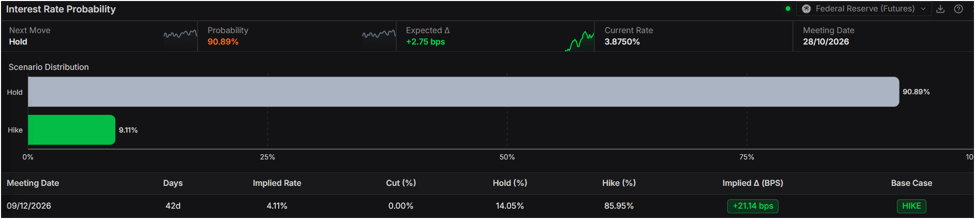
- Markets price an 85% probability of a December Fed hike ahead of Warsh's guidance.
Pressure on the Pound Sterling persists for a fourth straight day against the US Dollar, with the currency down 0.02%. Investors are weighing the UK’s Autumn Budget while preparing for the Federal Reserve’s policy announcement. Trading close to 1.3300, GBP/USD is only marginally changed.

Can Britain's fiscal discipline pledges support GBP/USD ahead of the Fed decision?
Describing the budget as “built on fiscal discipline which matches immediate action today, with clear direction for the future.”, UK finance minister John Healey outlined the government’s plans. According to Healey, the Office for Budget Responsibility (OBR) indicated that the Middle East war makes forecasting more difficult. He added that the budget “puts us on track to eliminate the current budget deficit and get Britain’s finances into the black within 3 years.”
With escalating tensions in the Middle East continuing to weigh on GBP/USD, the budget announcement prompted little reaction in the pair.
Attention in the US centres on the Federal Reserve’s monetary policy announcement. While money markets assign a nearly 91% probability to Warsh and company leaving rates steady, investors will scrutinise his press conference for any guidance he may offer on the foreseeable future.
According to Prime Terminal, swaps pricing for the end of the year reflected 21 basis points of tightening, equivalent to an 85% probability of a Fed rate increase at the December meeting.
Beyond the Fed announcement, GBP/USD’s direction as month-end approaches could also be shaped by US Q3 Gross Domestic Product (GDP) data and Core PCE, the Fed’s preferred inflation measure.
GBP/USD Price Forecast: Can buyers overcome technical resistance?
The near-term technical bias remains bearish on the daily chart, where GBP/USD stands at 1.3303 beneath a tightly grouped set of simple moving averages around 1.3390. Having broken below its rising trend structure, the pair now faces resistance near 1.3360, where it most recently touched the former support line. By contrast, a descending trend line that earlier restricted prices around 1.3255 now offers nearby support. At roughly 48, the Relative Strength Index (14) is slightly below its neutral midpoint, suggesting that bullish momentum is fading. Unless buyers recover the technical barriers above, the pair remains vulnerable to further declines.
For buyers, the first hurdle is the breached rising trend line around 1.3360. Beyond it lies an important confluence near 1.3390, where the 50-, 100- and 200-day simple moving averages converge; closing above this zone on a daily basis would reduce immediate selling pressure. Higher resistance comes from a falling trend line near 1.3544, followed by an older rising trend line around 1.3606 that provides another structural ceiling. Initial support, meanwhile, lies around 1.3255 at the descending trend line that has changed its role. A breach of that level would leave room for a larger decline towards earlier lows not displayed by the current set of indicators.
(The technical analysis of this story was written with the help of an AI tool. Know more.)
Pound Sterling: Frequently asked questions
As the United Kingdom’s official currency, the Pound Sterling (GBP) is also the world’s oldest currency, dating back to 886 AD. Figures for 2022 place it fourth globally by foreign exchange (FX) trading activity, with a 12% share of all transactions and average daily turnover of $630 billion. Among its main currency pairs, GBP/USD, also called ‘Cable’, represents 11% of FX trading. GBP/JPY, known to traders as the ‘Dragon’, accounts for 3%, while EUR/GBP makes up 2%. Issuance of the Pound Sterling is the responsibility of the Bank of England (BoE).
Monetary policy set by the Bank of England is the most important individual influence on the Pound Sterling’s value. In making policy decisions, the BoE assesses whether it has met its core objective of “price stability” – inflation holding at around 2%. Interest rate changes are its main means of pursuing that objective. To curb excessively high inflation, the BoE will seek to raise interest rates, increasing borrowing costs for households and businesses. GBP generally benefits because higher rates make the UK a more appealing destination for international investors’ funds. Inflation that drops too low, on the other hand, signals a slowdown in economic growth. The BoE will then consider cutting rates to make borrowing cheaper, encouraging businesses to take on more credit for investment in projects that generate growth.
Sterling can respond to economic releases because they indicate the economy’s health. GDP, Manufacturing and Services PMIs, and employment indicators can each shape GBP’s direction. Economic strength supports Sterling by drawing in more overseas investment and potentially prompting the BoE to raise interest rates, which would directly strengthen GBP. Weak economic readings, by contrast, are likely to lead to a decline in the Pound Sterling.
The Trade Balance is another important economic release for Sterling, showing the gap between a country’s export earnings and its spending on imports during a specified period. Strong overseas demand for a country’s exports creates additional demand for its currency as foreign buyers seek to purchase those goods. A positive net Trade Balance therefore supports the currency, whereas a negative balance has the opposite effect.
POPULAR ARTICLES
1Can the British Pound defend 1.3300 with UK budget support ahead of the Fed’s decision?2Australian Dollar: Can it advance towards the 0.7060 cap against the US Dollar? – UOB3Why is the Canadian Dollar struggling to gain traction despite a BoC rate hike?4United Kingdom: Neutral Budget leaves fiscal risks unresolved - Deutsche Bank5US Dollar: December risk remains in play as Fed stays on hold – BBH6ECB in focus as euro inches higher against CAD following expected BoC rate hike7Federal Reserve: Is a likely October hold set to precede an expected December hike? - ABN AMRO8New Zealand Dollar: Why Is RBNZ Delaying Hikes as Inflation Mounts? – Standard Chartered9Euro holds steady near 17-month lows as Fed rate decision approaches
LIVE QUOTES

ALL ABOUT FOREX
What Is a Stop Loss, How Does It Work and How Do You Set One?
Margin Call Meaning: What It Is, What Triggers It, and How to Avoid One
What Is an Islamic Account in Forex?
Best Indicators for Forex Trading and How to Use Them
The Top 10 Most Traded Currency Pairs in the World
What are the Major Forex Pairs? 7 Major Currency Pairs in the World
5 Best Forex Trading Apps In India In 2026
Top 15 Weakest Currencies in the World
Best Time to Trade Forex
Get Started!
Sign up and access the Global Markets in less than 3 minutes

Connect With Us









Contacts
Phone: +61 2 8036 8388
Fax: +61 2 8036 8388
Email: support@tmgm.com



The information provided on this website is of a general nature only and does not constitute personal financial advice. Before acting on any information on this website, you should consider the suitability of the information in relation to your objectives, financial situation and needs. Investing in CFDs and FX Margin Contracts carries significant risks and is not suitable for all investors. You may lose more than your initial deposit. You do not own, or have, any interest in the underlying asset. We recommend that you seek independent advice and ensure you fully understand the risks involved before trading. It is important that you read and consider the disclosure document before you acquire any product listed on the website. The information and advertisements offered on this website are not intended for use by any person in any country or jurisdiction where such use would be contrary to local laws and regulations. The Products and Services offered on this website are not intended for residents of the United States, Malaysia and Thailand.
TMGM is authorized and regulated in various jurisdictions.
Trademax Australia Limited, trading as TMGM, is regulated by the Australian Securities and Investments Commission (ASIC), AFSL no. 436416 and is located at Level 28, One International Tower, 100 Barangaroo Avenue, 2000 Sydney, NSW Australia.
Email: support@tmgm.com.au
Trademax Global Limited, trading as TMGM, is authorized and regulated by the Vanuatu Financial Services Commission (VFSC), registration number 40356 and registered at 1276, Kumul Highway, Port Vila, Vanuatu, Republic of Vanuatu.
Email: support@tmgm.com
Trademax Global Markets (SE) Limited, trading as TMGM, is authorized and regulated by the Financial Services Authority (FSA) of Seychelles, with license number SD224. The company is registered at Office No 13, Providence Estate ABIS Centre, Mahe, Seychelles.
Email: support@tmgm.com
Trademax Global Markets (International) Pty Ltd, trading as TMGM, is authorized and regulated by the Financial Services Commission, Mauritius (FSC) with license no. GB22201012, and registered at 33, Edith Cavell Street C/o IQ EQ Fund Services (Mauritius) Ltd Port Louis, 11324 Mauritius.
Email: support@tmgm.com
Copyright © TMGM. All rights reserved