

Trading
Explore a wide range of markets with competitive pricing, deep liquidity, and advanced trading tools.
Learn More 
Platform
Trade seamlessly with TMGM's powerful platform, built for speed, precision, and a superior trading experience.
Learn More Trading Platform
Academy
Learn the fundamentals of trading with beginner-friendly resources, including guides, webinars, and market insights.
Learn More News & Analysis
Get real-time market updates and expert analysis to stay ahead of trading opportunities
Learn More News & Analysis
About
Learn what sets TMGM apart — our global presence, regulatory strength, and commitment to innovation in trading.
Learn More Why Choose TMGM
Sponsorship
British Pound’s losing streak against US Dollar continues as attention turns to US PPI
- Selling pressure takes the British Pound closer to 1.3227 against the US Dollar on Friday.
- Persistent US inflation and a hawkish Fed outlook continue to underpin the US Dollar, according to NBC.
- US PPI figures and UK employment and CPI releases are next on investors’ radar.
Selling pressure on the British Pound (GBP) against the US Dollar (USD) persists on Friday, putting it on course for a fourth consecutive trading day of losses. With expectations of a faster monetary tightening cycle from the Federal Reserve (Fed) sustaining the US Dollar’s outperformance, GBP/USD retreats towards 1.3227.

The US Dollar Index (DXY) remains close to Thursday’s 19-month high of 103.24 at the time of writing. The index tracks the Greenback against a basket of six major currencies.
Can inflation and the Fed outlook sustain the Dollar’s safe-haven appeal?
According to strategists at National Bank of Canada (NBC), the Dollar “remains supported by persistent inflation and the prospect of further Fed tightening.” Their policy assessment is that “following October’s pause, another firm Consumer Price Index (CPI) report reinforces our expectation for tighter policy before year-end,” while a “deterioration in global risk appetite could provide further support through safe-haven demand.”
Tuesday’s US CPI release for October put monthly headline inflation at 0.4% and core inflation at 0.3%, with both readings exceeding expectations.
Before the US CPI figures were released, Fed Governor Christopher Waller had warned that “half-point Fed rate hike may be needed in December, if October core CPI inflation comes in around 0.3% or higher.”
How is Waller’s hawkish stance lifting Fed rate hike expectations?
A 9/10 FXS Speechtracker score, compared with a historical average of 7.3/10, highlights the distinctly hawkish tone of Fed Governor Waller’s remarks and his unusually strong emphasis on tighter policy. His willingness to consider a half-point Fed rate hike in December if core CPI reaches 0.3% or higher, alongside support for a quarter-point increase even if inflation data improve, points to a clear preference for further tightening. He described inflation as “too high” and recent data as “bad.” Broad-based price increases, continuing producer and energy price pressures, and the need to raise real interest rates all strengthen the assessment that policy is not yet sufficiently restrictive. Sharp movements in share prices carry limited weight in that assessment.
An increase of 3.17 points took the FXS Fed Sentiment Index to 145.50, placing it firmly in hawkish territory and aligning with the high FXS Speechtracker score. The shift points to a significant tightening in the Fed’s perceived policy stance. As markets assign a greater probability to December rate hikes, this is likely to underpin the Dollar and leave interest rate-sensitive assets under pressure.
Attention later in the day turns to October’s US Producer Price Index (PPI), due for release at 13:30 GMT.
For the British currency, the focus is moving to next week’s United Kingdom (UK) labour market figures for the three months ending September, alongside October’s Consumer Price Index (CPI) release.
GBP/USD Technical Analysis: Can the Pair Ease Its Bearish Bias?
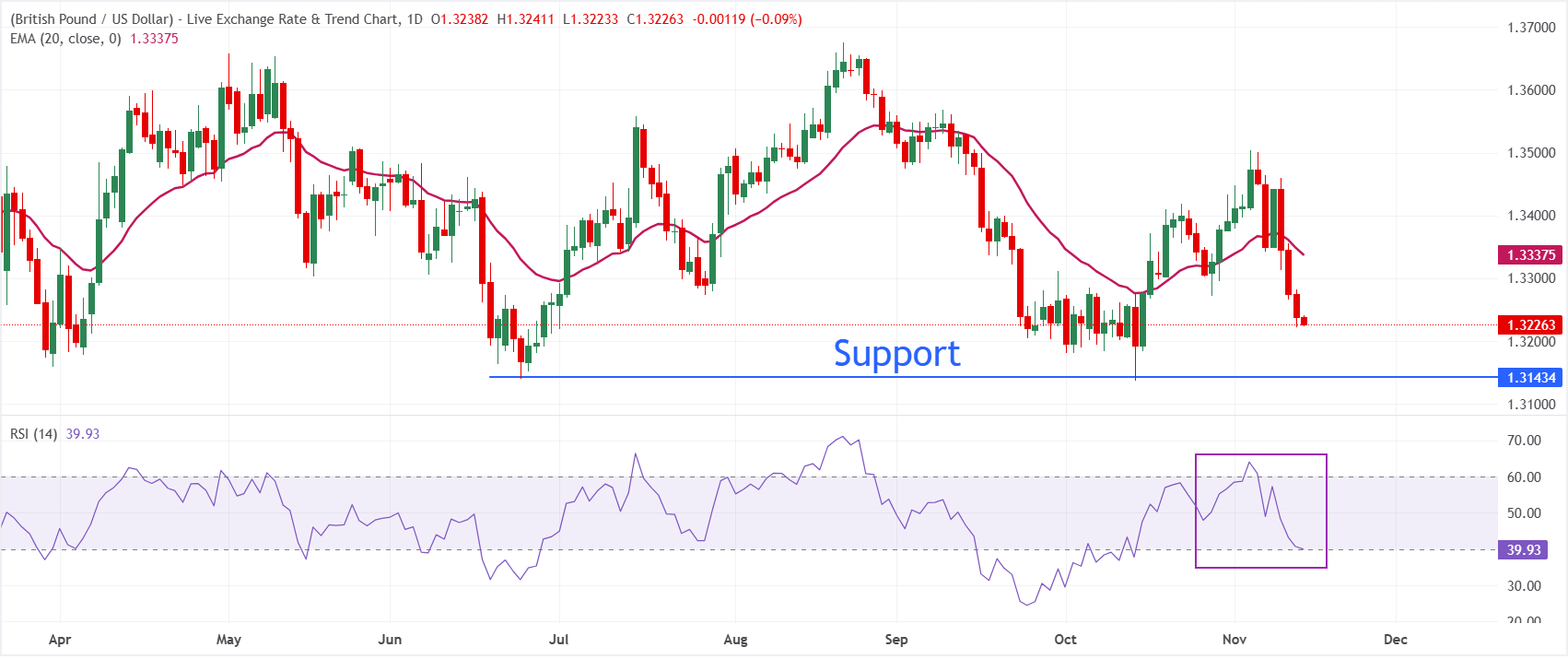
A near-term bearish outlook continues to shape GBP/USD on the daily chart, where the pair trades at 1.3226. Spot remains beneath the 20-period exponential moving average (EMA) of 1.3337, leaving that level as immediate overhead resistance. At 39.9, the Relative Strength Index (RSI) is also below the neutral 50 mark. This suggests that selling pressure remains dominant, although the indicator has not reached oversold extremes.
For a more durable recovery to become possible, GBP/USD would need a daily close above its first resistance at the 20-day EMA of 1.3337, easing the prevailing bearish tone. Without that break, further declines remain a risk. Traders are likely to sell on rebounds for as long as momentum stays below the midline.
(The technical analysis of this story was written with the help of an AI tool. Know more.)
Economic Data Indicator
Producer Price Index (MoM): What Does It Measure?
Published by the Bureau of Labor statistics, Department of Labor, the Producer Price Index tracks average price changes in US primary markets for commodities produced at all stages of processing. Movements in the PPI are closely monitored as a gauge of commodity inflation. A higher reading is generally regarded as positive, or bullish, for the USD; a lower reading is usually viewed as negative, or bearish.
View details.Next scheduled release: Fri 13 Nov 2026 13:30
Release frequency: Monthly
Consensus estimate: 0.4%
Previous reading: 1.3%
Data source: US Bureau of Labor Statistics
POPULAR ARTICLES
1Solana Price Forecast: Broader market sell-off intensifies bearish pressure on SOL2British Pound’s losing streak against US Dollar continues as attention turns to US PPI3EUR/USD Price Forecast: Modest gains hold above 1.1050, but the 100-day SMA keeps a lid on upside4Continued US Dollar outperformance drives further correction in Indian Rupee5Easing political uncertainty lifts Indonesian Rupiah despite MSCI outflow risks6WTI Price Forecast: Why do bears retain control below 23.6% Fibo. and the 200-hour SMA?7Cardano Price Forecast: Does weakness in on-chain and derivatives markets signal further ADA downside?8Currency market: Japan’s Takaichi reports close contact with US financial authorities9EUR/JPY Price Forecast: Bearish bias persists below 100-day SMA despite gains above 176.50


Get Started!
Sign up and access the Global Markets in less than 3 minutes

Connect With Us









Contacts
Phone: +61 2 8036 8388
Fax: +61 2 8036 8388
Email: support@tmgm.com



The information provided on this website is of a general nature only and does not constitute personal financial advice. Before acting on any information on this website, you should consider the suitability of the information in relation to your objectives, financial situation and needs. Investing in CFDs and FX Margin Contracts carries significant risks and is not suitable for all investors. You may lose more than your initial deposit. You do not own, or have, any interest in the underlying asset. We recommend that you seek independent advice and ensure you fully understand the risks involved before trading. It is important that you read and consider the disclosure document before you acquire any product listed on the website. The information and advertisements offered on this website are not intended for use by any person in any country or jurisdiction where such use would be contrary to local laws and regulations. The Products and Services offered on this website are not intended for residents of the United States, Malaysia and Thailand.
TMGM is authorized and regulated in various jurisdictions.
Trademax Australia Limited, trading as TMGM, is regulated by the Australian Securities and Investments Commission (ASIC), AFSL no. 436416 and is located at Level 28, One International Tower, 100 Barangaroo Avenue, 2000 Sydney, NSW Australia.
Email: support@tmgm.com.au
Trademax Global Limited, trading as TMGM, is authorized and regulated by the Vanuatu Financial Services Commission (VFSC), registration number 40356 and registered at 1276, Kumul Highway, Port Vila, Vanuatu, Republic of Vanuatu.
Email: support@tmgm.com
Trademax Global Markets (SE) Limited, trading as TMGM, is authorized and regulated by the Financial Services Authority (FSA) of Seychelles, with license number SD224. The company is registered at Office No 13, Providence Estate ABIS Centre, Mahe, Seychelles.
Email: support@tmgm.com
Trademax Global Markets (International) Pty Ltd, trading as TMGM, is authorized and regulated by the Financial Services Commission, Mauritius (FSC) with license no. GB22201012, and registered at 33, Edith Cavell Street C/o IQ EQ Fund Services (Mauritius) Ltd Port Louis, 11324 Mauritius.
Email: support@tmgm.com
Copyright © TMGM. All rights reserved