

Trading
Explore a wide range of markets with competitive pricing, deep liquidity, and advanced trading tools.
Learn More 
Platform
Trade seamlessly with TMGM's powerful platform, built for speed, precision, and a superior trading experience.
Learn More Trading Platform
Academy
Learn the fundamentals of trading with beginner-friendly resources, including guides, webinars, and market insights.
Learn More News & Analysis
Get real-time market updates and expert analysis to stay ahead of trading opportunities
Learn More News & Analysis
About
Learn what sets TMGM apart — our global presence, regulatory strength, and commitment to innovation in trading.
Learn More Why Choose TMGM
Sponsorship
Why is the British Pound stalling below 1.3400 despite strong UK CPI and bets on a BoE rate hike?
- With geopolitical risks underpinning the Dollar, GBP/USD remains under pressure below 1.3400.
- Higher energy costs push UK inflation up to 3.5%.
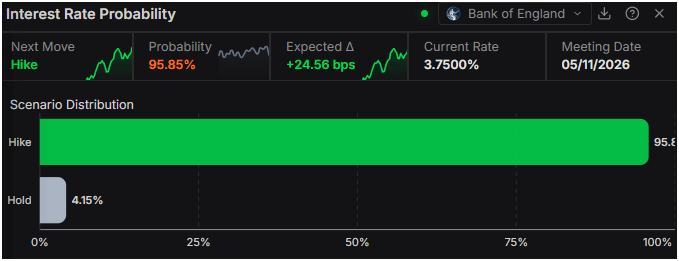
- Ahead of the pivotal Autumn Budget, the probability of a November BoE rate hike climbs to 95%.
Gains in the Pound Sterling against the US Dollar remain difficult to sustain on Wednesday, with GBP/USD hovering below 1.3400 as mounting geopolitical tensions fuel a recovery in the Greenback. This comes despite United Kingdom inflation reinforcing the case for a Bank of England rate increase at its next meeting.
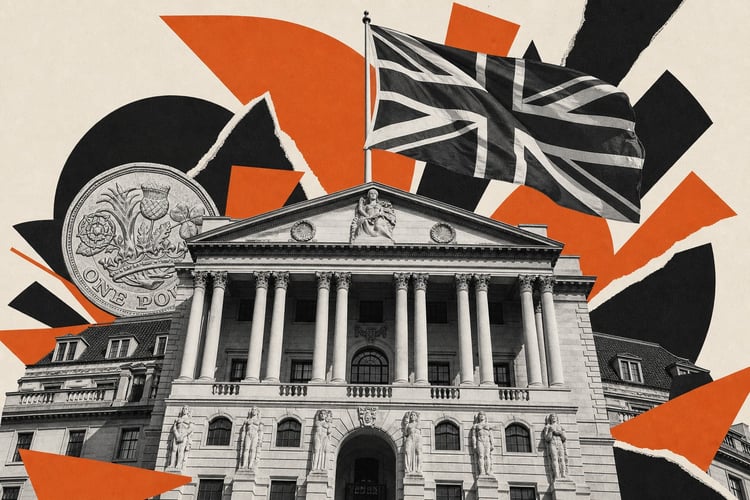
Can rising UK inflation support Sterling as geopolitical tensions lift Dollar demand?
Technology stocks are lifting US equities into positive territory as enthusiasm over AI drives a rally, offering market participants some cues on a Wednesday with little US economic data. Meanwhile, US Treasury yields remain firm, with the US 10-year T-note yielding 5.10%.
Support for the Greenback is also coming from geopolitical developments. Although Tuesday's news had pointed to a potential resolution, reports indicated that the Pakistani Army Chief had met Iranian officials in Tehran and put forward a “compromise proposal,” while N12 news said he had conveyed a “final warning.” to the US. The implication is that attacks would restart if Iran does not agree to a peace deal.
Higher energy prices resulting from the Middle East conflict were the main driver of the UK's September inflation increase, according to the Office for National Statistics (ONS). The Consumer Price Index (CPI) climbed to 3.5% YoY from 3.1%.
This inflation release follows the latest UK employment report, which showed a modest increase in wages together with further evidence of labour market resilience.
Against this backdrop, market pricing put the probability of a quarter-percentage-point Bank of England rate increase at its 5 November meeting at 95%.
British Finance Minister John Healey's first budget, scheduled for next week, is now the focus. Healey said earlier this month that the budget would strengthen Britain's resilience to the energy-price shock from the Iran war and provide the country with "a bit of breathing space."
GBP/USD Price Forecast: Can the pair clear near-term resistance?
Trading at 1.3387 on the daily chart, GBP/USD retains a bearish short-term bias, with the latest triple simple moving average at 1.3409 and the downward resistance trend line break at 1.3405 limiting gains. Further overhead, the upward support trend line breaks at 1.3620 and 1.3805 form a wider cluster of structural hurdles above the pair. Although the Relative Strength Index (14), at around 57, points to improving bullish momentum, that momentum remains moderate and has not yet absorbed the overhead supply.
The first upside hurdle lies near 1.3405 at the downward resistance trend line break, with the triple simple moving average at 1.3409 just beyond it. A daily close above this range would pave the way for a move towards the next resistance area, marked by the upward trend line break around 1.3620, followed by 1.3805. Immediate support, meanwhile, sits at 1.3271, where the former downward resistance trend line break now provides a floor. A retreat below that level would strengthen the broader bearish bias and leave lower levels vulnerable in the sessions ahead.
(The technical analysis of this story was written with the help of an AI tool. Know more.)
How Is the Pound Sterling Performing Today?
The British Pound's strongest performance today was against the Euro. Its percentage changes against the major currencies listed are shown in the table below.
| USD | EUR | GBP | JPY | CAD | AUD | NZD | CHF | |
|---|---|---|---|---|---|---|---|---|
| USD | 0.12% | -0.01% | -0.02% | 0.07% | -0.41% | -0.10% | 0.12% | |
| EUR | -0.12% | -0.22% | -0.16% | -0.09% | -0.48% | -0.27% | -0.05% | |
| GBP | 0.01% | 0.22% | 0.04% | 0.11% | -0.27% | -0.07% | 0.16% | |
| JPY | 0.02% | 0.16% | -0.04% | 0.09% | -0.29% | -0.10% | 0.13% | |
| CAD | -0.07% | 0.09% | -0.11% | -0.09% | -0.39% | -0.17% | 0.04% | |
| AUD | 0.41% | 0.48% | 0.27% | 0.29% | 0.39% | 0.22% | 0.42% | |
| NZD | 0.10% | 0.27% | 0.07% | 0.10% | 0.17% | -0.22% | 0.23% | |
| CHF | -0.12% | 0.05% | -0.16% | -0.13% | -0.04% | -0.42% | -0.23% |
Percentage movements between major currencies are displayed in the heat map. Read the base currency from the left-hand column and the quote currency from the top row. To see GBP (base)/USD (quote), for instance, select the British Pound in the left-hand column and follow that row across to the US Dollar; the cell at their intersection shows the percentage change.
POPULAR ARTICLES
1Australian Dollar climbs to one-month high on support from hawkish RBA2Why is the British Pound stalling below 1.3400 despite strong UK CPI and bets on a BoE rate hike?3Bitcoin vs Gold Forecast: Can BTC sustain momentum toward $84K as XAU leaps above $4,100?4How is the energy shock shaping inflation in the United Kingdom? – ING5Poland: What does fiscal change mean for bond positioning? – BNY6United States: What are the pre-election tail risks? – Danske Bank7United States EIA Heating Oil Stocks Change above expectations (0M) in October 16: Actual (0.652M)8United States EIA Gasoline Stocks Change below expectations (0M) in October 16: Actual (-2.952M)9United States EIA Distillate Stocks Change above expectations (0M) in October 16: Actual (1.675M)
LIVE QUOTES

ALL ABOUT FOREX
Margin Call Meaning: What It Is, What Triggers It, and How to Avoid One
What Is an Islamic Account in Forex?
Best Indicators for Forex Trading and How to Use Them
The Top 10 Most Traded Currency Pairs in the World
What are the Major Forex Pairs? 7 Major Currency Pairs in the World
5 Best Forex Trading Apps In India In 2026
Top 15 Weakest Currencies in the World
Best Time to Trade Forex
Forex Trading Regulations in India
Get Started!
Sign up and access the Global Markets in less than 3 minutes

Connect With Us









Contacts
Phone: +61 2 8036 8388
Fax: +61 2 8036 8388
Email: support@tmgm.com



The information provided on this website is of a general nature only and does not constitute personal financial advice. Before acting on any information on this website, you should consider the suitability of the information in relation to your objectives, financial situation and needs. Investing in CFDs and FX Margin Contracts carries significant risks and is not suitable for all investors. You may lose more than your initial deposit. You do not own, or have, any interest in the underlying asset. We recommend that you seek independent advice and ensure you fully understand the risks involved before trading. It is important that you read and consider the disclosure document before you acquire any product listed on the website. The information and advertisements offered on this website are not intended for use by any person in any country or jurisdiction where such use would be contrary to local laws and regulations. The Products and Services offered on this website are not intended for residents of the United States, Malaysia and Thailand.
TMGM is authorized and regulated in various jurisdictions.
Trademax Australia Limited, trading as TMGM, is regulated by the Australian Securities and Investments Commission (ASIC), AFSL no. 436416 and is located at Level 28, One International Tower, 100 Barangaroo Avenue, 2000 Sydney, NSW Australia.
Email: support@tmgm.com.au
Trademax Global Limited, trading as TMGM, is authorized and regulated by the Vanuatu Financial Services Commission (VFSC), registration number 40356 and registered at 1276, Kumul Highway, Port Vila, Vanuatu, Republic of Vanuatu.
Email: support@tmgm.com
Trademax Global Markets (SE) Limited, trading as TMGM, is authorized and regulated by the Financial Services Authority (FSA) of Seychelles, with license number SD224. The company is registered at Office No 13, Providence Estate ABIS Centre, Mahe, Seychelles.
Email: support@tmgm.com
Trademax Global Markets (International) Pty Ltd, trading as TMGM, is authorized and regulated by the Financial Services Commission, Mauritius (FSC) with license no. GB22201012, and registered at 33, Edith Cavell Street C/o IQ EQ Fund Services (Mauritius) Ltd Port Louis, 11324 Mauritius.
Email: support@tmgm.com
Copyright © TMGM. All rights reserved