

Trading
Explore a wide range of markets with competitive pricing, deep liquidity, and advanced trading tools.
Learn More 
Platform
Trade seamlessly with TMGM's powerful platform, built for speed, precision, and a superior trading experience.
Learn More Trading Platform
Academy
Learn the fundamentals of trading with beginner-friendly resources, including guides, webinars, and market insights.
Learn More News & Analysis
Get real-time market updates and expert analysis to stay ahead of trading opportunities
Learn More News & Analysis
About
Learn what sets TMGM apart — our global presence, regulatory strength, and commitment to innovation in trading.
Learn More Why Choose TMGM
Sponsorship
British Pound begins BoE policy week on a positive note
- Gains against major peers lift the British Pound as investors await Thursday’s BoE policy decision.
- A 25 bps increase in interest rates to 4% is widely expected from the BoE.
- According to market expectations, the Democrats have a 70-72% chance of winning both the House and the Senate.
Gains against most major currencies mark the start of the week for the British Pound (GBP), which is trading near 1.3430 against the US Dollar (USD), up 0.3%. Sterling’s advance comes as investors turn their attention to Thursday’s monetary policy announcement from the Bank of England (BoE).

How Is Pound Sterling Performing Today?
Against the major currencies listed below, today’s percentage movements in the British Pound (GBP) are set out in the table. The Australian Dollar was the currency against which the British Pound recorded its strongest performance.
| USD | EUR | GBP | JPY | CAD | AUD | NZD | CHF | |
|---|---|---|---|---|---|---|---|---|
| USD | -0.49% | -0.27% | 0.05% | -0.08% | 0.10% | -0.02% | -0.58% | |
| EUR | 0.49% | 0.22% | 0.51% | 0.40% | 0.59% | 0.47% | -0.06% | |
| GBP | 0.27% | -0.22% | 0.32% | 0.18% | 0.37% | 0.25% | -0.27% | |
| JPY | -0.05% | -0.51% | -0.32% | -0.11% | 0.06% | -0.06% | -0.61% | |
| CAD | 0.08% | -0.40% | -0.18% | 0.11% | 0.19% | 0.06% | -0.46% | |
| AUD | -0.10% | -0.59% | -0.37% | -0.06% | -0.19% | -0.12% | -0.65% | |
| NZD | 0.02% | -0.47% | -0.25% | 0.06% | -0.06% | 0.12% | -0.52% | |
| CHF | 0.58% | 0.06% | 0.27% | 0.61% | 0.46% | 0.65% | 0.52% |
Percentage movements between major currencies are illustrated in the heat map. Select the base currency in the left-hand column and the quote currency in the top row. To read GBP (base)/USD (quote), for instance, choose the British Pound on the left and follow that row across to the US Dollar; the corresponding cell gives the pair’s percentage change.
Can Sterling stay firm as markets treat a BoE hike to 4.00% as certain?
Market conviction that high energy costs leave the BoE with “no alternative but to hike rates on Thursday” is underpinning Sterling, according to ING analysts, who describe the currency as “trading reasonably well,” ahead of the decision. Their assessment that “a 25bp rate hike to 4.00% looks like a done deal,” adds to the positive sentiment towards the Pound.
Given financial markets’ confidence in a BoE rate increase, the voting split and the outlook for monetary policy might attract particular scrutiny from investors.
Selling pressure is weighing on the US Dollar as Tuesday’s United States (US) midterm elections approach. At the time of writing, the US Dollar Index (DXY) is near 101.65, down 0.3%; the index measures the Greenback against a basket of six major currencies.
Could a Democrat sweep in the US midterms weigh on the Dollar?
For currency markets this week, the principal event risk is the US midterm elections, according to ING’s Chris Turner. He points to betting markets assigning the Democrats a “70-72% chance of taking both the House and the Senate.” On the potential currency impact, he argues that “one could make the case that the Dollar should come lower on such an outcome,” explaining that a Democrat clean sweep would likely “lead to gridlock on the debt ceiling, a prolonged government shutdown next year and could encourage President Trump to pursue an even more activist foreign policy agenda.” Turner suggests that investors will weigh these political risks against factors that continue to support the Dollar and DXY around the 102.00 area: robust US growth, inflation above target and continued Fed tightening.
GBP/USD Technical Analysis: Can the Bullish Bias Hold?
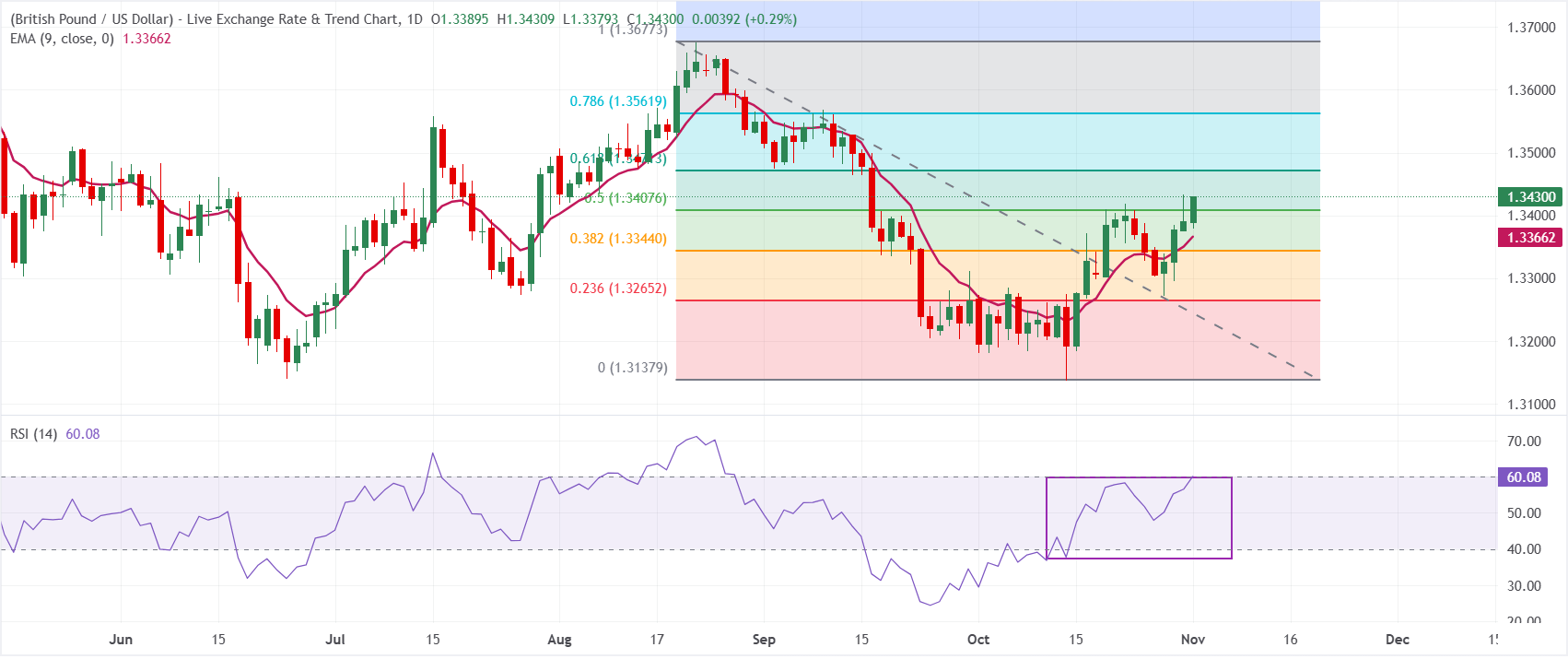
A positive near-term bias remains in place for GBP/USD on the daily chart, with the pair trading around 1.3430. Spot remains above both the 9-day Exponential Moving Average (EMA) at 1.3366 and 1.3408, the 50.0% Fibonacci retracement of the 1.3138–1.3677 move. At nearly 60, the Relative Strength Index (14) signals solid positive momentum without reaching overbought territory, lending further support to the bullish tone.
The first upside hurdle is 1.3471, the 61.8% Fibonacci retracement, followed by 1.3562 at the 78.6% level. Should buyers extend the rally, the cycle peak of 1.3677 would present a more substantial obstacle. Below current prices, the 50.0% retracement at 1.3408 offers initial support, with the 9-day EMA at 1.3366 and the 38.2% level at 1.3344 next in line. A larger decline would bring the 23.6% retracement at 1.3265 and the structural reference point near 1.3138 into focus.
(The technical analysis of this story was written with the help of an AI tool. Know more.)
Economic Data in Focus
How Does the BoE Interest Rate Decision Affect Sterling?
At the conclusion of each of its eight scheduled annual meetings, the Bank of England (BoE) publishes its interest rate decision. A rate increase accompanied by a hawkish assessment of the economy’s inflation outlook is generally positive for Pound Sterling (GBP). Conversely, a dovish assessment of the UK economy, together with a decision to hold rates steady or lower them, is generally viewed as negative for GBP.
Continue reading.Upcoming release: Thu 5 November 2026 12:00
Release frequency: No fixed schedule
Market consensus: -
Prior reading: 3.75%
Data source: Bank of England
POPULAR ARTICLES
1Gold: Rebound from One-Year Low Comes Despite Lingering Rate Risks – ING2Australian Dollar: How are RBA hike hopes lifting AUD against US Dollar? - Societe Generale3Why is the Japanese Yen flat despite a modestly weaker US Dollar?4Can the Euro Extend Gains Against the Canadian Dollar After German Data?5Silver price today: FXStreet data shows Silver moving higher6British Pound: Can Resilience Continue With the Bar Set Higher? – OCBC7ECB's Kazimir: We should act before high inflation begins to seem normal8Japanese Yen: Is there upside risk against US Dollar amid sideways trading? – UOB9Dow Jones futures climb as risk appetite recovers ahead of a packed week


Get Started!
Sign up and access the Global Markets in less than 3 minutes

Connect With Us









Contacts
Phone: +61 2 8036 8388
Fax: +61 2 8036 8388
Email: support@tmgm.com



The information provided on this website is of a general nature only and does not constitute personal financial advice. Before acting on any information on this website, you should consider the suitability of the information in relation to your objectives, financial situation and needs. Investing in CFDs and FX Margin Contracts carries significant risks and is not suitable for all investors. You may lose more than your initial deposit. You do not own, or have, any interest in the underlying asset. We recommend that you seek independent advice and ensure you fully understand the risks involved before trading. It is important that you read and consider the disclosure document before you acquire any product listed on the website. The information and advertisements offered on this website are not intended for use by any person in any country or jurisdiction where such use would be contrary to local laws and regulations. The Products and Services offered on this website are not intended for residents of the United States, Malaysia and Thailand.
TMGM is authorized and regulated in various jurisdictions.
Trademax Australia Limited, trading as TMGM, is regulated by the Australian Securities and Investments Commission (ASIC), AFSL no. 436416 and is located at Level 28, One International Tower, 100 Barangaroo Avenue, 2000 Sydney, NSW Australia.
Email: support@tmgm.com.au
Trademax Global Limited, trading as TMGM, is authorized and regulated by the Vanuatu Financial Services Commission (VFSC), registration number 40356 and registered at 1276, Kumul Highway, Port Vila, Vanuatu, Republic of Vanuatu.
Email: support@tmgm.com
Trademax Global Markets (SE) Limited, trading as TMGM, is authorized and regulated by the Financial Services Authority (FSA) of Seychelles, with license number SD224. The company is registered at Office No 13, Providence Estate ABIS Centre, Mahe, Seychelles.
Email: support@tmgm.com
Trademax Global Markets (International) Pty Ltd, trading as TMGM, is authorized and regulated by the Financial Services Commission, Mauritius (FSC) with license no. GB22201012, and registered at 33, Edith Cavell Street C/o IQ EQ Fund Services (Mauritius) Ltd Port Louis, 11324 Mauritius.
Email: support@tmgm.com
Copyright © TMGM. All rights reserved