

Trading
Explore a wide range of markets with competitive pricing, deep liquidity, and advanced trading tools.
Learn More 
Platform
Trade seamlessly with TMGM's powerful platform, built for speed, precision, and a superior trading experience.
Learn More Trading Platform
Academy
Learn the fundamentals of trading with beginner-friendly resources, including guides, webinars, and market insights.
Learn More News & Analysis
Get real-time market updates and expert analysis to stay ahead of trading opportunities
Learn More News & Analysis
About
Learn what sets TMGM apart — our global presence, regulatory strength, and commitment to innovation in trading.
Learn More Why Choose TMGM
Sponsorship
Why is the Dow Jones Industrial Average lagging as Anthropic's filing boosts tech?
- DJIA closes below 52,400 after surrendering about two-thirds of its early advance.
- Most of the price-weighted index's rise comes from Goldman Sachs, which contributes about 105 points.
- Wednesday brings the Fed decision, followed by results from Microsoft and Alphabet.
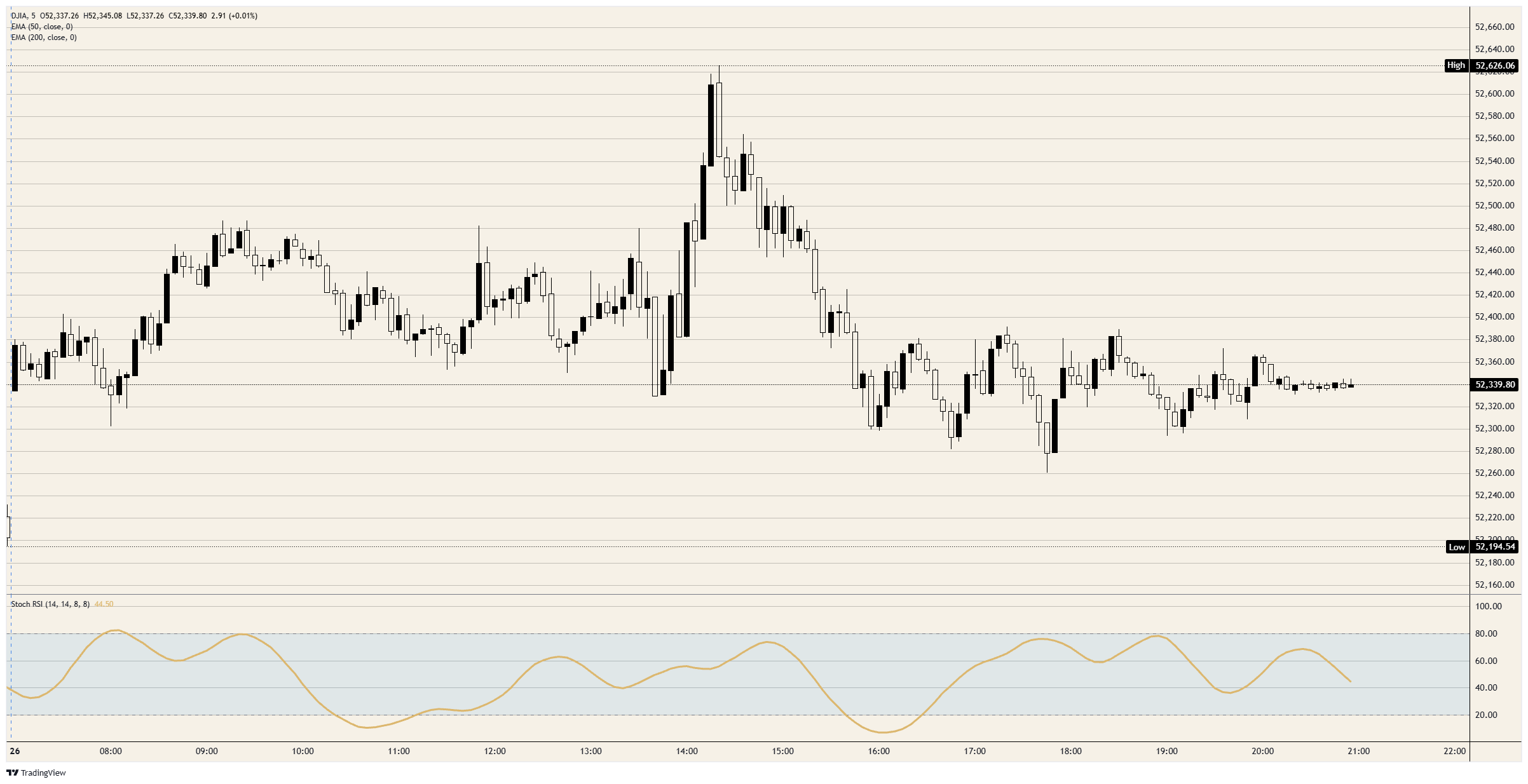
Monday's advance in the Dow Jones Industrial Average was heavily dependent on Goldman Sachs (GS), which contributed about seven out of every ten points gained. By the tenth five-minute bar, the index had reached close to 52,600. It subsequently surrendered about two-thirds of that rise at the session low near 52,250 before finishing below 52,400.

Goldman's 2% advance contributed about 105 points because the Dow weights constituents by share price, and Goldman, at about $890, is its highest-priced stock. Together, UnitedHealth (UNH) and Merck (MRK) subtracted about 70 points. That kept the Dow trailing the S&P 500, which gives technology shares a larger weighting.
Nvidia (NVDA) contributed about 30 points as Anthropic's Nasdaq listing filing outlined spending of up to $120.5 billion on computing powered by Nvidia chips. That filing also commits up to $114.5 billion to Google through 2033. Alphabet (GOOGL) declined about 1%, subtracting about 20 points from the Dow.
Which events are on the calendar?
Futures imply about a 10% probability of a rate increase from 3.75%-4.00% ahead of the Federal Open Market Committee (FOMC) decision, scheduled for 18:00 GMT on Wednesday. Fed Chair Warsh will hold his press conference at 18:30 GMT. Thursday's releases at 12:30 GMT include the September Personal Consumption Expenditures Price Index (PCE) and third-quarter Gross Domestic Product (GDP), both of which have implications for a December hike.
Tuesday's earnings schedule starts with Boeing (BA), Coca-Cola (KO) and Sherwin-Williams (SHW) before the market opens, followed by Visa (V) after the close. On Wednesday, Microsoft (MSFT) and Alphabet release results after the Fed decision. Thursday brings reports from Merck and Caterpillar (CAT), which, at about $690, is the Dow's second-highest-priced stock. Chevron (CVX) reports on Friday.
What do the charts indicate?
About a quarter of the Dow's advance between the 1 October low near 50,500 and the 22 October high near 52,900 has now been retraced. The index nevertheless remains above its 50-day Exponential Moving Average (EMA), near 52,100. Around 4% higher lies the 5 August peak, just below 54,750. Since Thursday, daily momentum has eased from overbought levels.
Dow Jones chart: 5-minute view
Dow Jones: frequently asked questions
Comprising the 30 most actively traded US stocks, the Dow Jones Industrial Average ranks among the world's oldest stock market indices. Share prices, rather than market capitalisation, determine its weightings. To calculate the index, the prices of its constituent stocks are added together and divided by a factor, currently 0.152. Its founder, Charles Dow, also established the Wall Street Journal. Over subsequent years, critics have questioned whether an index tracking just 30 conglomerates is sufficiently representative compared with broader benchmarks such as the S&P 500.
The combined performance of constituent companies, as disclosed in their quarterly earnings reports, is the principal influence on the Dow Jones Industrial Average (DJIA). Several other factors also matter. Macroeconomic releases from the US and abroad shape investor sentiment and, in turn, the index. Interest rates determined by the Federal Reserve (Fed) affect borrowing costs for corporations, many of which depend heavily on credit, and therefore influence the DJIA. Inflation can consequently be an important driver, alongside other indicators that inform Fed decisions.
Developed by Charles Dow, Dow Theory provides a framework for identifying the stock market's primary trend. It calls for comparing the direction of the Dow Jones Industrial Average (DJIA) with that of the Dow Jones Transportation Average (DJTA), and following a trend only when both move in the same direction. Trading volume serves as confirmation, while analysis of peaks and troughs also forms part of the approach. The theory divides trends into three phases: accumulation, when smart money begins buying or selling; public participation, as the broader public joins the move; and distribution, when smart money exits.
Investors and traders can access the DJIA through several instruments. ETFs offer a way to trade it as one security without purchasing shares in each of its 30 constituent companies; the SPDR Dow Jones Industrial Average ETF (DIA) is a prominent example. Futures contracts allow traders to speculate on the index's future value. Options, meanwhile, confer the right, without any obligation, to buy or sell the index at a price agreed in advance for a future date. Through mutual funds, investors can purchase a share in a diversified portfolio of DJIA stocks, gaining exposure to the index as a whole.
POPULAR ARTICLES
1Third consecutive RBNZ hike priced in by New Zealand Dollar traders2What do Fed and ECB decisions a day apart mean for the Euro below 1.12?3Pound below its high: What will the UK Budget and Fed decision bring?4Why is the Dow Jones Industrial Average lagging as Anthropic's filing boosts tech?5GBP/JPY Price Forecast: Bulls target 211.10 despite ongoing bearish trend6Why is the Mexican Peso holding firm against a stronger Dollar as Iran peace hopes boost sentiment?7Singapore Dollar: How are FOMC and yields shaping SGD moves against US Dollar? – OCBC8Chinese Yuan: Does the outlook favour gradual gains against US Dollar? – UOB9Malaysian Ringgit: How is the trade surplus supporting Ringgit resilience? – OCBC
LIVE QUOTES


ALL ABOUT INDICATORS
Moving Average Crossover: How to Read and Trade the Signal
Zero Lag Exponential Moving Average (ZLEMA): Formula, Calculation and How to Use It
What Is a Triple Exponential Moving Average: How It Works & How to Trade It
Death Cross: Understand the Signal and Its Track Record
Double Exponential Moving Average: How It Works & How to Use It
What Is a Golden Cross? Formation and Trading Guide
EMA vs SMA: What's the Difference and Which Is Better?
Exponential Moving Average (EMA): Formula, Settings & Strategies
5 Best Support and Resistance Indicators
Get Started!
Sign up and access the Global Markets in less than 3 minutes

Connect With Us









Contacts
Phone: +61 2 8036 8388
Fax: +61 2 8036 8388
Email: support@tmgm.com



The information provided on this website is of a general nature only and does not constitute personal financial advice. Before acting on any information on this website, you should consider the suitability of the information in relation to your objectives, financial situation and needs. Investing in CFDs and FX Margin Contracts carries significant risks and is not suitable for all investors. You may lose more than your initial deposit. You do not own, or have, any interest in the underlying asset. We recommend that you seek independent advice and ensure you fully understand the risks involved before trading. It is important that you read and consider the disclosure document before you acquire any product listed on the website. The information and advertisements offered on this website are not intended for use by any person in any country or jurisdiction where such use would be contrary to local laws and regulations. The Products and Services offered on this website are not intended for residents of the United States, Malaysia and Thailand.
TMGM is authorized and regulated in various jurisdictions.
Trademax Australia Limited, trading as TMGM, is regulated by the Australian Securities and Investments Commission (ASIC), AFSL no. 436416 and is located at Level 28, One International Tower, 100 Barangaroo Avenue, 2000 Sydney, NSW Australia.
Email: support@tmgm.com.au
Trademax Global Limited, trading as TMGM, is authorized and regulated by the Vanuatu Financial Services Commission (VFSC), registration number 40356 and registered at 1276, Kumul Highway, Port Vila, Vanuatu, Republic of Vanuatu.
Email: support@tmgm.com
Trademax Global Markets (SE) Limited, trading as TMGM, is authorized and regulated by the Financial Services Authority (FSA) of Seychelles, with license number SD224. The company is registered at Office No 13, Providence Estate ABIS Centre, Mahe, Seychelles.
Email: support@tmgm.com
Trademax Global Markets (International) Pty Ltd, trading as TMGM, is authorized and regulated by the Financial Services Commission, Mauritius (FSC) with license no. GB22201012, and registered at 33, Edith Cavell Street C/o IQ EQ Fund Services (Mauritius) Ltd Port Louis, 11324 Mauritius.
Email: support@tmgm.com
Copyright © TMGM. All rights reserved