

Trading
Explore a wide range of markets with competitive pricing, deep liquidity, and advanced trading tools.
Learn More 
Platform
Trade seamlessly with TMGM's powerful platform, built for speed, precision, and a superior trading experience.
Learn More Trading Platform
Academy
Learn the fundamentals of trading with beginner-friendly resources, including guides, webinars, and market insights.
Learn More News & Analysis
Get real-time market updates and expert analysis to stay ahead of trading opportunities
Learn More News & Analysis
About
Learn what sets TMGM apart — our global presence, regulatory strength, and commitment to innovation in trading.
Learn More Why Choose TMGM
Sponsorship
ECB recap: Rates held steady as energy costs rise and financial conditions tighten
Renewed increases in energy prices prompted a cautious policy stance at the European Central Bank (ECB), which unanimously kept its three key interest rates on hold, including the deposit rate at 2.50%. According to President Christine Lagarde, the Governing Council considered whether a rate hike was warranted before deciding that a measured approach was still justified for now.
With energy prices exceeding its baseline assumptions, the ECB recognised greater upside risks to inflation and downside risks to growth. Although headline inflation is likely to stay well above target over the coming quarters, the central bank expects a subsequent decline as energy inflation moderates. Meanwhile, underlying inflation has been broadly steady. Wages have shown no significant second-round response, and longer-term inflation expectations remain near 2%.

Negotiated wage growth is indicated at 2.5%-2.8% for the remaining months of 2026 by the ECB’s wage tracker, while Lagarde noted that early pricing-chain data signalled fresh upward pressure. Although indirect effects from the energy shock are becoming more evident to the central bank, it has observed no further second-round effects beyond those already factored into its projections.
Signs of third-quarter economic expansion sit alongside a mixed growth outlook. AI investment, government expenditure and a possible export recovery are supporting activity, according to incoming data. At the same time, higher energy prices and financing costs, weaker confidence, fiscal uncertainty and tighter financial conditions are all curbing demand. Growth risks remain skewed to the downside, whereas the balance of inflation risks is still to the upside.
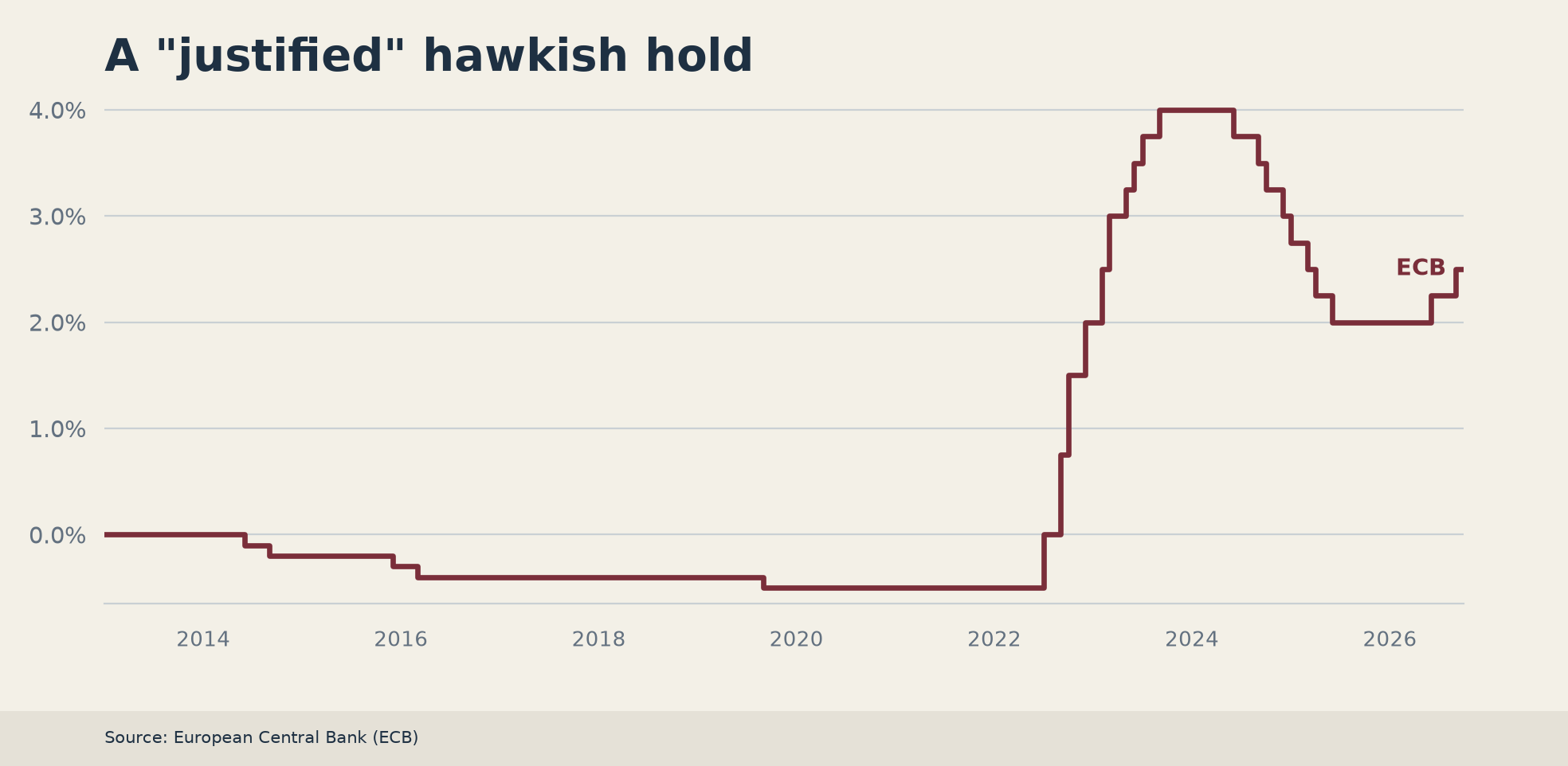
Taken together, the outcome amounted to a cautious hold with a slightly hawkish tilt. Without committing in advance to an interest-rate path, the Governing Council will closely base its decision on underlying inflation and monetary policy transmission. Describing the six weeks leading up to the next meeting as information-rich, Lagarde suggested that the December decision would hinge largely on whether energy pressures spread or stay contained.
POPULAR ARTICLES
1Thai Baht: What Are the Curve-Steepening Risks as BoT Holds Rates? – DBS2Philippine Peso: Depreciation eases as officials jawbone – OCBC3Why is HYPE rallying 17% as ICE and Druckenmiller invest in tradeXYZ for US expansion?4ECB recap: Rates held steady as energy costs rise and financial conditions tighten5Thai Baht: Do oil risks signal weakness against the US Dollar? - MUFG6Singapore Dollar: Fading momentum keeps trading rangebound against US Dollar - UOB7Forex Today: Is the BoJ Set to Hold Rates Steady?8Can the Japanese Yen find direction ahead of the BoJ interest rate decision?9Indonesian Rupiah: How are MSCI risks intensifying pressure against the US Dollar? - OCBC


Get Started!
Sign up and access the Global Markets in less than 3 minutes

Connect With Us









Contacts
Phone: +61 2 8036 8388
Fax: +61 2 8036 8388
Email: support@tmgm.com



The information provided on this website is of a general nature only and does not constitute personal financial advice. Before acting on any information on this website, you should consider the suitability of the information in relation to your objectives, financial situation and needs. Investing in CFDs and FX Margin Contracts carries significant risks and is not suitable for all investors. You may lose more than your initial deposit. You do not own, or have, any interest in the underlying asset. We recommend that you seek independent advice and ensure you fully understand the risks involved before trading. It is important that you read and consider the disclosure document before you acquire any product listed on the website. The information and advertisements offered on this website are not intended for use by any person in any country or jurisdiction where such use would be contrary to local laws and regulations. The Products and Services offered on this website are not intended for residents of the United States, Malaysia and Thailand.
TMGM is authorized and regulated in various jurisdictions.
Trademax Australia Limited, trading as TMGM, is regulated by the Australian Securities and Investments Commission (ASIC), AFSL no. 436416 and is located at Level 28, One International Tower, 100 Barangaroo Avenue, 2000 Sydney, NSW Australia.
Email: support@tmgm.com.au
Trademax Global Limited, trading as TMGM, is authorized and regulated by the Vanuatu Financial Services Commission (VFSC), registration number 40356 and registered at 1276, Kumul Highway, Port Vila, Vanuatu, Republic of Vanuatu.
Email: support@tmgm.com
Trademax Global Markets (SE) Limited, trading as TMGM, is authorized and regulated by the Financial Services Authority (FSA) of Seychelles, with license number SD224. The company is registered at Office No 13, Providence Estate ABIS Centre, Mahe, Seychelles.
Email: support@tmgm.com
Trademax Global Markets (International) Pty Ltd, trading as TMGM, is authorized and regulated by the Financial Services Commission, Mauritius (FSC) with license no. GB22201012, and registered at 33, Edith Cavell Street C/o IQ EQ Fund Services (Mauritius) Ltd Port Louis, 11324 Mauritius.
Email: support@tmgm.com
Copyright © TMGM. All rights reserved