

Trading
Explore a wide range of markets with competitive pricing, deep liquidity, and advanced trading tools.
Learn More 
Platform
Trade seamlessly with TMGM's powerful platform, built for speed, precision, and a superior trading experience.
Learn More Trading Platform
Academy
Learn the fundamentals of trading with beginner-friendly resources, including guides, webinars, and market insights.
Learn More News & Analysis
Get real-time market updates and expert analysis to stay ahead of trading opportunities
Learn More News & Analysis
About
Learn what sets TMGM apart — our global presence, regulatory strength, and commitment to innovation in trading.
Learn More Why Choose TMGM
Sponsorship
Euro at a 19-month low as ECB's Lagarde delivers three speeches
- EUR/USD slides for a fifth consecutive session, breaching 1.1000 to hit a 19-month low.
- The Dollar gains on Fed rate-hike expectations as Eurozone industrial output falls short of forecasts.
- Wednesday, Thursday and Friday each bring a speech by ECB President Lagarde.
EUR/USD remained under pressure on Monday, slipping below 1.1000 for the first time in 19 months as the Dollar extended its advance and Eurozone industrial data disappointed. Now trading just beneath that mark, the pair has declined for five consecutive sessions. Since its November 10 peak, it has not recorded a single higher daily close.

An imminent European Central Bank (ECB) rate increase is doing little to shift the interest-rate differential in the Euro's favour. A Reuters survey conducted on November 10-12 found that all 71 economists expected a rise in the ECB deposit rate to 2.75% from 2.50% on December 17. With traders fully pricing in a Fed increase from 3.75%-4.00% eight days before that, the differential would remain unchanged.
Following August's 0.5% contraction, Eurozone industrial production increased by 0.2% in September, short of the projected 0.6%. According to Bloomberg, political deadlock in France and missed deficit targets had already weighed on the Euro in October. On November 11, EUR/USD slipped beneath the lower boundary of its October trading range, near 1.1100; no daily close has regained that level since.
Which releases and speeches are next?
Tuesday's calendar brings the ZEW economic sentiment survey at 10:00 GMT, with a reading of 18.3 expected against the previous 18.5. At 10:00 GMT on Wednesday, October consumer price figures are due; core inflation is projected to hold at 2.5% for a second month. Remarks from ECB President Lagarde are scheduled for 14:25 GMT on Wednesday, 13:30 GMT on Thursday and 08:30 GMT on Friday. Each appearance offers an opportunity to reinforce or temper expectations of a December 17 rate increase.
Having raised the possibility of a half-point increase in December, Fed Governor Waller is due to speak at 14:10 GMT on Tuesday and 13:25 GMT on Friday. Thursday's US weekly jobless claims release, scheduled for 13:30 GMT, is expected to show 196K compared with 200K previously. While equal-sized ECB and Fed increases would leave the rate differential intact, a larger Fed move would widen it.
What do the charts indicate?
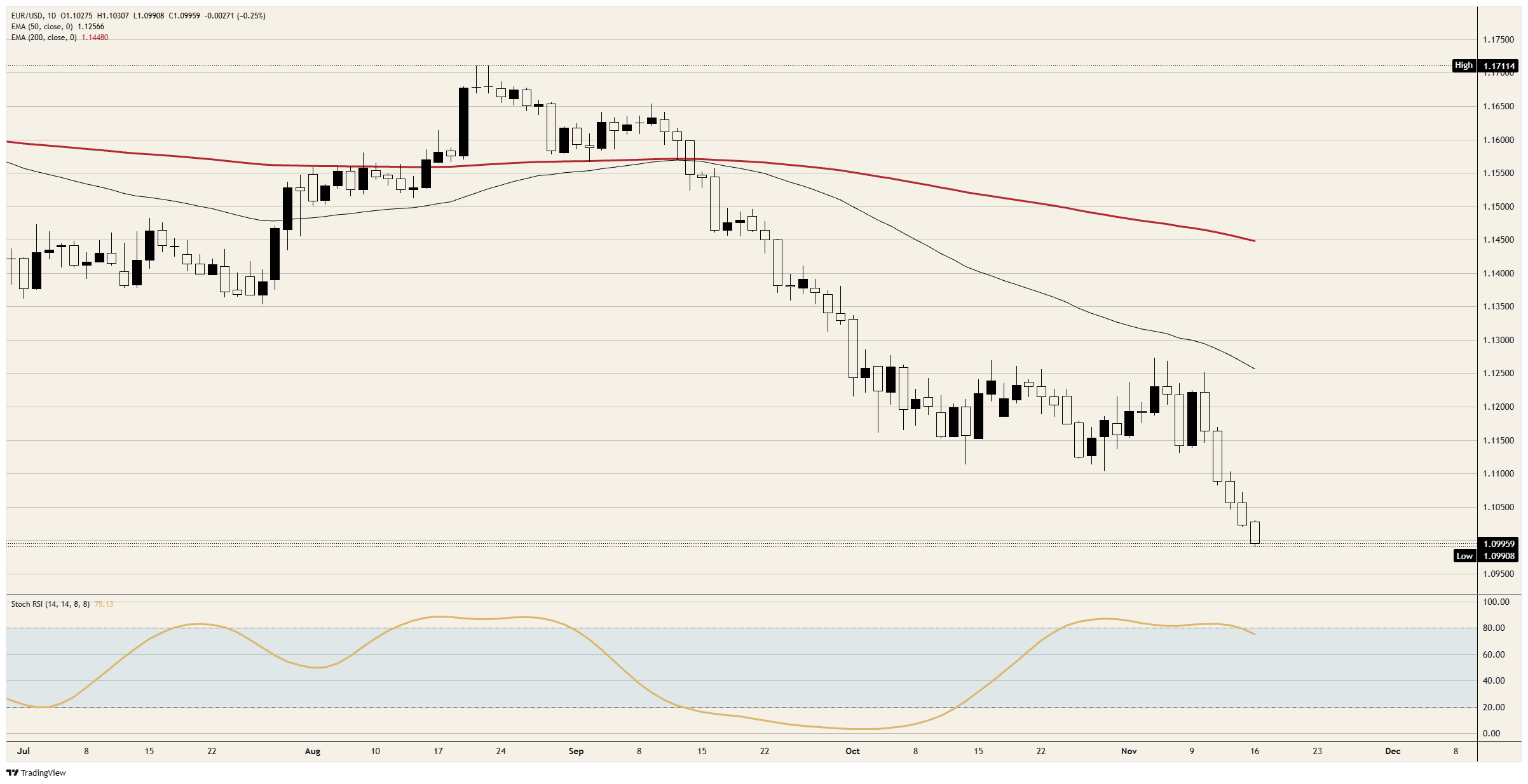
On a daily chart extending back to July, EUR/USD is at its lowest level and far beneath the August peak just above 1.1700. Both key averages are declining: the 50-day Exponential Moving Average (EMA) stands near 1.1250, while the 200-day EMA is around 1.1450. Since the 50-day average crossed beneath the 200-day in mid-September, the pair has remained below both.
Daily chart for EUR/USD
Euro: frequently asked questions
Used by the 20 European Union countries that make up the Eurozone, the Euro ranks second only to the US Dollar in global currency trading. Its share of all foreign exchange transactions reached 31% in 2022, when average daily turnover exceeded $2.2 trillion. An estimated 30% of all transactions involve EUR/USD, making it the world's most actively traded currency pair. Next come EUR/JPY (4%), EUR/GBP (3%) and EUR/AUD (2%).
Based in Frankfurt, Germany, the European Central Bank (ECB) serves as the Eurozone's reserve bank, determining interest rates and overseeing monetary policy. Maintaining price stability is the ECB's central mandate, whether through curbing inflation or supporting growth. Adjustments to interest rates are its main policy instrument. The Euro generally benefits when rates are relatively high, or when higher rates are anticipated; the reverse also holds. Monetary policy is decided by the ECB Governing Council, which meets eight times a year. The decision-makers comprise the heads of Eurozone national banks and six permanent members, among them ECB President Christine Lagarde.
For the Euro, a key economic measure is Eurozone inflation, tracked through the Harmonised Index of Consumer Prices (HICP). An unexpectedly sharp rise in inflation, particularly beyond the ECB's 2% target, requires the central bank to increase interest rates to bring price pressures under control. When interest rates in the region are relatively high compared with those elsewhere, the Euro usually gains support, as global investors find the region a more attractive destination for their money.
By revealing the state of the economy, data releases can move the Euro. GDP figures, Manufacturing and Services PMIs, employment data and consumer sentiment surveys are among the indicators that can shape the single currency's direction. Economic strength supports the Euro by drawing in additional foreign investment. It may also prompt the ECB to raise interest rates, directly strengthening the currency. Weak economic readings, by contrast, are likely to weigh on the Euro. Particular attention is paid to Germany, France, Italy and Spain, the euro area's four largest economies, which together represent 75% of the Eurozone economy.
The Trade Balance is another release closely watched for its implications for the Euro. Over a specified period, it captures the gap between a country's export earnings and its spending on imports. Strong overseas demand for a country's exports creates additional demand for its currency as foreign buyers seek to purchase those goods, lifting the currency's value. A positive net Trade Balance therefore supports a currency, while a negative balance has the opposite effect.
POPULAR ARTICLES
1Euro at a 19-month low as ECB's Lagarde delivers three speeches2Nasdaq drops to a one-week low as chip stocks retreat3Ethereum Price Forecast: Why does BitMine see a SpaceX IPO-like trend in ETH ahead of Anthropic IPO?4Bitcoin’s recovery hinges on holding $57,800, says Bitfinex5Broadening inflation: Fed's Hammack favours gradual rate hikes6Eurozone: Is the Manufacturing Outlook Still Fragile? – ING7EUR/USD Price Forecast: Can bears breach 1.1000 with RSI near oversold territory?8Forex Today: Market attention turns to US consumer spending and UK jobs9Why are safe-haven demand and intervention fears supporting the Japanese Yen?


Get Started!
Sign up and access the Global Markets in less than 3 minutes

Connect With Us









Contacts
Phone: +61 2 8036 8388
Fax: +61 2 8036 8388
Email: support@tmgm.com



The information provided on this website is of a general nature only and does not constitute personal financial advice. Before acting on any information on this website, you should consider the suitability of the information in relation to your objectives, financial situation and needs. Investing in CFDs and FX Margin Contracts carries significant risks and is not suitable for all investors. You may lose more than your initial deposit. You do not own, or have, any interest in the underlying asset. We recommend that you seek independent advice and ensure you fully understand the risks involved before trading. It is important that you read and consider the disclosure document before you acquire any product listed on the website. The information and advertisements offered on this website are not intended for use by any person in any country or jurisdiction where such use would be contrary to local laws and regulations. The Products and Services offered on this website are not intended for residents of the United States, Malaysia and Thailand.
TMGM is authorized and regulated in various jurisdictions.
Trademax Australia Limited, trading as TMGM, is regulated by the Australian Securities and Investments Commission (ASIC), AFSL no. 436416 and is located at Level 28, One International Tower, 100 Barangaroo Avenue, 2000 Sydney, NSW Australia.
Email: support@tmgm.com.au
Trademax Global Limited, trading as TMGM, is authorized and regulated by the Vanuatu Financial Services Commission (VFSC), registration number 40356 and registered at 1276, Kumul Highway, Port Vila, Vanuatu, Republic of Vanuatu.
Email: support@tmgm.com
Trademax Global Markets (SE) Limited, trading as TMGM, is authorized and regulated by the Financial Services Authority (FSA) of Seychelles, with license number SD224. The company is registered at Office No 13, Providence Estate ABIS Centre, Mahe, Seychelles.
Email: support@tmgm.com
Trademax Global Markets (International) Pty Ltd, trading as TMGM, is authorized and regulated by the Financial Services Commission, Mauritius (FSC) with license no. GB22201012, and registered at 33, Edith Cavell Street C/o IQ EQ Fund Services (Mauritius) Ltd Port Louis, 11324 Mauritius.
Email: support@tmgm.com
Copyright © TMGM. All rights reserved