

Trading
Explore a wide range of markets with competitive pricing, deep liquidity, and advanced trading tools.
Learn More 
Platform
Trade seamlessly with TMGM's powerful platform, built for speed, precision, and a superior trading experience.
Learn More Trading Platform
Academy
Learn the fundamentals of trading with beginner-friendly resources, including guides, webinars, and market insights.
Learn More News & Analysis
Get real-time market updates and expert analysis to stay ahead of trading opportunities
Learn More News & Analysis
About
Learn what sets TMGM apart — our global presence, regulatory strength, and commitment to innovation in trading.
Learn More Why Choose TMGM
Sponsorship
Why is the Federal Reserve poised to leave interest rates unchanged despite persistent inflation?
- Expectations overwhelmingly favour an interest rate hold by the US Federal Reserve at its October meeting.
- A December rate increase remains a strong possibility in market pricing.
- US Dollar volatility could pick up in response to Fed Chair Warsh’s press conference comments.
The monetary policy outlook for the rest of the year will be in focus as the United States (US) Federal Reserve (Fed) delivers its Interest Rate Decision on Wednesday, after another crucial policy meeting that could offer important signals on the central bank’s approach towards year-end.

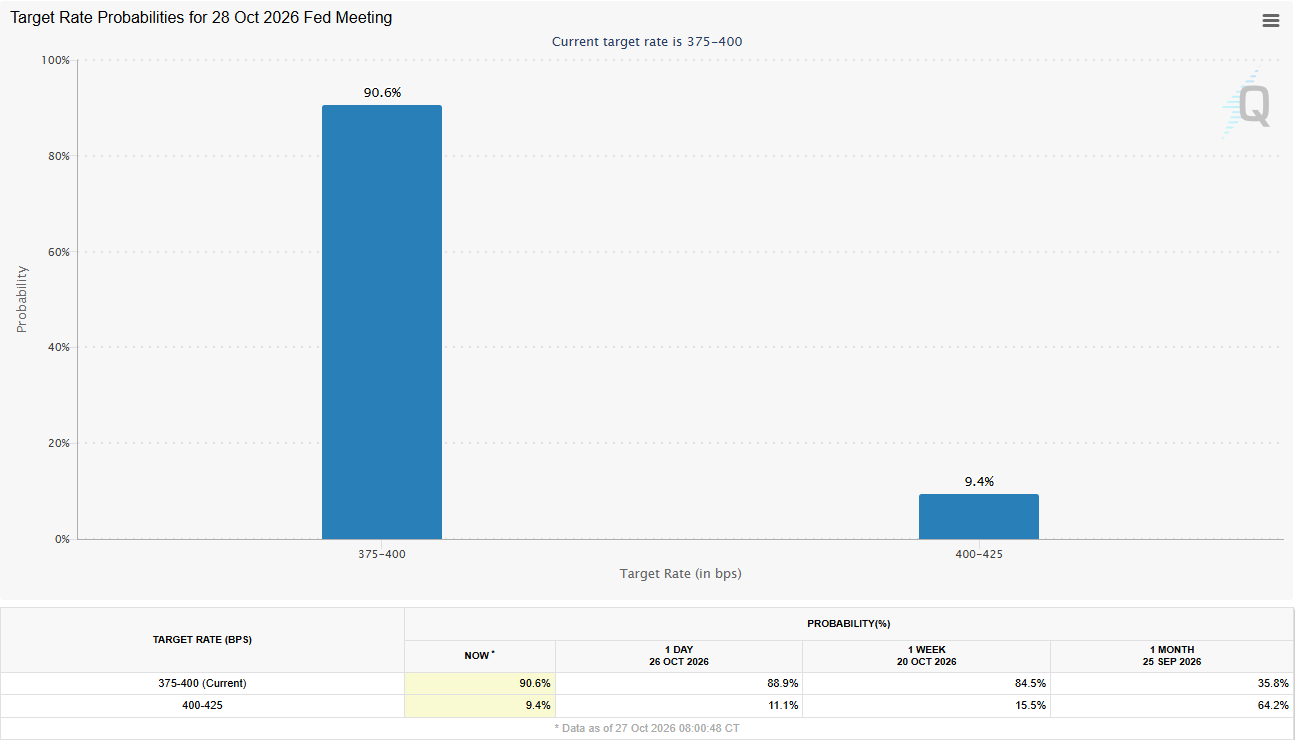
The broad market consensus is for the Federal Open Market Committee (FOMC) to retain the policy rate within the 3.75%-4% range after September’s announced increase of 25 basis points (bps).
With the CME FedWatch Tool assigning only about a 9% probability to higher borrowing costs, a hold is almost entirely reflected in market prices. Attention could therefore turn to Fed Chair Kevin Warsh’s post-meeting press conference, where his remarks may clarify the rate outlook and influence the US Dollar’s (USD) value.
At an International Monetary Fund (IMF) event earlier this month, Warsh reaffirmed the focus on achieving price stability, while saying he did not believe in “pre-judging meetings.” Investors took that remark as a reason to all but rule out an October rate increase. This was despite September’s US Consumer Price Index (CPI) exceeding expectations, as annual headline inflation accelerated from 3.4% to 3.7%.
With a rate change at the forthcoming meeting largely ruled out, Deutsche Bank economists expect the tone of the Fed’s communication to take centre stage. They observe that “the interest will therefore be in Chair Warsh’s press conference and how the Fed balances still-elevated inflation and solid growth against the recent tightening in financial conditions.” In their assessment, the policy message will be evaluated on whether the Fed convincingly recognises stubborn price pressures and strong economic activity while accounting for the effect of tighter market conditions on the wider outlook.
What time is the Fed rate decision, and what could it mean for EUR/USD?
Wednesday brings the Fed’s Interest Rate Decision alongside the release of its Monetary Policy Statement at 18:00 GMT. Afterwards, Fed Chair Kevin Warsh’s press conference will begin at 18:30 GMT.
September’s updated Summary of Economic Projections (SEP) indicated that 12 of 18 officials anticipated one further 25-basis-point (bps) increase this year. Of the remaining members, four expected two increases, while two foresaw no further hikes.
The June dot plot, which forms part of the SEP and sets out policymakers’ interest rate forecasts, had indicated an increase of just 25 bps in 2026. The projections then pointed to a 25 bps reduction in 2027 and a further 25 bps cut in 2028.
Market pricing leaves scope for the USD to strengthen again if Warsh departs from his earlier IMF remarks and points to a December rate increase on account of persistently elevated inflation. The CME FedWatch Tool puts the probability of the policy rate being unchanged at year-end at only about 17%. Such a signal could place EUR/USD under immediate selling pressure. However, the European Central Bank (ECB) also delivers its policy decision on Thursday, meaning any decline in the pair driven by a hawkish Fed message could stall ahead of that announcement.
MUFG/BTMU analysts point out that “the final FOMC meeting of the year is not until 9th December,” while observing that “the signs of tightening financial conditions continue to build,” which leaves “certainly a chance that Fed rate hike expectations for December could ease.” Their assessment is that “the willingness of Warsh to signal the Fed remains on the path highlighted by the dots will be important.” They further state that “in circumstances of tightening financial conditions and bond market volatility in Europe we would assume the Dollar will remain underpinned, and the risks remain skewed to the upside.”
By contrast, the Greenback could lose ground against other major currencies if Fed Chair Warsh plays down recent inflation developments and avoids indicating a December rate increase. A renewed refusal to pre-judge the year’s final meeting could discourage investors from fully pricing in a hike, allowing EUR/USD to move marginally higher. Even so, a marked improvement in inflation figures or a very poor employment report would likely be needed before market participants rule out that possibility.
The apparent resilience of EUR/USD conceals a less favourable underlying trend for the single currency, according to Commerzbank’s Thu Lan Nguyen. As she observes, “short-term inflation expectations have risen more strongly in the Euro Area than in the US,” but “higher inflation expectations are currently not being offset by a corresponding shift in relative interest-rate expectations.” Commerzbank argues that this divergence “is, in principle, a negative signal for the Euro,” because market pricing does not reflect sufficient policy tightening to offset rising Euro Area inflation expectations. That could expose the currency to weakness if sentiment deteriorates.
For the short-term technical picture in EUR/USD, FXStreet European Session Lead Analyst Eren Sengezer offers the following assessment:
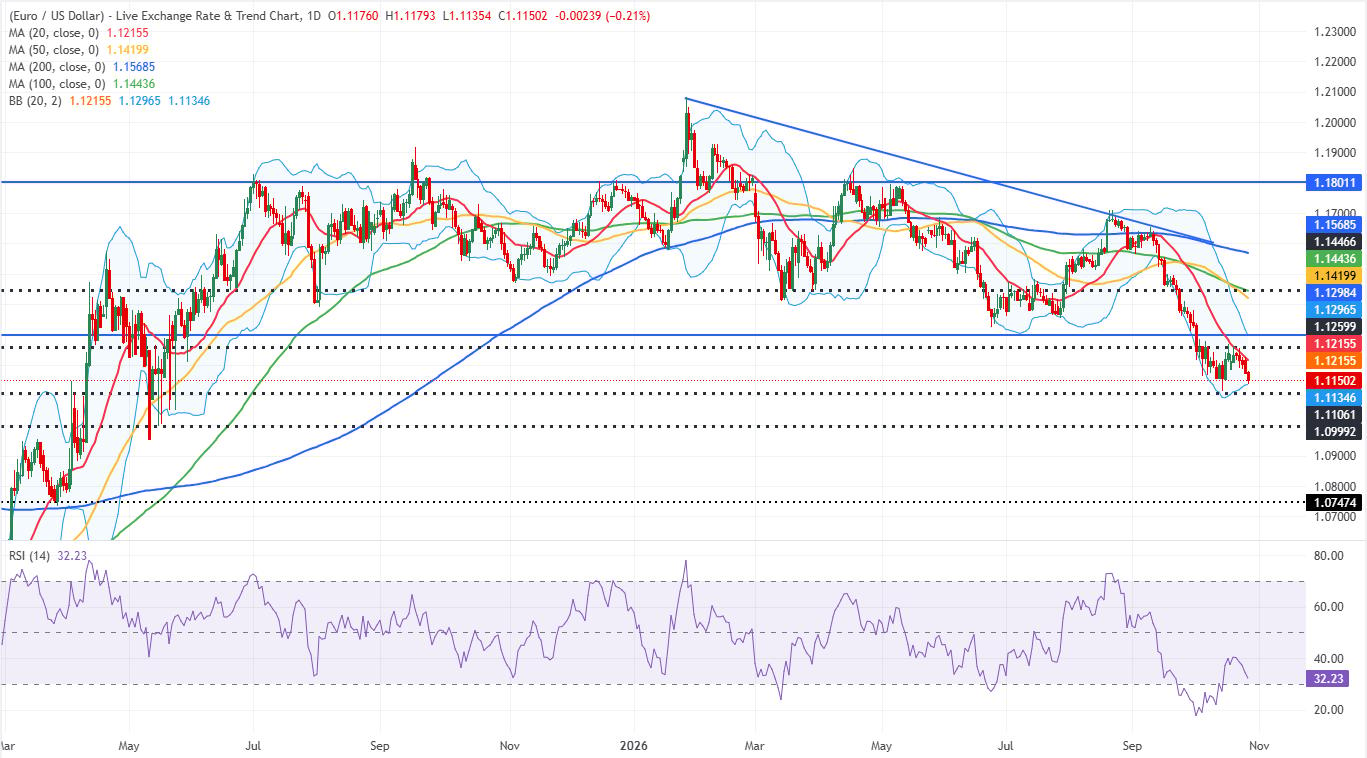
“The near-term technical outlook for EUR/USD highlights a bearish bias as the pair remains in the lower half of the Bollinger Band on the daily chart and the Relative Strength Index stays well below 40. On the downside, 1.1130-1.1100 (lower limit of the Bollinger Band, static level) aligns as the immediate support level ahead of 1.1000 (psychological level, static level). If this latter support fails, a deeper pullback toward 1.0750 (static level) could be witnessed. If the daily RSI falls into the oversold territory below 30 and EUR/USD stays below the lower limit of the Bollinger Band, investors could wait for a technical correction before committing to an extended decline.”
“Looking north, an interim resistance area could be spotted at 1.1260 - 1.1300 (static level, upper limit of the Bollinger Band). In case the pair manages to stabilize above this region, the 50-day and the 100-day Simple Moving Averages in the 1.1420-1.1440 area could become the next difficult hurdle to clear.”
Questions about the Fed
The Federal Reserve (Fed) sets US monetary policy with a dual mandate of maintaining price stability and promoting full employment. Adjusting interest rates is its main instrument for meeting these objectives. If prices climb too rapidly and inflation exceeds its 2% target, the Fed increases interest rates, raising borrowing costs across the economy. By making the US a more appealing destination for international investors’ funds, this strengthens the US Dollar (USD). If inflation drops below 2% or the Unemployment Rate becomes too high, the Fed may cut interest rates to stimulate borrowing, putting pressure on the Greenback.
At eight policy meetings each year, the Federal Open Market Committee (FOMC) of the Federal Reserve (Fed) reviews the economy and decides on monetary policy. Twelve Fed officials participate in the FOMC: the seven Board of Governors members, the Federal Reserve Bank of New York president, and four of the other eleven regional Reserve Bank presidents. Those four regional presidents rotate through one-year terms.
When conditions become extreme, the Federal Reserve may adopt Quantitative Easing (QE), a policy that sharply expands credit flows through a financial system that is not functioning smoothly. This unconventional measure is deployed during crises or periods of exceptionally low inflation. During the Great Financial Crisis in 2008, it was the Fed’s preferred policy response. Under QE, the Fed prints additional Dollars to purchase high-grade bonds from financial institutions. The US Dollar usually weakens as a result.
In a reversal of QE, quantitative tightening (QT) sees the Federal Reserve halt bond purchases from financial institutions and stop reinvesting principal received from its maturing bond holdings in new bonds. This process generally supports the US Dollar’s value.
POPULAR ARTICLES
1Australian Dollar: Can it advance towards the 0.7060 cap against the US Dollar? – UOB2Why is the Canadian Dollar struggling to gain traction despite a BoC rate hike?3United Kingdom: Neutral Budget leaves fiscal risks unresolved - Deutsche Bank4US Dollar: December risk remains in play as Fed stays on hold – BBH5ECB in focus as euro inches higher against CAD following expected BoC rate hike6Federal Reserve: Is a likely October hold set to precede an expected December hike? - ABN AMRO7New Zealand Dollar: Why Is RBNZ Delaying Hikes as Inflation Mounts? – Standard Chartered8Euro holds steady near 17-month lows as Fed rate decision approaches9Why is the Federal Reserve poised to leave interest rates unchanged despite persistent inflation?
LIVE QUOTES

ALL ABOUT FOREX
What Is a Stop Loss, How Does It Work and How Do You Set One?
Margin Call Meaning: What It Is, What Triggers It, and How to Avoid One
What Is an Islamic Account in Forex?
Best Indicators for Forex Trading and How to Use Them
The Top 10 Most Traded Currency Pairs in the World
What are the Major Forex Pairs? 7 Major Currency Pairs in the World
5 Best Forex Trading Apps In India In 2026
Top 15 Weakest Currencies in the World
Best Time to Trade Forex
Get Started!
Sign up and access the Global Markets in less than 3 minutes

Connect With Us









Contacts
Phone: +61 2 8036 8388
Fax: +61 2 8036 8388
Email: support@tmgm.com



The information provided on this website is of a general nature only and does not constitute personal financial advice. Before acting on any information on this website, you should consider the suitability of the information in relation to your objectives, financial situation and needs. Investing in CFDs and FX Margin Contracts carries significant risks and is not suitable for all investors. You may lose more than your initial deposit. You do not own, or have, any interest in the underlying asset. We recommend that you seek independent advice and ensure you fully understand the risks involved before trading. It is important that you read and consider the disclosure document before you acquire any product listed on the website. The information and advertisements offered on this website are not intended for use by any person in any country or jurisdiction where such use would be contrary to local laws and regulations. The Products and Services offered on this website are not intended for residents of the United States, Malaysia and Thailand.
TMGM is authorized and regulated in various jurisdictions.
Trademax Australia Limited, trading as TMGM, is regulated by the Australian Securities and Investments Commission (ASIC), AFSL no. 436416 and is located at Level 28, One International Tower, 100 Barangaroo Avenue, 2000 Sydney, NSW Australia.
Email: support@tmgm.com.au
Trademax Global Limited, trading as TMGM, is authorized and regulated by the Vanuatu Financial Services Commission (VFSC), registration number 40356 and registered at 1276, Kumul Highway, Port Vila, Vanuatu, Republic of Vanuatu.
Email: support@tmgm.com
Trademax Global Markets (SE) Limited, trading as TMGM, is authorized and regulated by the Financial Services Authority (FSA) of Seychelles, with license number SD224. The company is registered at Office No 13, Providence Estate ABIS Centre, Mahe, Seychelles.
Email: support@tmgm.com
Trademax Global Markets (International) Pty Ltd, trading as TMGM, is authorized and regulated by the Financial Services Commission, Mauritius (FSC) with license no. GB22201012, and registered at 33, Edith Cavell Street C/o IQ EQ Fund Services (Mauritius) Ltd Port Louis, 11324 Mauritius.
Email: support@tmgm.com
Copyright © TMGM. All rights reserved