

Trading
Explore a wide range of markets with competitive pricing, deep liquidity, and advanced trading tools.
Learn More 
Platform
Trade seamlessly with TMGM's powerful platform, built for speed, precision, and a superior trading experience.
Learn More Trading Platform
Academy
Learn the fundamentals of trading with beginner-friendly resources, including guides, webinars, and market insights.
Learn More News & Analysis
Get real-time market updates and expert analysis to stay ahead of trading opportunities
Learn More News & Analysis
About
Learn what sets TMGM apart — our global presence, regulatory strength, and commitment to innovation in trading.
Learn More Why Choose TMGM
Sponsorship
Gold drops below $4,000 ahead of Fed as surging Oil intensifies weekly sell-off
- Gold slides under $4,000 as losses for the week approach 3.90%.
- WTI breaks above $100 amid escalating hostilities in the Middle East.
- Markets price in a 78% chance of a December Fed hike before FOMC and PCE releases.
Selling pressure continues to weigh on Gold (XAU/USD), which is down nearly 0.60% on Friday and heading for a weekly loss. Rising energy costs have increased the likelihood of major central banks tightening monetary policy to contain inflation. Having touched a three-month low of $3,975, XAU/US is hovering near $4,000 at the time of writing.

Can XAU/USD find support after a nearly 4% weekly fall as energy costs fuel global inflation risks?
Sentiment across financial markets has soured as the Middle East conflict intensifies, leaving bullion on course for a weekly decline of almost 3.90%. According to newswire reports, the US and Israel are preparing to attack Iran after the US midterm elections, while the Islamic Revolutionary Guard Corps (IRGC) is targeting vessels passing through “illegal routes” in the Strait of Hormuz. Exchanges of fire between the Houthis and Saudi Arabia have further dampened the market mood.
US economic releases offered contrasting signals: business activity grew, but consumer sentiment weakened.
Higher energy costs and expectations of interest rates staying elevated for longer under the Federal Reserve (Fed) drove the University of Michigan Consumer Sentiment Index to a five-month low in October. The index slipped from 48.1 to 48. Although inflation expectations were steady compared with the previous report, they remained above the Fed’s 2% target. Consumers expect inflation of 4.7% over the next 12 months and 3.5% over a 5-year horizon.
Preliminary US Services and Manufacturing Purchasing Managers’ Index (PMI) readings released by S&P Global showed a rise in manufacturing activity from 55.9 to 56 in October. Services activity, by contrast, eased from 58.8 to 57.9, in line with analysts’ expectations.
Oil continues to draw support from geopolitical tensions. West Texas Intermediate (WTI), the US crude benchmark, has gained over 4% to move back above $100. The prospect of persistently high energy prices consequently raises the likelihood of the Federal Reserve increasing rates to return inflation to its 2% target.
Money markets have nevertheless ruled out a rate increase at next week’s Fed meeting, despite these developments and last week’s exceptionally strong consumer and producer inflation readings. For December, however, Prime Terminal puts the probability of a hike at 78%.
The US calendar next week begins with the Fed’s meeting on Tuesday and Wednesday. Thursday then brings the core Personal Consumption Expenditures (PCE) Price Index, the Fed's preferred measure of inflation.
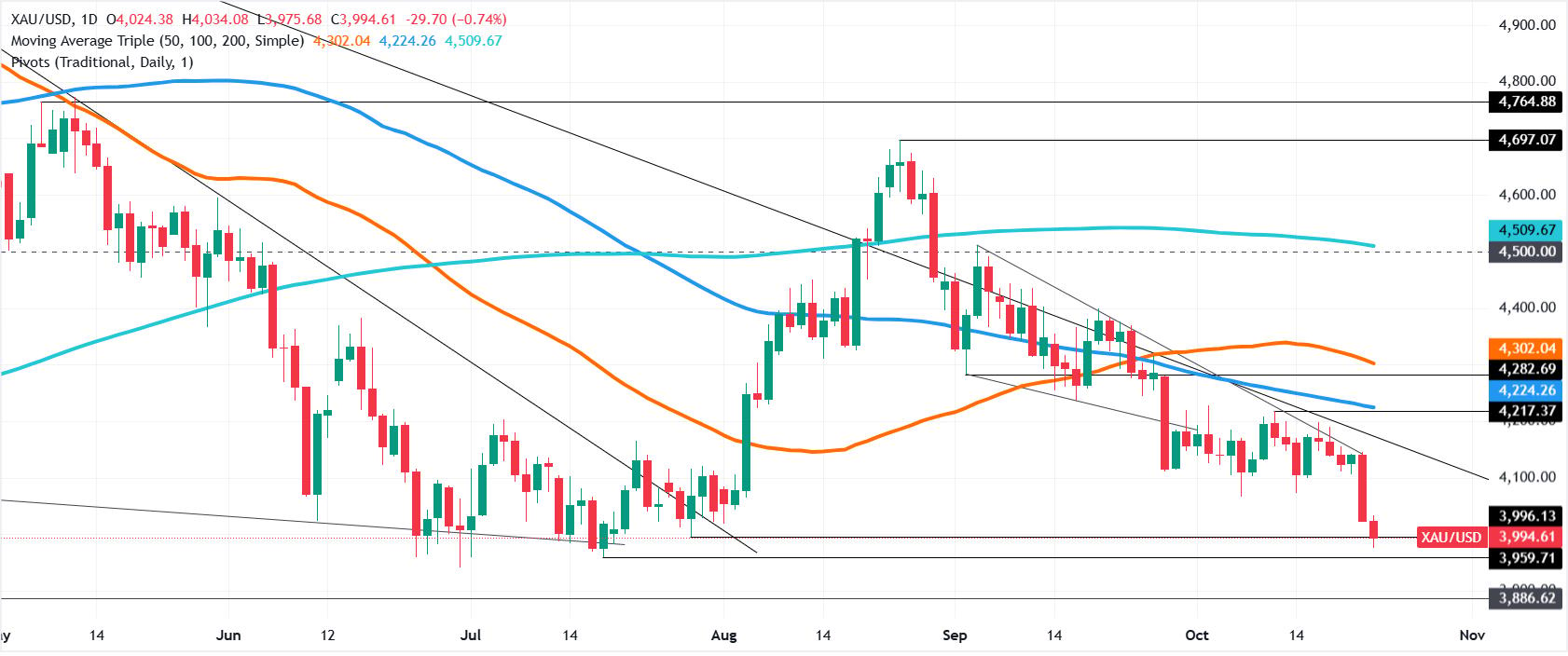
XAU/USD technical analysis: Does Gold’s break below $4,000 put $3,900 in sight?
Buyers are pushing back after sellers drove Gold to a three-month low of $3,975. Their efforts have brought bullion towards $4,000, with the price now trading around that level.
The balance between buyers and sellers nonetheless remains tilted towards the bears. Successive lower highs and lower lows continue to define the market structure, while momentum points to further declines as the RSI (14) approaches a test of oversold territory.
If the decline continues, XAU/USD would first encounter support at the day’s low of $3,975. A break below would bring the July 17 low of $3,959 into focus, followed by the year-to-date (YTD) low of $3,941.
A recovery would require bulls to regain $4,10 before the $4,200 level comes into view. Above that, the next levels are $4,224 at the 100-day Simple Moving Average (SMA), $4,302 at the 50-day SMA, and then $4,500.
Gold: frequently asked questions
Throughout human history, Gold has been important both as a store of value and as a medium of exchange. Beyond its lustre and use in jewellery, the precious metal is now widely regarded as a safe-haven asset, making it a preferred investment during periods of turmoil. Its independence from any particular issuer or government also underpins its widespread use as a hedge against inflation and currency depreciation.
The largest holders of Gold are central banks. To shore up their currencies during unsettled periods, they typically diversify reserves and purchase Gold, strengthening perceptions of both the economy and the currency. Substantial Gold holdings can bolster confidence in a country’s solvency. World Gold Council data show that central banks increased their reserves by 1,136 tonnes in 2022, with those purchases worth around $70 billion. That was the largest annual purchase on record. Emerging-economy central banks, including those in China, India and Turkey, are rapidly expanding their Gold holdings.
Both the US Dollar and US Treasuries, major reserve and safe-haven assets, have an inverse correlation with Gold. A weakening Dollar generally supports Gold, allowing investors and central banks to diversify their holdings during turbulent periods. Risk assets also tend to move in the opposite direction to Gold: stock market gains usually weigh on its price, whereas selling in riskier markets tends to support the precious metal.
Several factors can drive Gold prices. Its safe-haven appeal means geopolitical turmoil or concerns about a severe recession can trigger a rapid rise. Because Gold offers no yield, lower interest rates generally support it, while higher borrowing costs tend to weigh on the metal. Most price movements, however, depend on the US Dollar (USD), since Gold is quoted in dollars (XAU/USD). Dollar strength usually restrains Gold prices, while a softer Dollar is likely to lift them.
POPULAR ARTICLES
1South Korean Won: Do pullbacks favour a recovery? – OCBC2Philippine Peso: Is oil limiting the bearish bias? – OCBC3Silver Price Forecast: Bears eye $50 after fresh yearly low4Gold drops below $4,000 ahead of Fed as surging Oil intensifies weekly sell-off5South Korean Won: Consolidation underpinned by hawkish BoK – Commerzbank6EUR/USD Price Forecast: Can the 200-week SMA hold as the last line of defence against deeper losses?7Singapore Dollar: UOB sees a modest upward bias against US Dollar8Gulf attacks lift Crude Oil to a 22-week high9Turkish Lira: CBRT keeps easing approach cautious - Commerzbank
LIVE QUOTES


ALL ABOUT GOLD & PRECIOUS METALS
Gold ETF Taxation: What Is the Tax on Gold ETF in India?
How Much Gold Is Allowed From Dubai to India?
How much is the Tax on Gold in India?
Gold Market Open Time: XAUUSD Trading Hours & Best Time to Trade
How to Trade Gold
Top 10 Most Traded Commodities in India & The Best Commodity to Trade
Gold Price Chart India 10 Years: An Overview
Why Invest in Gold: The Advantages of Trading Gold CFDs
4 Strategies for Investing in Gold for Beginners in 2025
Get Started!
Sign up and access the Global Markets in less than 3 minutes

Connect With Us









Contacts
Phone: +61 2 8036 8388
Fax: +61 2 8036 8388
Email: support@tmgm.com



The information provided on this website is of a general nature only and does not constitute personal financial advice. Before acting on any information on this website, you should consider the suitability of the information in relation to your objectives, financial situation and needs. Investing in CFDs and FX Margin Contracts carries significant risks and is not suitable for all investors. You may lose more than your initial deposit. You do not own, or have, any interest in the underlying asset. We recommend that you seek independent advice and ensure you fully understand the risks involved before trading. It is important that you read and consider the disclosure document before you acquire any product listed on the website. The information and advertisements offered on this website are not intended for use by any person in any country or jurisdiction where such use would be contrary to local laws and regulations. The Products and Services offered on this website are not intended for residents of the United States, Malaysia and Thailand.
TMGM is authorized and regulated in various jurisdictions.
Trademax Australia Limited, trading as TMGM, is regulated by the Australian Securities and Investments Commission (ASIC), AFSL no. 436416 and is located at Level 28, One International Tower, 100 Barangaroo Avenue, 2000 Sydney, NSW Australia.
Email: support@tmgm.com.au
Trademax Global Limited, trading as TMGM, is authorized and regulated by the Vanuatu Financial Services Commission (VFSC), registration number 40356 and registered at 1276, Kumul Highway, Port Vila, Vanuatu, Republic of Vanuatu.
Email: support@tmgm.com
Trademax Global Markets (SE) Limited, trading as TMGM, is authorized and regulated by the Financial Services Authority (FSA) of Seychelles, with license number SD224. The company is registered at Office No 13, Providence Estate ABIS Centre, Mahe, Seychelles.
Email: support@tmgm.com
Trademax Global Markets (International) Pty Ltd, trading as TMGM, is authorized and regulated by the Financial Services Commission, Mauritius (FSC) with license no. GB22201012, and registered at 33, Edith Cavell Street C/o IQ EQ Fund Services (Mauritius) Ltd Port Louis, 11324 Mauritius.
Email: support@tmgm.com
Copyright © TMGM. All rights reserved