

Trading
Explore a wide range of markets with competitive pricing, deep liquidity, and advanced trading tools.
Learn More 
Platform
Trade seamlessly with TMGM's powerful platform, built for speed, precision, and a superior trading experience.
Learn More Trading Platform
Academy
Learn the fundamentals of trading with beginner-friendly resources, including guides, webinars, and market insights.
Learn More News & Analysis
Get real-time market updates and expert analysis to stay ahead of trading opportunities
Learn More News & Analysis
About
Learn what sets TMGM apart — our global presence, regulatory strength, and commitment to innovation in trading.
Learn More Why Choose TMGM
Sponsorship
Gold drops below $4,000 amid market debate over a half-point Fed rate hike
- Buying interest in Gold remains subdued, with hawkish Fed expectations continuing to set the tone for market sentiment.
- A December rate hike is now fully priced in by markets following stronger US inflation and hawkish comments from the Fed.
- Weak buying momentum, reflected in an RSI near 41, leaves XAU/USD with a bearish bias beneath the 20-day SMA.
Gold (XAU/USD) comes under renewed pressure on Thursday, retreating below $4,000 and surrendering most of the previous week’s advance. Expectations of more aggressive interest rate hikes by the Federal Reserve (Fed) have pushed the US Dollar (USD) to a new year-to-date peak. A subsequent pullback in the Greenback has allowed Gold to rebound from an intraday trough of $3,924. XAU/USD is trading near $3,952 at the time of writing, a decline of 0.82% for the day.

After reaching a high of 103.08, the US Dollar Index (DXY) is trading around 102.88. The index measures the Greenback against a basket of six major currencies.
Ahead of Tuesday’s US inflation release, Fed Governor Christopher Waller had raised the possibility of a 50-basis-point (bps) increase in December. According to Waller, a half-point hike could be necessary if October’s core Consumer Price Index (CPI) registered “around 0.3% or higher.” The report met that condition: monthly core CPI increased 0.3%, exceeding the 0.2% forecast. Headline CPI, meanwhile, advanced 0.4% against an estimate of 0.3%.
Can the Dollar sustain momentum with a December Fed hike fully priced in?
Highlighting the extent of rate-hike pricing, MUFG/BTMU analysts say "there are currently around 28bps of hikes priced by December, and 43bps of hikes priced by the following meeting in January," a pattern they describe as "indicat[es] that even if the Fed hikes by 25bps in December, it is now expected to quickly follow up with another 25bps hike at the start of next year."
For ING strategists, the Dollar continues to benefit from the policy and inflation backdrop: "the combination of hawkish Fedspeak and a US CPI beat earlier this week continues to pay dividends for the Dollar," with DXY having returned to "back at Liberation Day (April 2025) levels." They emphasise that "real front-end rate differentials [are] continuing to fuel strong Dollar momentum" and describe the move as follows: "this remains a rates-driven move, with contained excessive USD strength relative to short-term fair value currently built in."
Gold’s appeal is being dented by the possibility of higher borrowing costs, which encourages investors to favour interest-bearing assets. Attention now shifts to the next US data releases: weekly jobless claims later on Thursday and the Producer Price Index (PPI) on Friday. Several Fed officials are also scheduled to speak during the remainder of the week.
Developments between the US and Iran remain another area of attention. According to The Wall Street Journal (WSJ), US Vice President JD Vance is considering in-person talks with senior Iranian security official Mohsen Rezaei. Discussions remain at a preliminary stage, with no date agreed. Any indication of progress towards a deal could maintain downward pressure on Oil prices. If that decline persists, inflation pressures could ease, leading traders to scale back expectations of more aggressive Fed rate hikes.
Technical analysis: Can Gold regain ground above key resistance?
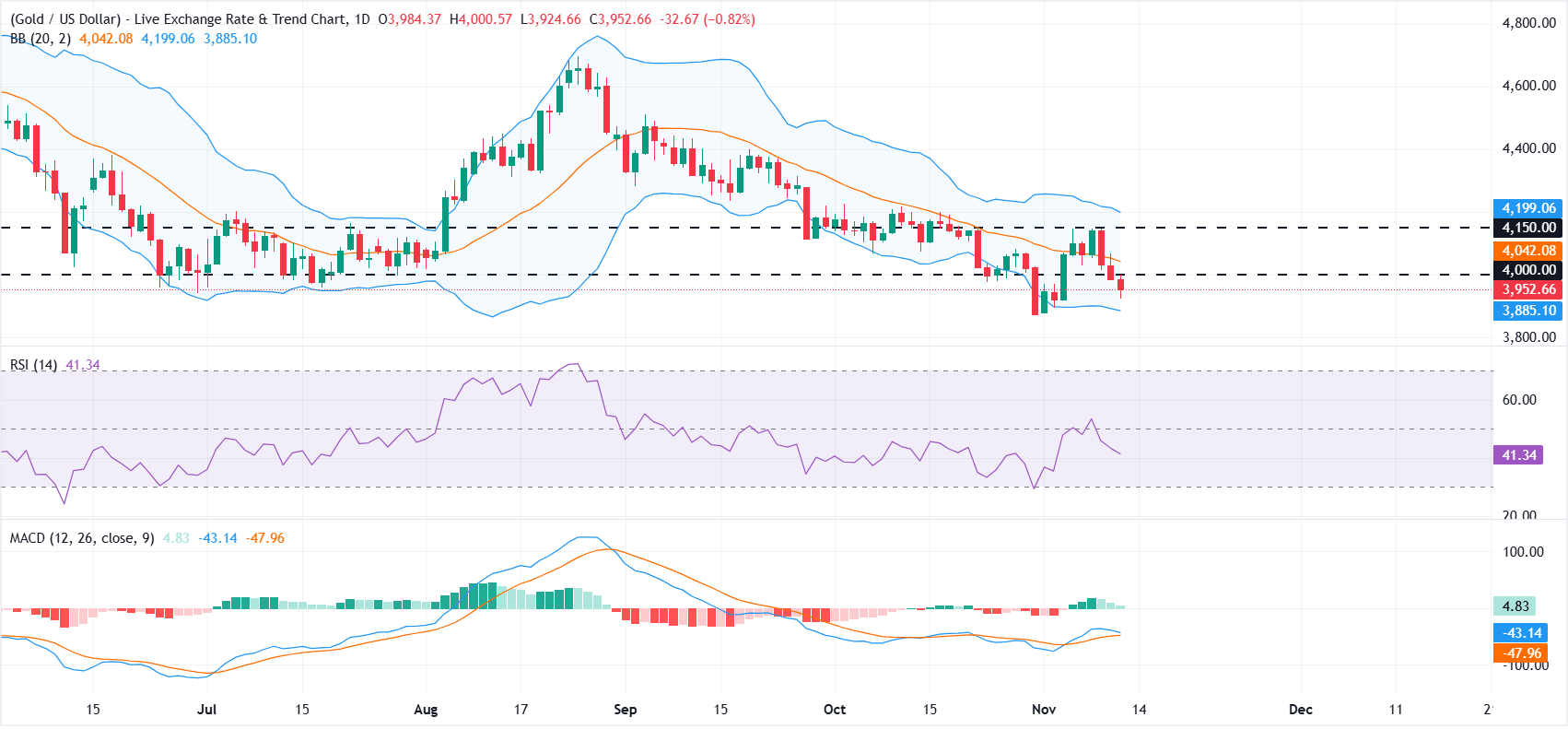
Buying interest remains limited on the daily XAU/USD chart. The 14-day Relative Strength Index (RSI) is near 41, signalling modest demand despite a slightly positive Moving Average Convergence Divergence (MACD) reading above zero. With the price still below the Bollinger Bands’ 20-day Simple Moving Average (SMA) at $4,042, the broader technical tone remains bearish and momentum relatively muted.
For a recovery, Gold first faces resistance at $4,000 and then at $4,042, the mid-Bollinger 20-day SMA. Holding above both levels would clear a path towards $4,150, followed by the upper Bollinger band around $4,199. Conversely, the lower Bollinger band near $3,885 provides immediate support. A decisive breach of that area would likely strengthen the existing bearish bias and bring deeper retracement levels into view.
(An AI tool assisted in preparing this story’s technical analysis. Learn more.)
Gold: Frequently Asked Questions
Widely used as both a store of value and a medium of exchange, Gold has held an important place throughout human history. Beyond its lustre and use in jewellery, the precious metal is now broadly regarded as a safe-haven asset, making it a favoured investment during periods of turmoil. Its independence from any particular issuer or government also underpins its widespread use as a hedge against inflation and currency depreciation.
The largest holders of Gold are central banks. To bolster their currencies during turbulent periods, they typically diversify reserves and purchase Gold, strengthening perceptions of the economy and its currency. Substantial Gold reserves can also inspire confidence in a country’s solvency. Data from the World Gold Council show that central banks increased their reserves by 1,136 tonnes of Gold, valued at about $70 billion, in 2022. No higher annual purchase has been recorded since records began. Emerging-economy central banks, including those in China, India and Turkey, are rapidly expanding their Gold holdings.
Both the US Dollar and US Treasuries are major reserve and safe-haven assets, and Gold tends to move inversely to them. A weakening Dollar generally supports Gold, allowing investors and central banks to diversify their holdings during unsettled periods. An inverse relationship also exists between Gold and risk assets: rising stock markets tend to weigh on Gold prices, whereas selling in riskier markets generally supports the precious metal.
Many factors can influence Gold prices. Its safe-haven appeal means geopolitical instability or concerns about a severe recession can trigger a rapid rise. Gold generates no yield, so lower interest rates generally support it, while higher borrowing costs usually weigh on the metal. Nevertheless, the US Dollar (USD) drives most price movements because Gold is denominated in dollars (XAU/USD). Dollar strength tends to restrain Gold prices; a weaker Dollar, by contrast, is likely to lift them.
POPULAR ARTICLES
1Gold hits one-year low near $3,850 as Fed hawks drive sharp sell-off2Fed’s Daly expects further rate hikes, warning that AI is fuelling inflation3Forex Today: US Inflation Returns4Why has silver fallen over 3% as Fed rate hike bets drive a US Dollar rally?5Overheating economy: Fed’s Goolsbee warns high inflation is no one-off6British Pound slides towards 1.32 as hawkish Fed sentiment overshadows solid UK growth7Mounting Fed tightening bets drive Australian Dollar to 10-month low8Dogecoin Price Forecast: Can DOGE defend its three-year low as selling pressure intensifies?9Can Euro Escape Pressure Near May 2025 Lows as Fed Hawks Bolster Dollar?

Get Started!
Sign up and access the Global Markets in less than 3 minutes

Connect With Us









Contacts
Phone: +61 2 8036 8388
Fax: +61 2 8036 8388
Email: support@tmgm.com



The information provided on this website is of a general nature only and does not constitute personal financial advice. Before acting on any information on this website, you should consider the suitability of the information in relation to your objectives, financial situation and needs. Investing in CFDs and FX Margin Contracts carries significant risks and is not suitable for all investors. You may lose more than your initial deposit. You do not own, or have, any interest in the underlying asset. We recommend that you seek independent advice and ensure you fully understand the risks involved before trading. It is important that you read and consider the disclosure document before you acquire any product listed on the website. The information and advertisements offered on this website are not intended for use by any person in any country or jurisdiction where such use would be contrary to local laws and regulations. The Products and Services offered on this website are not intended for residents of the United States, Malaysia and Thailand.
TMGM is authorized and regulated in various jurisdictions.
Trademax Australia Limited, trading as TMGM, is regulated by the Australian Securities and Investments Commission (ASIC), AFSL no. 436416 and is located at Level 28, One International Tower, 100 Barangaroo Avenue, 2000 Sydney, NSW Australia.
Email: support@tmgm.com.au
Trademax Global Limited, trading as TMGM, is authorized and regulated by the Vanuatu Financial Services Commission (VFSC), registration number 40356 and registered at 1276, Kumul Highway, Port Vila, Vanuatu, Republic of Vanuatu.
Email: support@tmgm.com
Trademax Global Markets (SE) Limited, trading as TMGM, is authorized and regulated by the Financial Services Authority (FSA) of Seychelles, with license number SD224. The company is registered at Office No 13, Providence Estate ABIS Centre, Mahe, Seychelles.
Email: support@tmgm.com
Trademax Global Markets (International) Pty Ltd, trading as TMGM, is authorized and regulated by the Financial Services Commission, Mauritius (FSC) with license no. GB22201012, and registered at 33, Edith Cavell Street C/o IQ EQ Fund Services (Mauritius) Ltd Port Louis, 11324 Mauritius.
Email: support@tmgm.com
Copyright © TMGM. All rights reserved