

Trading
Explore a wide range of markets with competitive pricing, deep liquidity, and advanced trading tools.
Learn More 
Platform
Trade seamlessly with TMGM's powerful platform, built for speed, precision, and a superior trading experience.
Learn More Trading Platform
Academy
Learn the fundamentals of trading with beginner-friendly resources, including guides, webinars, and market insights.
Learn More News & Analysis
Get real-time market updates and expert analysis to stay ahead of trading opportunities
Learn More News & Analysis
About
Learn what sets TMGM apart — our global presence, regulatory strength, and commitment to innovation in trading.
Learn More Why Choose TMGM
Sponsorship
Indian Rupee’s winning streak against US Dollar ends on Thursday
- Gains in the Indian Rupee fade against the US Dollar after the currency touches a fresh high of almost seven weeks.
- Support for INR is likely to persist, aided by stronger foreign inflows, fresh RBI measures and active intervention.
- October flash PMI releases from India and the US are next on investors’ radar.
The Indian Rupee’s (INR) rally against the US Dollar (USD) is losing momentum as the currency struggles to secure an eighth consecutive trading day of gains. Following substantial buying interest around the seven-week low of 97.33, USD/INR recovers towards 94.78. Nevertheless, several favourable factors are expected to keep supporting the Indian currency.
What Keeps the INR Outlook Bullish?
The Indian currency’s advance is being driven by a combination of RBI action and foreign capital inflows. The Reserve Bank of India (RBI) has intervened actively on several occasions in the spot and Non-Deliverable Forwards (NDFs) markets, while announcing fresh steps to restrain demand for the US Dollar. Substantial foreign fund inflows for the Jio Platforms Initial Public Offering (IPO) are also contributing to the rally.
According to DBS Group Research, the Reserve Bank of India’s “multi-layered defence strategy to support the rupee this year,” brings together “outright intervention in spot/forwards, regulatory action, liquidity steps, administrative measures and moves to curb import-related dollar demand.” DBS adds that the authorities “are likely not done yet and remain ready to take further action, as required,” a stance reinforced by RBI Governor Malhotra in a recent Moneycontrol interview on 13 October. Highlighting the central bank’s commitment, he stressed that “The RBI is determined to do whatever is necessary to ensure orderly movement in the foreign exchange market.”
Separately, Groww reports that Reliance Industries-backed Jio Platforms launched its ₹30,213 crore IPO on 21 October 2026, with subscriptions remaining open until 23 October.
What Will October’s India-US Flash PMI Data Show?
Friday’s preliminary private-sector Purchasing Managers’ Index (PMI) releases for October, covering both India and the US, are being closely watched by investors.
The US S&P Global PMI report is likely to point to another expansion in overall business activity, albeit at a moderate pace.
USD/INR Technical Analysis: Can Bearish Pressure Ease?
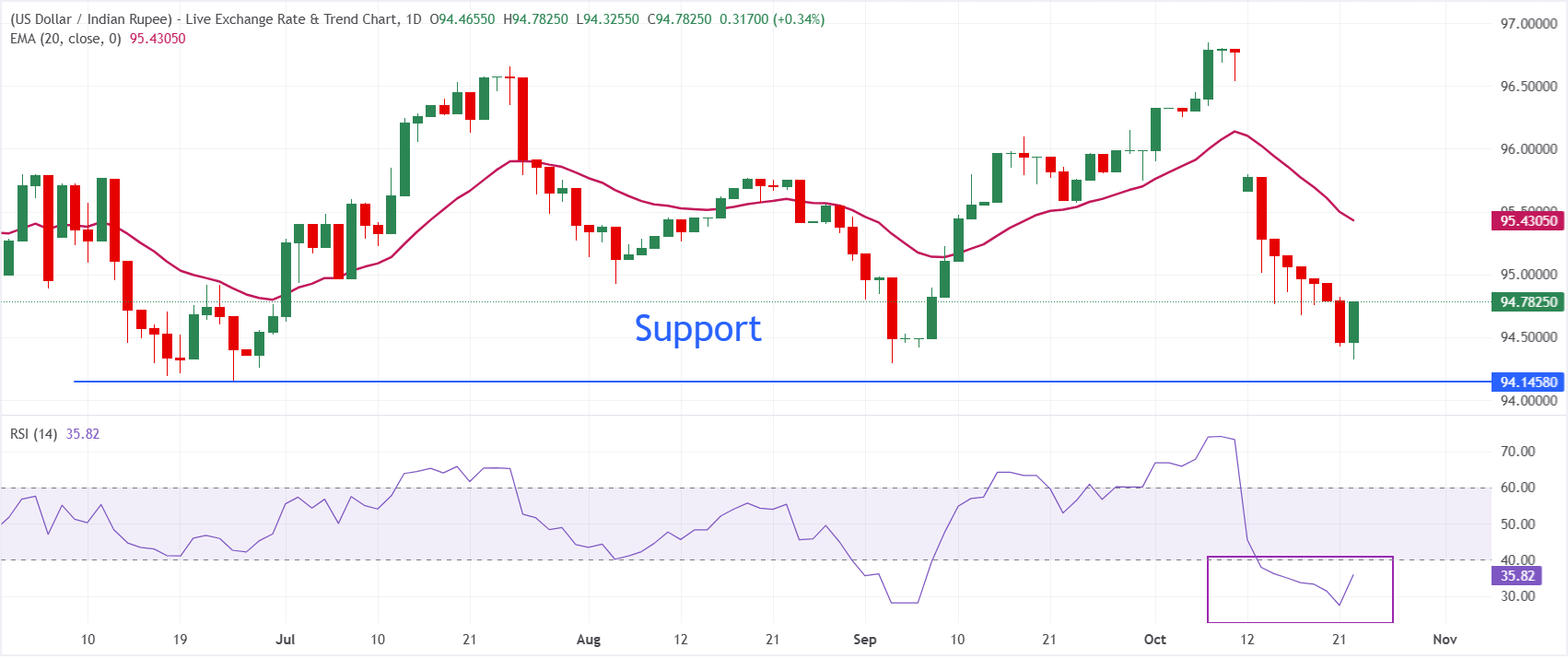
A bearish near-term bias persists on the daily chart, with USD/INR at 94.78, below its 20-day Exponential Moving Average (EMA) of 95.43. As immediate dynamic resistance, this moving average suggests that rallies are likely to attract selling for as long as the pair stays beneath it.
At 35.62, the Relative Strength Index (RSI) is close to oversold territory. This suggests that downward momentum is stretched, although a reversal has yet to be confirmed.
The 20-day EMA near 95.43 marks the first upside resistance. A daily close above it would be required to relieve the prevailing bearish pressure and create scope for a corrective recovery. On the downside, key support lies at 94.15, the low recorded on 25 June.
(The technical analysis of this story was written with the help of an AI tool. Know more.)
Indian Rupee: Frequently Asked Questions
External developments have a particularly strong influence on the Indian Rupee (INR). Key drivers include Crude Oil prices, given India’s heavy reliance on imported Oil; the US Dollar’s value, since most trade is settled in USD; and the extent of foreign investment. The Rupee is also significantly affected by the interest rates set by the Reserve Bank of India (RBI) and its direct intervention in FX markets to stabilise the exchange rate.
To facilitate trade, the Reserve Bank of India (RBI) intervenes actively in forex markets to keep the exchange rate stable. Interest-rate adjustments are another tool it uses to keep inflation at its 4% target. The Rupee generally benefits from higher rates because of the ‘carry trade’: investors borrow in lower-interest-rate countries and invest in countries offering relatively higher rates, earning the difference.
Inflation, interest rates, economic growth (GDP), the trade balance and foreign investment inflows all help determine the Rupee’s value. Faster growth can attract additional overseas investment and lift demand for the currency, while a narrowing trade deficit will eventually strengthen it. Higher interest rates also support the Rupee, particularly when real rates, or interest rates minus inflation, rise. When risk appetite improves, larger inflows of Foreign Direct and Indirect Investment (FDI and FII) can provide further support.
The Rupee generally comes under pressure when inflation rises, especially if it exceeds levels in India’s peer economies, as this reflects currency devaluation through oversupply. By making exports more expensive, inflation also results in more Rupees being sold to buy foreign imports, weighing on the currency. However, higher inflation usually prompts the Reserve Bank of India (RBI) to increase interest rates. The resulting rise in demand from international investors can support the Rupee. Lower inflation has the reverse effect.
POPULAR ARTICLES
1New Zealand Dollar loses ground as Q3 inflation data softens2Indian Rupee: How Is the RBI’s Hawkish Stance Supporting INR? – DBS3Turkish Lira: Carry trade holds as easing cycle restarts – ING4Indian Rupee’s winning streak against US Dollar ends on Thursday5Silver Price Forecast: YTD lows at $54.77 come into view as XAG/USD breaks lower6US Dollar Index Price Forecast: What follows a fresh three-week low near 101.45?7Indonesian Rupiah: Could BI measures curb IDR losses against US Dollar? - MUFG8Japanese Yen: Medium-Term Upside Risk Against US Dollar Amid Range-Bound Trading – UOB9Forex Today: US Dollar Retreat Deepens as US Yields Fall Further
LIVE QUOTES


ALL ABOUT FOREX
What Is a Stop Loss, How Does It Work and How Do You Set One?
Margin Call Meaning: What It Is, What Triggers It, and How to Avoid One
What Is an Islamic Account in Forex?
Best Indicators for Forex Trading and How to Use Them
The Top 10 Most Traded Currency Pairs in the World
What are the Major Forex Pairs? 7 Major Currency Pairs in the World
5 Best Forex Trading Apps In India In 2026
Top 15 Weakest Currencies in the World
Best Time to Trade Forex
Get Started!
Sign up and access the Global Markets in less than 3 minutes

Connect With Us









Contacts
Phone: +61 2 8036 8388
Fax: +61 2 8036 8388
Email: support@tmgm.com



The information provided on this website is of a general nature only and does not constitute personal financial advice. Before acting on any information on this website, you should consider the suitability of the information in relation to your objectives, financial situation and needs. Investing in CFDs and FX Margin Contracts carries significant risks and is not suitable for all investors. You may lose more than your initial deposit. You do not own, or have, any interest in the underlying asset. We recommend that you seek independent advice and ensure you fully understand the risks involved before trading. It is important that you read and consider the disclosure document before you acquire any product listed on the website. The information and advertisements offered on this website are not intended for use by any person in any country or jurisdiction where such use would be contrary to local laws and regulations. The Products and Services offered on this website are not intended for residents of the United States, Malaysia and Thailand.
TMGM is authorized and regulated in various jurisdictions.
Trademax Australia Limited, trading as TMGM, is regulated by the Australian Securities and Investments Commission (ASIC), AFSL no. 436416 and is located at Level 28, One International Tower, 100 Barangaroo Avenue, 2000 Sydney, NSW Australia.
Email: support@tmgm.com.au
Trademax Global Limited, trading as TMGM, is authorized and regulated by the Vanuatu Financial Services Commission (VFSC), registration number 40356 and registered at 1276, Kumul Highway, Port Vila, Vanuatu, Republic of Vanuatu.
Email: support@tmgm.com
Trademax Global Markets (SE) Limited, trading as TMGM, is authorized and regulated by the Financial Services Authority (FSA) of Seychelles, with license number SD224. The company is registered at Office No 13, Providence Estate ABIS Centre, Mahe, Seychelles.
Email: support@tmgm.com
Trademax Global Markets (International) Pty Ltd, trading as TMGM, is authorized and regulated by the Financial Services Commission, Mauritius (FSC) with license no. GB22201012, and registered at 33, Edith Cavell Street C/o IQ EQ Fund Services (Mauritius) Ltd Port Louis, 11324 Mauritius.
Email: support@tmgm.com
Copyright © TMGM. All rights reserved