

Trading
Explore a wide range of markets with competitive pricing, deep liquidity, and advanced trading tools.
Learn More 
Platform
Trade seamlessly with TMGM's powerful platform, built for speed, precision, and a superior trading experience.
Learn More Trading Platform
Academy
Learn the fundamentals of trading with beginner-friendly resources, including guides, webinars, and market insights.
Learn More News & Analysis
Get real-time market updates and expert analysis to stay ahead of trading opportunities
Learn More News & Analysis
About
Learn what sets TMGM apart — our global presence, regulatory strength, and commitment to innovation in trading.
Learn More Why Choose TMGM
Sponsorship
Iran talks lift Pound to its highest level since mid-September
- Trading above its 200-day average, GBP/USD moves past the October peaks.
- Sterling's advance has little to do with the UK, says ING, as the Dollar retreats alongside Crude Oil.
- A 7-2 vote is expected to take the BoE's Bank Rate to 4% on Thursday.
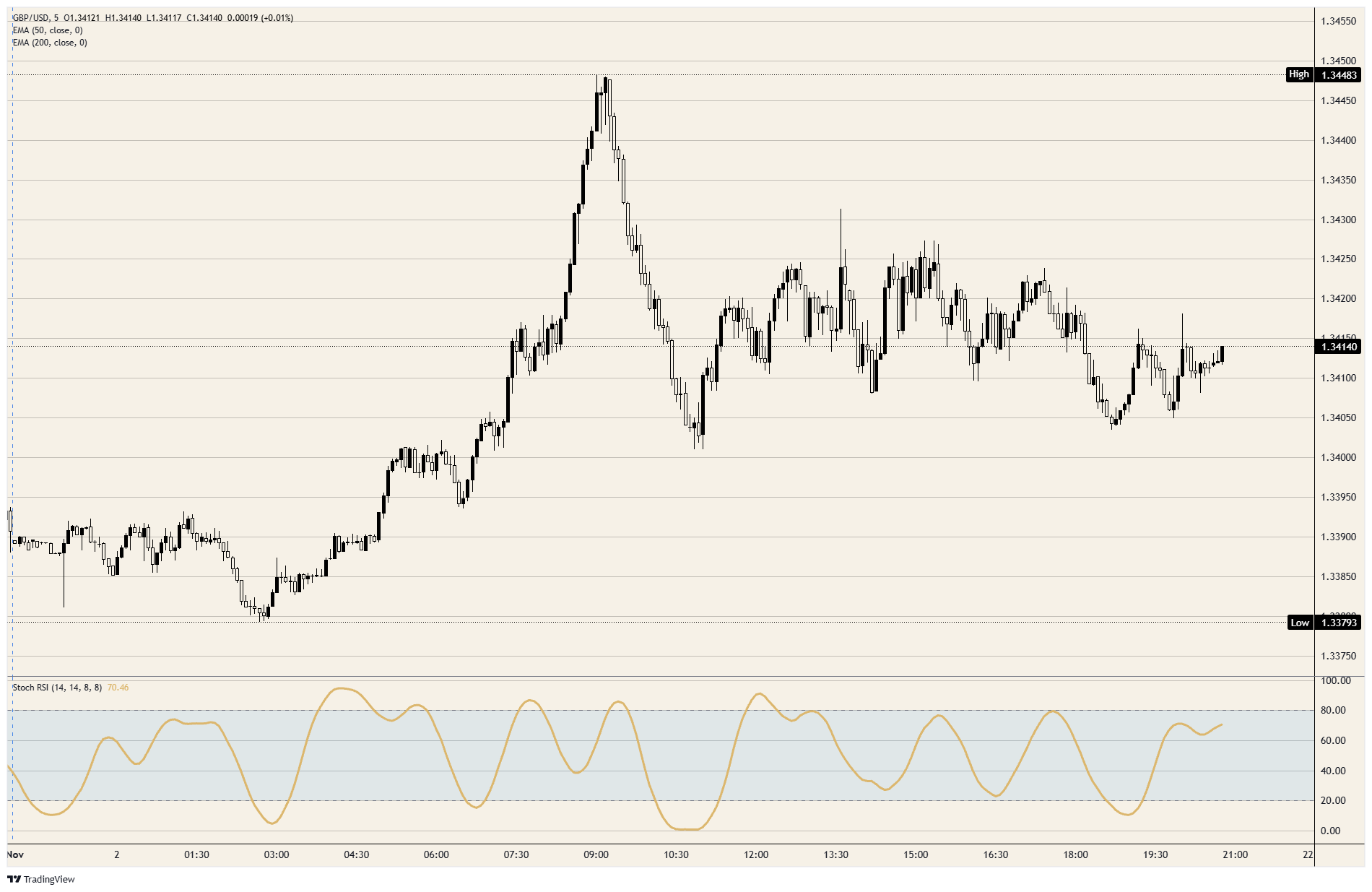
GBP/USD reached its strongest level since mid-September as the Dollar weakened alongside Crude Oil on optimism over a US-Iran agreement. After advancing to just below 1.3450, the pair surrendered roughly two-thirds of its rise from the session low. Trading has subsequently remained in the bottom half of the day's range.
Traders unwound Friday's bets on a weekend attack and Crude Oil declined following reports that President Trump wants to allow diplomacy with Iran to run its course. According to an official briefed on the discussions, Qatari mediators are travelling to Tehran to discuss a draft US-Iran agreement. ING attributed the Pound's advance primarily to the Dollar's accompanying decline rather than developments in the UK.
Following the Pound's peak, losses in Crude Oil more than doubled as President Trump indicated that an agreement with Iran was possible. GBP/USD has since held within a 1.3400 to 1.3450 range. Nor did the pair react when the Institute for Supply Management (ISM) manufacturing index registered 55.5, above the forecast of 54.6.
Which upcoming events could matter?
With a rate increase fully priced in, attention turns to the voting split in the Bank of England's (BoE) Thursday decision at 12:00 GMT and Governor Bailey's comments at 12:30 GMT, neither of which is yet reflected in prices. Forecasts point to a 7-2 vote to lift the UK's Bank Rate from 3.75% to 4%. At the previous meeting, policymakers voted 6-3 to leave rates unchanged.
Tuesday brings the US midterm elections, followed by October Nonfarm Payrolls (NFP) at 13:30 GMT on Friday, with 65K expected after 29K. Before the jobs release, Cleveland Fed President Hammack is due to speak at 13:50 GMT on Thursday. She was one of two Fed voters supporting a rate increase on October 28. Both her comments and the employment figures will help shape whether the Fed raises rates after that decision to hold.
What do the charts indicate?
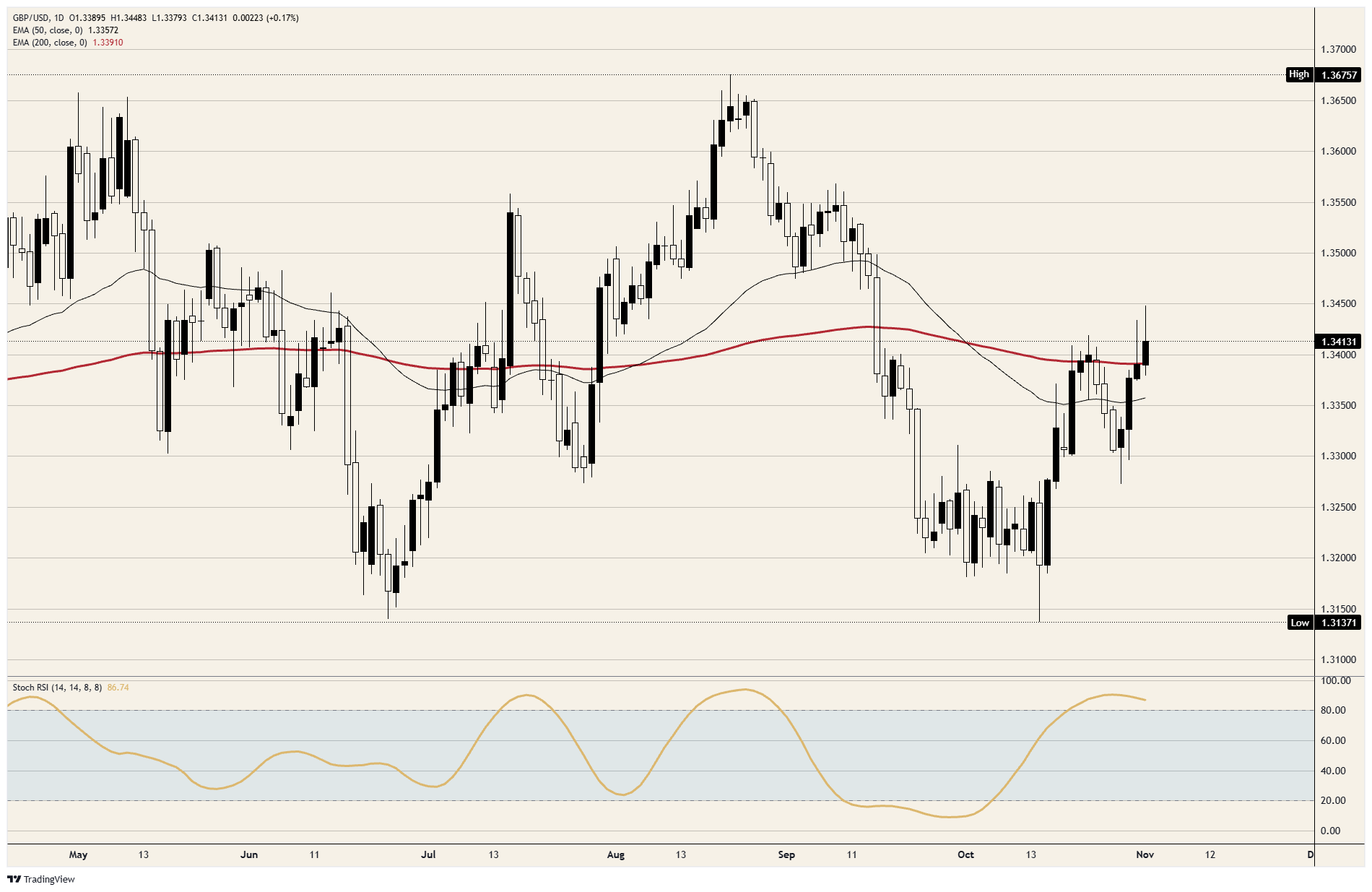
Roughly half of GBP/USD's decline from the late-August peak below 1.3700 to the October 14 trough just under 1.3150 has now been recovered. The pair trades above both the 50-day Exponential Moving Average (EMA), around 1.3350, and the 200-day EMA, near 1.3400, where its advance stalled around October 22. Having remained overbought since around October 20, daily momentum is beginning to ease.
GBP/USD: 5-minute price chart
GBP/USD: daily price chart
Pound Sterling: frequently asked questions
Issued by the Bank of England (BoE), the Pound Sterling (GBP) is the United Kingdom's official currency and the world's oldest, dating to 886 AD. Based on 2022 data, it ranks fourth globally by foreign exchange (FX) trading activity, representing 12% of all transactions and an average daily value of $630 billion. Among its main currency pairs, GBP/USD, known as ‘Cable’, accounts for 11% of FX trading. GBP/JPY, which traders call the ‘Dragon’, represents 3%, while EUR/GBP accounts for 2%.
Monetary policy set by the Bank of England is the most important influence on the Pound Sterling's value. In taking decisions, the BoE assesses whether it has met its main objective of “price stability”, meaning inflation steady at around 2%. Adjusting interest rates is its principal means of pursuing that objective. To curb excessively high inflation, the BoE will seek to raise interest rates, increasing borrowing costs for households and businesses. GBP generally benefits, since higher rates make the UK more attractive to international investors looking to invest their funds. By contrast, inflation that falls too low signals a slowdown in economic growth. The BoE will then consider cutting interest rates to make credit cheaper, encouraging businesses to borrow more for investment in projects that support growth.
The Pound Sterling can respond to economic releases because they provide a measure of the economy's health. GDP, Manufacturing and Services PMIs, and employment figures are among the indicators that can determine GBP's direction. Sterling benefits from economic strength, which draws in more overseas investment and may prompt the BoE to raise interest rates, directly strengthening GBP. Weak economic readings, on the other hand, are likely to push the Pound Sterling lower.
The Trade Balance is another key release for the Pound Sterling, showing the gap between a country's export earnings and its spending on imports during a specified period. Strong overseas demand for a country's exports supports its currency through the additional demand from foreign buyers purchasing those goods. A positive net Trade Balance therefore strengthens the currency, while a negative balance has the opposite effect.
POPULAR ARTICLES
1Why is the Yen weakening against the Dollar despite hopes of a US-Iran deal?2New Zealand Dollar gives up Iran-talks gain following RBNZ hold3Why Has the Euro Surrendered Half Its Gain on US-Iran Diplomacy?4Iran talks lift Pound to its highest level since mid-September5Silver Price Forecast: Can the oversold rebound break through $52.50 resistance?6Dow Jones Industrial Average posts a modest gain as funds flow out of tech stocks7Ethereum posts 16% October loss as ETF outflows reach record $1.61B8Forex Today: US elections and RBA in focus as the US Dollar pulls back9Chinese Yuan: Weak data fails to prevent four-year high – Commerzbank


Get Started!
Sign up and access the Global Markets in less than 3 minutes

Connect With Us









Contacts
Phone: +61 2 8036 8388
Fax: +61 2 8036 8388
Email: support@tmgm.com



The information provided on this website is of a general nature only and does not constitute personal financial advice. Before acting on any information on this website, you should consider the suitability of the information in relation to your objectives, financial situation and needs. Investing in CFDs and FX Margin Contracts carries significant risks and is not suitable for all investors. You may lose more than your initial deposit. You do not own, or have, any interest in the underlying asset. We recommend that you seek independent advice and ensure you fully understand the risks involved before trading. It is important that you read and consider the disclosure document before you acquire any product listed on the website. The information and advertisements offered on this website are not intended for use by any person in any country or jurisdiction where such use would be contrary to local laws and regulations. The Products and Services offered on this website are not intended for residents of the United States, Malaysia and Thailand.
TMGM is authorized and regulated in various jurisdictions.
Trademax Australia Limited, trading as TMGM, is regulated by the Australian Securities and Investments Commission (ASIC), AFSL no. 436416 and is located at Level 28, One International Tower, 100 Barangaroo Avenue, 2000 Sydney, NSW Australia.
Email: support@tmgm.com.au
Trademax Global Limited, trading as TMGM, is authorized and regulated by the Vanuatu Financial Services Commission (VFSC), registration number 40356 and registered at 1276, Kumul Highway, Port Vila, Vanuatu, Republic of Vanuatu.
Email: support@tmgm.com
Trademax Global Markets (SE) Limited, trading as TMGM, is authorized and regulated by the Financial Services Authority (FSA) of Seychelles, with license number SD224. The company is registered at Office No 13, Providence Estate ABIS Centre, Mahe, Seychelles.
Email: support@tmgm.com
Trademax Global Markets (International) Pty Ltd, trading as TMGM, is authorized and regulated by the Financial Services Commission, Mauritius (FSC) with license no. GB22201012, and registered at 33, Edith Cavell Street C/o IQ EQ Fund Services (Mauritius) Ltd Port Louis, 11324 Mauritius.
Email: support@tmgm.com
Copyright © TMGM. All rights reserved