

Trading
Explore a wide range of markets with competitive pricing, deep liquidity, and advanced trading tools.
Learn More 
Platform
Trade seamlessly with TMGM's powerful platform, built for speed, precision, and a superior trading experience.
Learn More Trading Platform
Academy
Learn the fundamentals of trading with beginner-friendly resources, including guides, webinars, and market insights.
Learn More News & Analysis
Get real-time market updates and expert analysis to stay ahead of trading opportunities
Learn More News & Analysis
About
Learn what sets TMGM apart — our global presence, regulatory strength, and commitment to innovation in trading.
Learn More Why Choose TMGM
Sponsorship
Ahead of UK retail sales, pound revisits its October low
- GBP/USD retreats to the level that marked its June and October reversals.
- December BoE rate-hike odds ease to 80% following softer UK inflation.
- Friday brings October UK retail sales, preceded by GfK consumer confidence.
GBP/USD is hovering near just under 1.3150 after falling back to the area where it rebounded in late June and on 14 October. The decline from just above 1.3500 on 4 November comes as UK inflation data widen the divide between expectations for the Federal Reserve and the Bank of England (BoE). For the Fed, markets are weighing the size of December's rate increase; for the BoE, the question is whether there will be an increase at all.

The probability priced in for a BoE rate increase on 17 December has slipped from nine in ten to about four in five. This followed a 3.6% year-on-year rise in the UK's Consumer Price Index (CPI) to October, against a 3.7% forecast, while core inflation remained at 2.8%. The first increase, on 5 November, took the UK's Bank Rate to 4.00%. Speaking at a London conference, BoE Governor Bailey said the labour market was strengthening, a development that favours higher rates. GBP/USD nevertheless remained close to its low.
A Fed rate increase on 9 December is regarded as certain by CME FedWatch, although it assigns a probability of less than one in ten to a half-point rise. According to the Fed's October minutes, two officials were open to considering an increase larger than a quarter-point if inflation figures proved unfavourable. Fed Governor Barr also said he would support additional increases. At 3.75%-4.00%, the Fed's rate is no higher than the UK's 4.00%; GBP/USD has declined in every session but one since 10 November.
Which releases could shape December's rate decisions?
Friday's UK releases begin with November GfK consumer confidence at 00:01 GMT, with a reading of -22 expected against the previous -24. October retail sales are then due at 07:00 GMT. Forecasts point to unchanged sales on the month following a 0.4% decline, and annual growth of 1.7% after 0.8%. Both releases will inform the BoE's 17 December decision, for which uncertainty centres on whether rates will rise at all.
The debate over the size of the Fed's increase will be informed by two officials' appearances and a consumer sentiment release. Fed Governor Barr is scheduled to speak on Thursday at 19:15 GMT. On Friday, Fed Governor Waller, who favours a half-point December increase, will deliver welcoming remarks at 13:25 GMT. The University of Michigan's November sentiment index is due afterwards at 15:00 GMT, with 51.5 forecast compared with 51 previously.
What do the GBP/USD charts show?
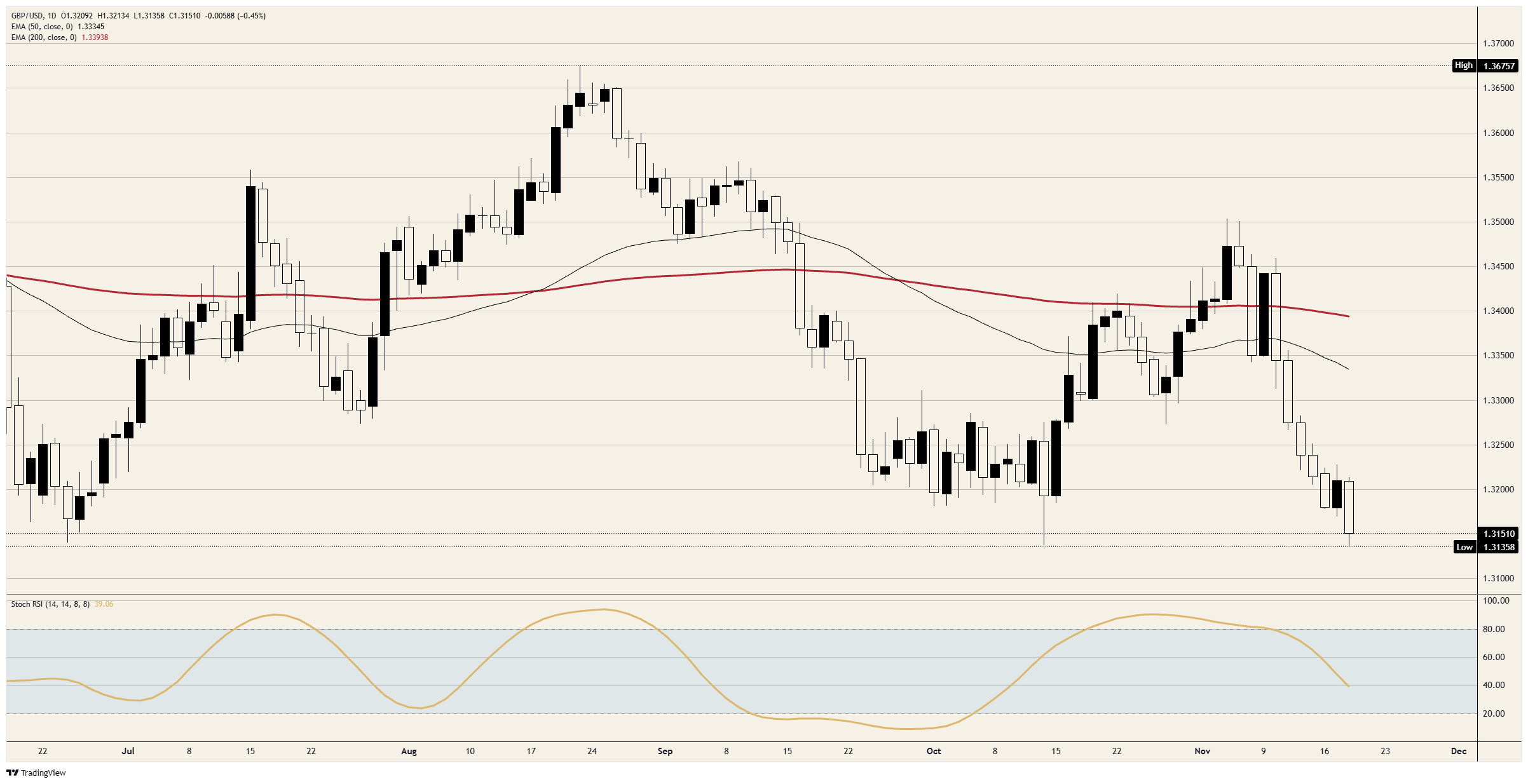
In a single session on 10 November, GBP/USD broke below both its 50-day Exponential Moving Average (EMA), around 1.3350, and its 200-day EMA, around 1.3400. It is down about 4% from August's peak, which was short of 1.3700. The low reached on Wednesday undercut the 14 October trough by a few pips, taking the pair to its weakest level since at least mid-June.
Daily price chart for GBP/USD
Pound Sterling: common questions
As the United Kingdom's official currency, the Pound Sterling (GBP) is also the world's oldest currency, dating to 886 AD. Figures for 2022 place it fourth among the most actively traded currencies in the global foreign exchange (FX) market. It represents 12% of all transactions, with average daily turnover of $630 billion. Among its main pairs, GBP/USD, known as ‘Cable’, makes up 11% of FX trading. GBP/JPY, called the ‘Dragon’ by traders, accounts for 3%, while EUR/GBP represents 2%. Responsibility for issuing the Pound Sterling lies with the Bank of England (BoE).
Monetary policy set by the Bank of England has the greatest influence on the Pound Sterling's value. In taking decisions, the BoE assesses whether its central objective of “price stability” has been met, meaning inflation holding steady at around 2%. Adjusting interest rates is its main means of pursuing that goal. Faced with excessively high inflation, the BoE seeks to curb it through rate increases, which raise borrowing costs for households and businesses. GBP generally benefits because higher rates make the UK more appealing to international investors looking to place their funds. By contrast, inflation that drops too low signals slowing economic growth. The BoE will then consider rate cuts to reduce borrowing costs, encouraging businesses to take on more credit for investment in projects that generate growth.
By indicating the economy's condition, data releases can affect the Pound Sterling's value. GDP, Manufacturing and Services PMIs, and employment figures are among the indicators capable of moving GBP. Sterling benefits from economic strength, which draws in additional foreign investment and may also prompt the BoE to raise interest rates, directly strengthening GBP. Weak economic readings, by contrast, are likely to weigh on the Pound Sterling.
The Trade Balance is another key release affecting the Pound Sterling. Over a specified period, it records the gap between a country's export earnings and its spending on imports. Strong overseas demand for a country's exports creates additional demand for its currency as foreign buyers seek to purchase those products. A positive net Trade Balance therefore supports the currency, while a negative balance has the opposite effect.
POPULAR ARTICLES
1Ahead of UK retail sales, pound revisits its October low2Euro trades below 1.1000 ahead of ECB President Lagarde’s upcoming remarks3Dow Jones Industrial Average retreats as UnitedHealth and Nvidia lose ground4Bitcoin’s bearish signals strengthen amid a 400K BTC contraction in demand5Ethereum Price Forecast: Futures and Spot Distribution Leave ETH Unable to Reclaim $1,8006Taiwan Dollar: Is a recovery against the US Dollar taking shape at 33.00? – OCBC7Will Australia’s Unemployment Rate Remain at 4.7% as Expected?8Singapore Dollar: Can Export Support Sustain a Stable Range? – Commerzbank9Indonesian Rupiah: Why has BI’s surprise hike eased pressure only partly? – BBH


Get Started!
Sign up and access the Global Markets in less than 3 minutes

Connect With Us









Contacts
Phone: +61 2 8036 8388
Fax: +61 2 8036 8388
Email: support@tmgm.com



The information provided on this website is of a general nature only and does not constitute personal financial advice. Before acting on any information on this website, you should consider the suitability of the information in relation to your objectives, financial situation and needs. Investing in CFDs and FX Margin Contracts carries significant risks and is not suitable for all investors. You may lose more than your initial deposit. You do not own, or have, any interest in the underlying asset. We recommend that you seek independent advice and ensure you fully understand the risks involved before trading. It is important that you read and consider the disclosure document before you acquire any product listed on the website. The information and advertisements offered on this website are not intended for use by any person in any country or jurisdiction where such use would be contrary to local laws and regulations. The Products and Services offered on this website are not intended for residents of the United States, Malaysia and Thailand.
TMGM is authorized and regulated in various jurisdictions.
Trademax Australia Limited, trading as TMGM, is regulated by the Australian Securities and Investments Commission (ASIC), AFSL no. 436416 and is located at Level 28, One International Tower, 100 Barangaroo Avenue, 2000 Sydney, NSW Australia.
Email: support@tmgm.com.au
Trademax Global Limited, trading as TMGM, is authorized and regulated by the Vanuatu Financial Services Commission (VFSC), registration number 40356 and registered at 1276, Kumul Highway, Port Vila, Vanuatu, Republic of Vanuatu.
Email: support@tmgm.com
Trademax Global Markets (SE) Limited, trading as TMGM, is authorized and regulated by the Financial Services Authority (FSA) of Seychelles, with license number SD224. The company is registered at Office No 13, Providence Estate ABIS Centre, Mahe, Seychelles.
Email: support@tmgm.com
Trademax Global Markets (International) Pty Ltd, trading as TMGM, is authorized and regulated by the Financial Services Commission, Mauritius (FSC) with license no. GB22201012, and registered at 33, Edith Cavell Street C/o IQ EQ Fund Services (Mauritius) Ltd Port Louis, 11324 Mauritius.
Email: support@tmgm.com
Copyright © TMGM. All rights reserved