

Trading
Explore a wide range of markets with competitive pricing, deep liquidity, and advanced trading tools.
Learn More 
Platform
Trade seamlessly with TMGM's powerful platform, built for speed, precision, and a superior trading experience.
Learn More Trading Platform
Academy
Learn the fundamentals of trading with beginner-friendly resources, including guides, webinars, and market insights.
Learn More News & Analysis
Get real-time market updates and expert analysis to stay ahead of trading opportunities
Learn More News & Analysis
About
Learn what sets TMGM apart — our global presence, regulatory strength, and commitment to innovation in trading.
Learn More Why Choose TMGM
Sponsorship
Silver Price Forecast: XAG/USD plunges 5% as momentum indicators turn bearish
- Silver slides to its lowest level since early August as the US Dollar and Treasury yields climb.
- XAG/USD remains below its 50-day, 100-day and 200-day SMAs, with all three averages acting as resistance.
- The RSI points to bearish momentum as Silver tests Fibonacci support near $61.
Silver (XAG/USD) falls around 5% on Monday, slipping to its lowest level since early August. A stronger US Dollar (USD) and rising US Treasury yields weigh on the non-yielding metal as the US-Iran stalemate keeps Oil prices elevated, strengthening expectations of further Federal Reserve (Fed) rate hikes. At the time of writing, XAG/USD trades around $61.08.
The US 10-year Treasury yield has risen to 5.27%, its highest level since 2007, while the US Dollar Index (DXY) holds near 101.25, close to a two-month high. Higher yields increase the opportunity cost of holding Silver, while a firmer US Dollar makes the metal more expensive for overseas buyers.
Markets are pricing in a 70% chance of another rate hike in October, according to CME FedWatch, after the central bank raised rates by 25 basis points at its September 15-16 meeting. Traders now turn to a busy week of US data, including the Personal Consumption Expenditures (PCE) inflation report on Wednesday, the ISM Manufacturing Purchasing Managers’ Index (PMI) on Thursday and Nonfarm Payrolls (NFP) on Friday.
Technical Analysis:
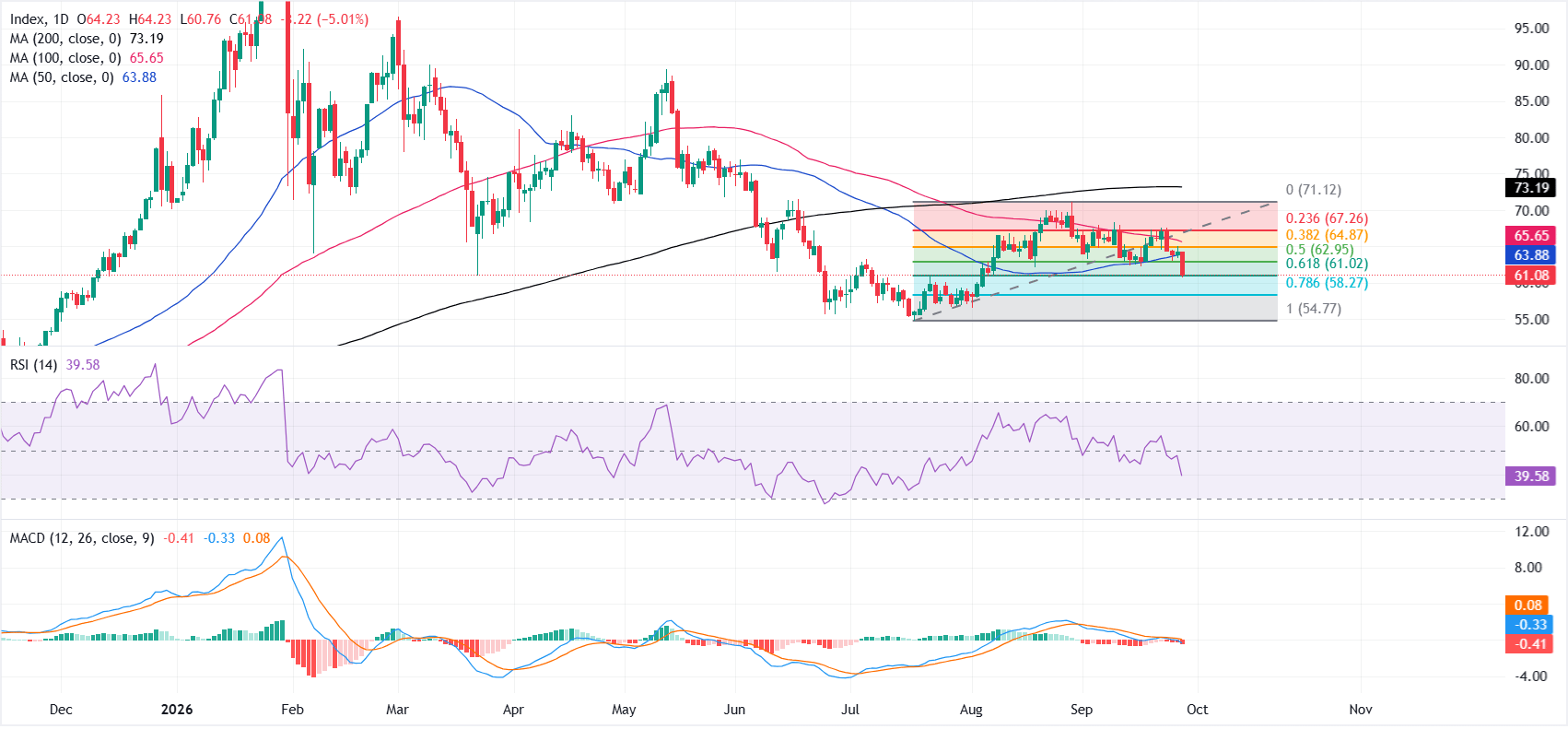
On the daily chart, XAG/USD remains under a dense cap of moving averages, with the 50-day Simple Moving Average (SMA) at $63.88, the 100-day SMA at $65.65 and the 200-day SMA at $73.19 all acting as overhead resistance, which maintains a bearish near-term bias.
Price is hovering just above the 61.8% Fibonacci retracement at $61.02, hinting at a fragile pivot area, while the Relative Strength Index (RSI) at 39 leans toward bearish momentum and the Moving Average Convergence Divergence (MACD) stays negative, reinforcing downside pressure.
On the topside, initial resistance emerges at the 50.0% Fibonacci retracement at $62.95, followed by the 50-day SMA at $63.88 and the 38.2% retracement at $64.87, with the 100-day SMA at $65.65 and the 23.6% level at $67.26 marking higher barriers before the $71.12 anchor and the 200-day SMA at $73.19. On the downside, immediate support is found at the 61.8% Fibonacci retracement at $61.02, ahead of the 78.6% level at $58.27 and the prior cycle low near $54.77, where buyers may attempt to stabilize the decline.
(The technical analysis of this story was written with the help of an AI tool. Know more.)
Silver FAQs
Silver is a precious metal highly traded among investors. It has been historically used as a store of value and a medium of exchange. Although less popular than Gold, traders may turn to Silver to diversify their investment portfolio, for its intrinsic value or as a potential hedge during high-inflation periods. Investors can buy physical Silver, in coins or in bars, or trade it through vehicles such as Exchange Traded Funds, which track its price on international markets.
Silver prices can move due to a wide range of factors. Geopolitical instability or fears of a deep recession can make Silver price escalate due to its safe-haven status, although to a lesser extent than Gold's. As a yieldless asset, Silver tends to rise with lower interest rates. Its moves also depend on how the US Dollar (USD) behaves as the asset is priced in dollars (XAG/USD). A strong Dollar tends to keep the price of Silver at bay, whereas a weaker Dollar is likely to propel prices up. Other factors such as investment demand, mining supply – Silver is much more abundant than Gold – and recycling rates can also affect prices.
Silver is widely used in industry, particularly in sectors such as electronics or solar energy, as it has one of the highest electric conductivity of all metals – more than Copper and Gold. A surge in demand can increase prices, while a decline tends to lower them. Dynamics in the US, Chinese and Indian economies can also contribute to price swings: for the US and particularly China, their big industrial sectors use Silver in various processes; in India, consumers’ demand for the precious metal for jewellery also plays a key role in setting prices.
Silver prices tend to follow Gold's moves. When Gold prices rise, Silver typically follows suit, as their status as safe-haven assets is similar. The Gold/Silver ratio, which shows the number of ounces of Silver needed to equal the value of one ounce of Gold, may help to determine the relative valuation between both metals. Some investors may consider a high ratio as an indicator that Silver is undervalued, or Gold is overvalued. On the contrary, a low ratio might suggest that Gold is undervalued relative to Silver.
POPULAR ARTICLES
1US President Trump to ease sanctions on Iran over nuclear progress2USD: Speculative longs steady as Fed hikes – Rabobank3Bitcoin vs Gold Outlook: BTC pulls back alongside XAU/USD ahead of US-Iran indirect talks4British Pound defies US yields surge as BoE hike bets build5Silver Price Forecast: XAG/USD plunges 5% as momentum indicators turn bearish6GBP: Shorts at highs as Pound tracks Oil-led USD rally – Rabobank7Euro struggles as Fed rate-hike bets overshadow ECB tightening expectations8AUD: Speculative shorts rise as gains versus Dollar fade – Rabobank9USD/CAD: Overbought but seen sideways into year end – Rabobank
LIVE QUOTES

ALL ABOUT GOLD & PRECIOUS METALS
Gold ETF Taxation: What Is the Tax on Gold ETF in India?
How Much Gold Is Allowed From Dubai to India?
How much is the Tax on Gold in India?
Gold Market Open Time: XAUUSD Trading Hours & Best Time to Trade
How to Trade Gold
Top 10 Most Traded Commodities in India & The Best Commodity to Trade
Gold Price Chart India 10 Years: An Overview
Why Invest in Gold: The Advantages of Trading Gold CFDs
4 Strategies for Investing in Gold for Beginners in 2025
Get Started!
Sign up and access the Global Markets in less than 3 minutes

Connect With Us









Contacts
Phone: +61 2 8036 8388
Fax: +61 2 8036 8388
Email: support@tmgm.com



The information provided on this website is of a general nature only and does not constitute personal financial advice. Before acting on any information on this website, you should consider the suitability of the information in relation to your objectives, financial situation and needs. Investing in CFDs and FX Margin Contracts carries significant risks and is not suitable for all investors. You may lose more than your initial deposit. You do not own, or have, any interest in the underlying asset. We recommend that you seek independent advice and ensure you fully understand the risks involved before trading. It is important that you read and consider the disclosure document before you acquire any product listed on the website. The information and advertisements offered on this website are not intended for use by any person in any country or jurisdiction where such use would be contrary to local laws and regulations. The Products and Services offered on this website are not intended for residents of the United States, Malaysia and Thailand.
TMGM is authorized and regulated in various jurisdictions.
Trademax Australia Limited, trading as TMGM, is regulated by the Australian Securities and Investments Commission (ASIC), AFSL no. 436416 and is located at Level 28, One International Tower, 100 Barangaroo Avenue, 2000 Sydney, NSW Australia.
Email: support@tmgm.com.au
Trademax Global Limited, trading as TMGM, is authorized and regulated by the Vanuatu Financial Services Commission (VFSC), registration number 40356 and registered at 1276, Kumul Highway, Port Vila, Vanuatu, Republic of Vanuatu.
Email: support@tmgm.com
Trademax Global Markets (SE) Limited, trading as TMGM, is authorized and regulated by the Financial Services Authority (FSA) of Seychelles, with license number SD224. The company is registered at Office No 13, Providence Estate ABIS Centre, Mahe, Seychelles.
Email: support@tmgm.com
Trademax Global Markets (International) Pty Ltd, trading as TMGM, is authorized and regulated by the Financial Services Commission, Mauritius (FSC) with license no. GB22201012, and registered at 33, Edith Cavell Street C/o IQ EQ Fund Services (Mauritius) Ltd Port Louis, 11324 Mauritius.
Email: support@tmgm.com
Copyright © TMGM. All rights reserved