

Trading
Explore a wide range of markets with competitive pricing, deep liquidity, and advanced trading tools.
Learn More 
Platform
Trade seamlessly with TMGM's powerful platform, built for speed, precision, and a superior trading experience.
Learn More Trading Platform
Academy
Learn the fundamentals of trading with beginner-friendly resources, including guides, webinars, and market insights.
Learn More News & Analysis
Get real-time market updates and expert analysis to stay ahead of trading opportunities
Learn More News & Analysis
About
Learn what sets TMGM apart — our global presence, regulatory strength, and commitment to innovation in trading.
Learn More Why Choose TMGM
Sponsorship
Yen holds steady ahead of Tokyo inflation despite strong US data
- USD/JPY remains confined to 158.50–159.50 as US inflation and growth data fail to shift the pair.
- At 4.2% year-on-year, Japan's services producer price inflation reaches its highest since 1990.
- Thursday brings a speech by BoJ board member Tamura alongside Tokyo's November CPI release.
USD/JPY remained caught between opposing forces on Wednesday, with stronger US data offset by Japan's fastest services inflation since 1990. Trading just above its opening level of 159.00, the pair has covered less than a Yen during the session. This marks its eighth session within the range established after the November 13 high.

The case for a December interest rate increase by the Bank of Japan (BoJ) strengthened as Japan's services producer prices climbed 4.2% in the year to October, their fastest rise since 1990. Another factor restraining USD/JPY has been Finance Minister Katayama's November 13 assessment that the Yen was seeing rapid, one-sided moves. That was also the last day the pair traded above 160.00, a level it has not revisited amid these two factors.
With a December Fed rate increase already almost fully priced in, stronger US releases left little scope for markets to adjust expectations. Core inflation exceeded forecasts, third-quarter economic growth reached 4.3% against expectations of 3.4%, and jobless claims fell to 189K. Yet Treasury yields declined as investors sold technology shares, removing the usual support that robust US numbers provide to USD/JPY.
Which upcoming events could influence USD/JPY?
Thursday's schedule includes remarks from BoJ board member Tamura at 01:00 GMT, followed by Tokyo's November Consumer Price Index (CPI) at 23:30 GMT. Inflation excluding fresh food is forecast at 3%, up from 2.6%, while the measure excluding food and energy is also expected at 3%, against 2.4% previously. Both readings will inform the BoJ's December decision and, in turn, the Japanese component of the interest rate gap driving USD/JPY.
Tokyo's data will arrive while New York is on holiday, with US markets closed on Thursday for Thanksgiving. On Saturday, the Fed enters its pre-meeting quiet period ahead of its December 8-9 meeting, which takes place before the BoJ's meeting.
What do the charts indicate for USD/JPY?
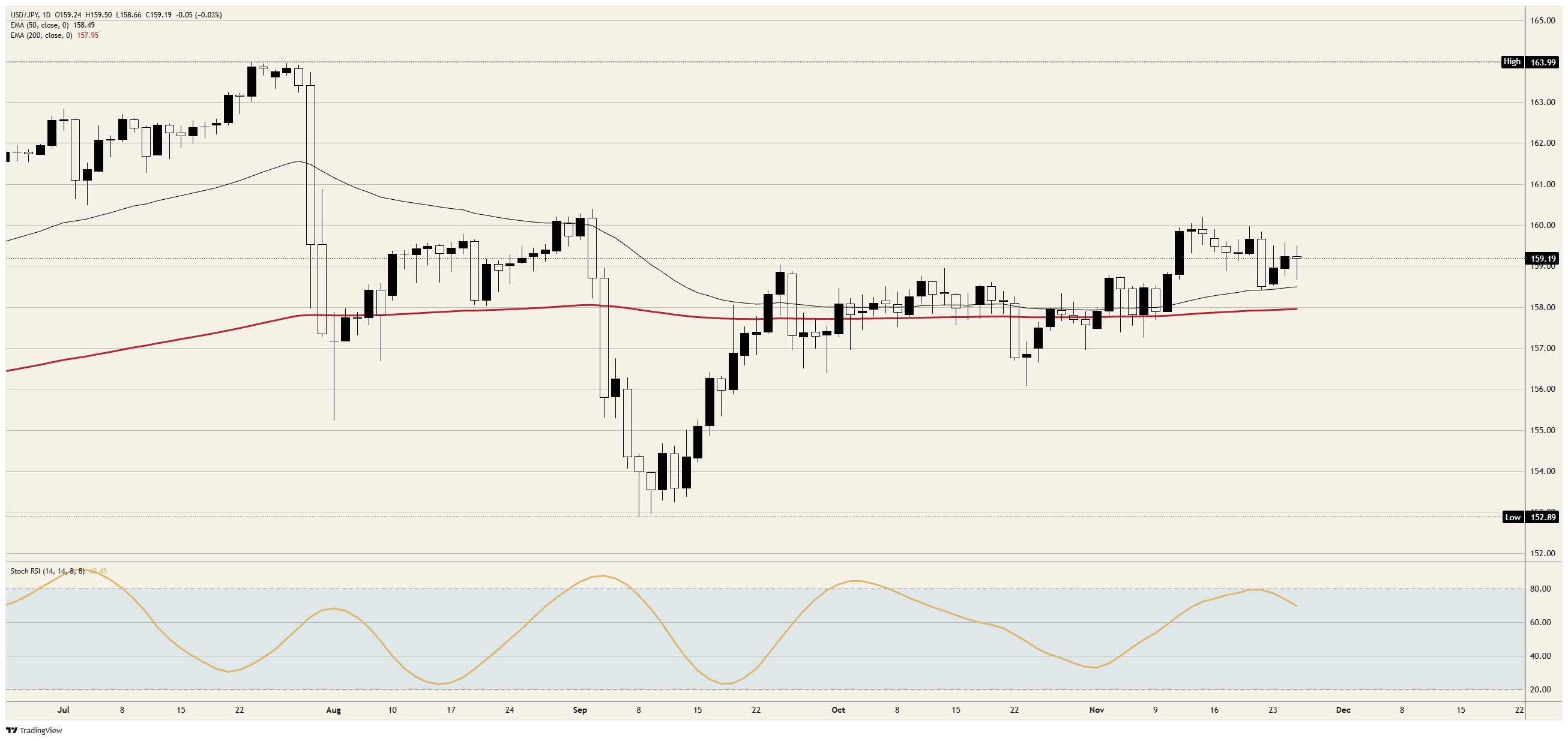
USD/JPY's November 12 and 13 highs, slightly above 160.00, marked its first trading above that level since early September. Near 158.50, the 50-day Exponential Moving Average (EMA) was tested by Friday's low, while Wednesday's low held just above it. The 200-day EMA sits near 158.00, and daily momentum has turned lower after approaching overbought territory.
Daily chart: USD/JPY
Japanese Yen: Frequently Asked Questions
Among the world's most actively traded currencies, the Japanese Yen (JPY) is influenced broadly by Japan's economic performance. More specific drivers include the Bank of Japan's policy decisions, the gap between Japanese and US bond yields, and traders' appetite for risk, alongside other factors.
Currency control is part of the Bank of Japan's mandate, making its actions an important influence on the Yen. Direct intervention in currency markets has occurred on occasion, usually aimed at weakening the currency, though political concerns among Japan's main trading partners discourage frequent intervention. Between 2013 and 2024, the BoJ's ultra-loose monetary policy weakened the Yen against its major peers as the policy gap between the Bank of Japan and other leading central banks widened. More recently, a gradual withdrawal of that ultra-loose policy has provided some support to the currency.
By maintaining ultra-loose monetary policy over the past decade, the BoJ increasingly diverged from other central banks, especially the US Federal Reserve. The resulting widening in the yield gap between 10-year US and Japanese bonds supported the US Dollar relative to the Japanese Yen. That gap is now narrowing as the BoJ's 2024 decision to gradually move away from ultra-loose policy coincides with interest rate cuts by other major central banks.
Investors often regard the Japanese Yen as a safe-haven asset, making them more inclined to allocate money to it during periods of market stress because of its perceived reliability and stability. As a result, market turbulence is likely to lift the Yen against currencies viewed as riskier investments.
POPULAR ARTICLES
1Yen holds steady ahead of Tokyo inflation despite strong US data2New Zealand Dollar recovers from 2009 low as confidence data looms3Pound holds steady ahead of BoE stability report following rate hearing4Euro above 19-month low: What next as ECB meeting accounts loom?5Dow Jones Industrial Average recovers lost ground even as AI stocks retreat6FX Today: Why is the US Dollar weakening despite strong US data? ECB minutes in focus7Why is gold tumbling despite lower US yields as core PCE reaches 3.3%?8Chinese Yuan: Is Its Role in Global Portfolios Growing? – DBS9Australian Dollar recovers even as risk appetite stays weak and Fed outlook remains hawkish


Get Started!
Sign up and access the Global Markets in less than 3 minutes

Connect With Us









Contacts
Phone: +61 2 8036 8388
Fax: +61 2 8036 8388
Email: support@tmgm.com



The information provided on this website is of a general nature only and does not constitute personal financial advice. Before acting on any information on this website, you should consider the suitability of the information in relation to your objectives, financial situation and needs. Investing in CFDs and FX Margin Contracts carries significant risks and is not suitable for all investors. You may lose more than your initial deposit. You do not own, or have, any interest in the underlying asset. We recommend that you seek independent advice and ensure you fully understand the risks involved before trading. It is important that you read and consider the disclosure document before you acquire any product listed on the website. The information and advertisements offered on this website are not intended for use by any person in any country or jurisdiction where such use would be contrary to local laws and regulations. The Products and Services offered on this website are not intended for residents of the United States, Malaysia and Thailand.
TMGM is authorized and regulated in various jurisdictions.
Trademax Australia Limited, trading as TMGM, is regulated by the Australian Securities and Investments Commission (ASIC), AFSL no. 436416 and is located at Level 28, One International Tower, 100 Barangaroo Avenue, 2000 Sydney, NSW Australia.
Email: support@tmgm.com.au
Trademax Global Limited, trading as TMGM, is authorized and regulated by the Vanuatu Financial Services Commission (VFSC), registration number 40356 and registered at 1276, Kumul Highway, Port Vila, Vanuatu, Republic of Vanuatu.
Email: support@tmgm.com
Trademax Global Markets (SE) Limited, trading as TMGM, is authorized and regulated by the Financial Services Authority (FSA) of Seychelles, with license number SD224. The company is registered at Office No 13, Providence Estate ABIS Centre, Mahe, Seychelles.
Email: support@tmgm.com
Trademax Global Markets (International) Pty Ltd, trading as TMGM, is authorized and regulated by the Financial Services Commission, Mauritius (FSC) with license no. GB22201012, and registered at 33, Edith Cavell Street C/o IQ EQ Fund Services (Mauritius) Ltd Port Louis, 11324 Mauritius.
Email: support@tmgm.com
Copyright © TMGM. All rights reserved