

Trading
Explore a wide range of markets with competitive pricing, deep liquidity, and advanced trading tools.
Learn More 
Platform
Trade seamlessly with TMGM's powerful platform, built for speed, precision, and a superior trading experience.
Learn More Trading Platform
Academy
Learn the fundamentals of trading with beginner-friendly resources, including guides, webinars, and market insights.
Learn More News & Analysis
Get real-time market updates and expert analysis to stay ahead of trading opportunities
Learn More News & Analysis
About
Learn what sets TMGM apart — our global presence, regulatory strength, and commitment to innovation in trading.
Learn More Why Choose TMGM
Sponsorship
Top 3 Price Predictions: Can Bitcoin, Ethereum and Ripple (BTC, ETH and XRP) sustain their recovery as Big Tech earnings come into focus?
- Bitcoin’s recovery gathers pace above $80,900 on Wednesday, with investors weighing the forthcoming Big Tech earnings.
- A clear direction remains elusive for Ethereum as it consolidates between the 100-day and 200-day EMAs.
- Having secured support around $1.300 earlier this week, XRP continues its recovery.
The recovery in Bitcoin (BTC), Ethereum (ETH) and Ripple (XRP) continues on Wednesday, with market attention shifting to earnings from major technology companies. Wednesday brings Q3 results from Microsoft and Alphabet, while Amazon is scheduled to report on Thursday. Concerns about hyperscaler valuations could ease if the results support sustained heavy spending on Artificial Intelligence (AI). Disappointing numbers, however, could prolong the ongoing AI-driven market sell-off.

The rebound takes BTC above $80,900, even as ETH remains in consolidation between key moving averages. XRP, too, builds on its recovery after securing support near $1.300 earlier in the week.
Can Bitcoin advance towards $81,000?
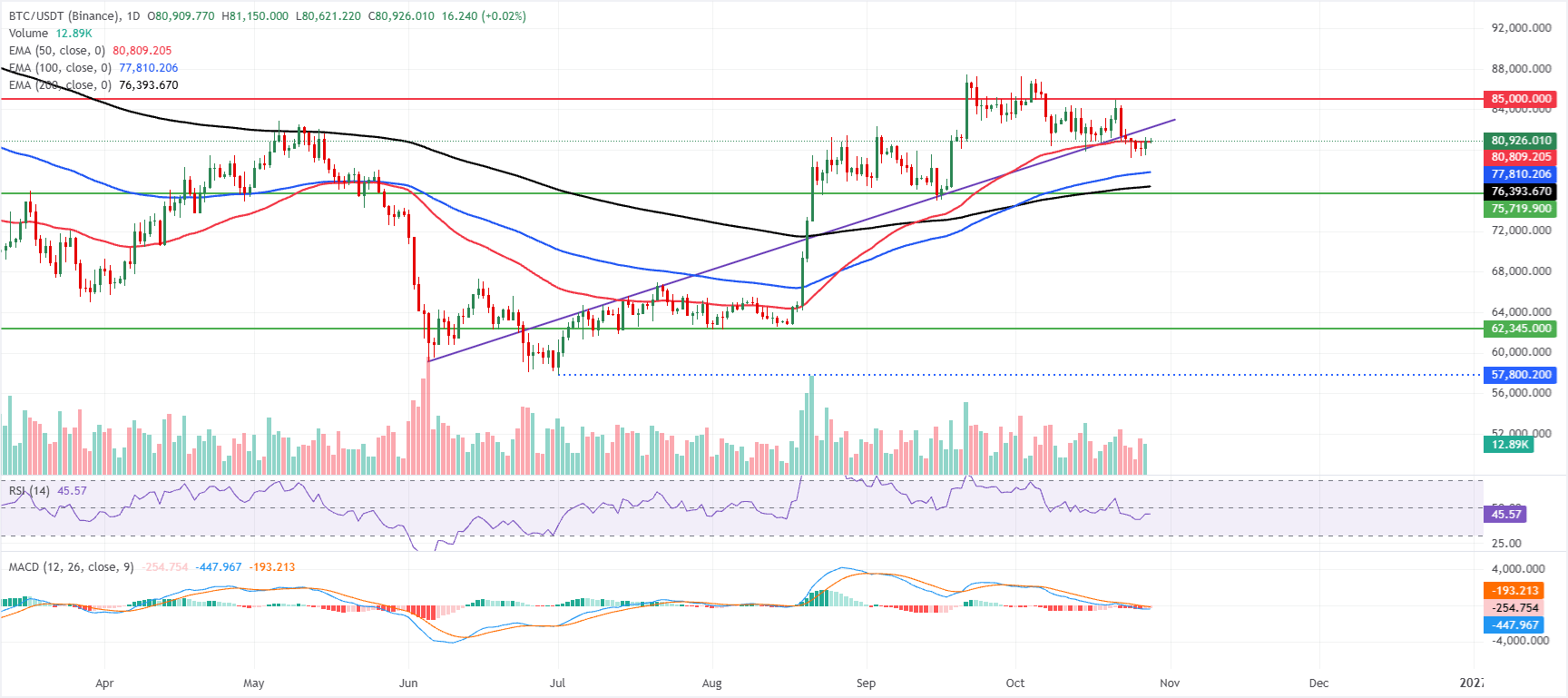
Trading at $80,926 on Wednesday, Bitcoin retains a positive bias above its 50-day, 100-day and 200-day Exponential Moving Averages (EMAs). The 50-day EMA, around $80,810, provides the closest dynamic support.
Although the grouping of EMAs beneath the price indicates that the wider uptrend is intact, momentum signals warrant caution. A Relative Strength Index (RSI) near 46, alongside a negative Moving Average Convergence Divergence (MACD) reading, suggests bullish momentum is weakening and further rallies could encounter growing resistance.
A daily close above the horizontal resistance at $85,000 would create scope for a more pronounced advance. This level represents the immediate hurdle on the upside.
The 50-day EMA near $80,810 offers the first downside support, ahead of the 100-day EMA around $77,810 and the 200-day EMA near $76,394. A breach of this group of EMAs would likely point to a deeper correction.
Can Ethereum break out between key EMAs?
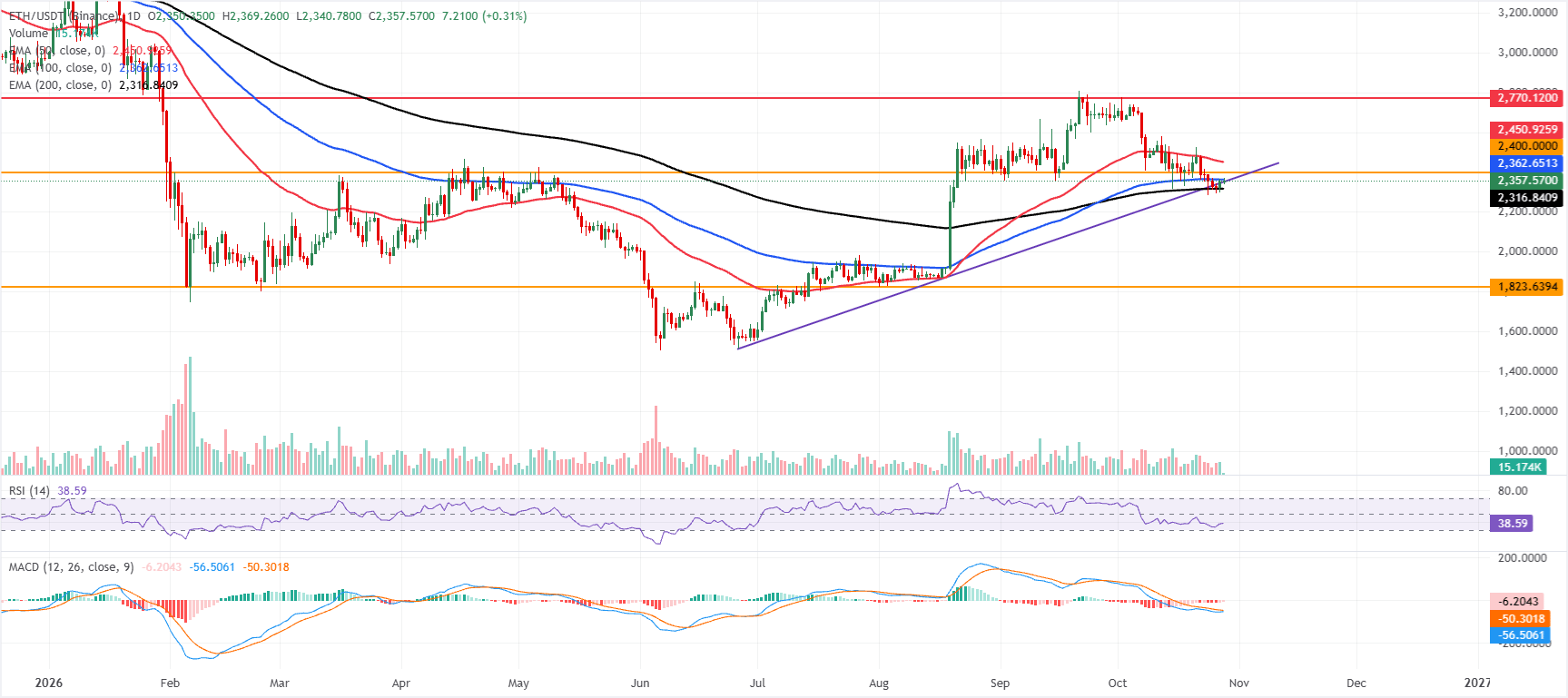
A neutral to mildly bearish near-term outlook persists for Ethereum, which trades at $2,357 on Wednesday between its major EMAs. The price remains just above the 200-day EMA at $2,316 and the former rising trendline support, now a pivot around $2,351. Overhead, the 100-day EMA at $2,362 continues to restrict gains, while the 50-day EMA at $2,450 remains well above the market. This positioning suggests selling could emerge as rallies approach these levels.
Buying pressure appears muted, with the RSI at 38 remaining below its midpoint. Although the MACD is edging upwards, it remains negative. Together, these signals indicate that recovery attempts are taking place within a corrective phase, rather than signalling a confirmed bullish reversal.
A move above the immediate resistance at the 100-day EMA near $2,362 would bring the psychological and structural hurdle at $2,400 into focus. Beyond that, further resistance lies at the 50-day EMA at $2,450 and the more distant horizontal level of $2,770.
The trendline pivot around $2,351 provides the first downside support, with stronger demand expected at the 200-day EMA at $2,316. Should the price close below that zone on a daily basis, the route towards deeper horizontal support near $1,823 would open up, strengthening the broader corrective bias.
Can XRP sustain its recovery?
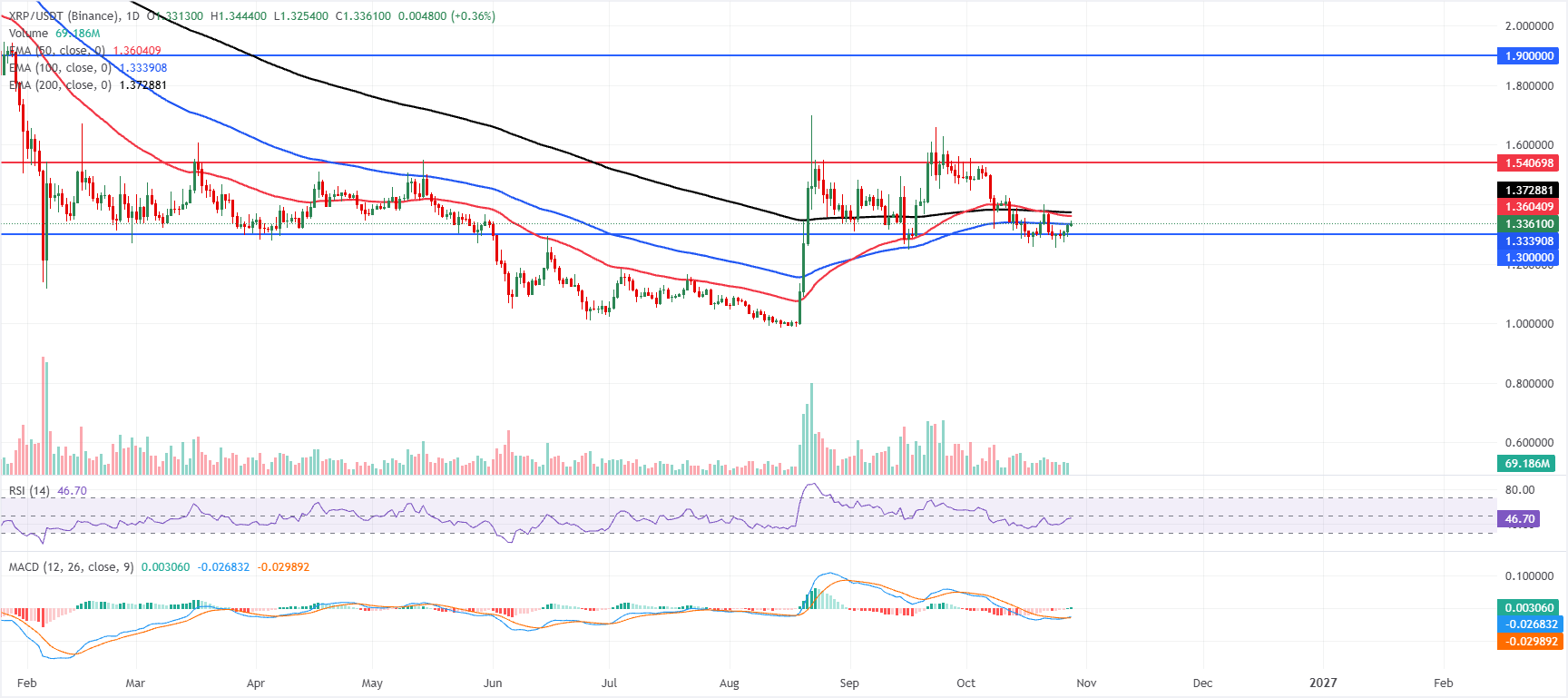
Despite the latest rebound, XRP’s near-term bias remains bearish as Wednesday’s price of $1.336 sits below the 50-day EMA at $1.360 and the 200-day EMA at $1.372. Initial trend support comes from the 100-day EMA at $1.333, just beneath the current price, while an RSI around 46 points to muted momentum. A slightly positive MACD suggests selling pressure is easing, but the overhead EMAs continue to limit the price.
For gains to extend, XRP first faces the 50-day EMA at $1.360, followed by the 200-day EMA at $1.372. A daily close above this cluster of averages would be required to clear a path towards the higher horizontal resistance at $1.540 and subsequently $1.900.
Support on the downside begins at the 100-day EMA at $1.333, followed by the horizontal base at $1.300. Losing $1.300 would strengthen the bearish bias and leave room for deeper declines. Staying above this zone, by contrast, preserves the possibility of further consolidation below the EMA cluster.
(The technical analysis of this story was written with the help of an AI tool. Know more.)
Crypto ETFs: key questions answered
Investors use an Exchange-Traded Fund (ETF) to obtain exposure to a particular asset. An ETF is an investment vehicle or index that follows the price of an underlying asset, and it can track either a single asset or a collection of assets and sectors. A Bitcoin ETF, for instance, follows Bitcoin’s price.
Yes. In October 2021, approval for the first Bitcoin futures ETF in the US came from the US Securities & Exchange Commission. Seven Bitcoin futures ETFs have received approval in total, while more than 20 are still awaiting the regulator’s permission. Citing the cryptocurrency industry’s newness and susceptibility to manipulation, the SEC says it has delayed crypto-related futures ETFs over the last few years.
Yes. Several Bitcoin spot Exchange-Traded Funds received SEC approval for listing and trading in January 2024. The move enabled institutional capital and mainstream investors to trade the leading cryptocurrency, and the industry welcomed the decision as a game changer.
Exposure to a cryptocurrency without owning it is the key benefit of crypto ETFs, lowering the risk and expense of holding the asset. They also require less learning and offer investors greater security, as responsibility for safeguarding the underlying holdings rests with the ETF. The principal drawback is the absence of direct ownership of the asset, captured by the crypto saying “not your keys, not your coins.” Fees charged by ETFs for active management also increase the costs associated with holding crypto. Moreover, while ETF investments reduce the risks of holding an asset, fluctuations in the underlying cryptocurrency’s price are likely to be reflected in the investment vehicle as well.
POPULAR ARTICLES
1Ahead of Fed policy decision, Swiss Franc slips as US Dollar strengthens2United States Dollar Index rises towards 102.50 ahead of Fed rate decision3Firm USD pushes Canadian Dollar to one-week low as traders await BoC and Fed4NEAR Protocol Price Forecast: Launch of India’s biggest IPO, Jio Platforms perps, drives NEAR rebound5India Gold price today: FXStreet data points to a decline6EUR/JPY Price Forecast: Will bearish signals keep the pair under pressure as it falls towards 175.50?7Why is gold edging lower as USD reaches a two-week high ahead of the FOMC decision?8Silver Price Forecast: Why have higher oil prices pushed XAG/USD down to near $54.00?9Top 3 Price Predictions: Can Bitcoin, Ethereum and Ripple (BTC, ETH and XRP) sustain their recovery as Big Tech earnings come into focus?
LIVE QUOTES

ALL ABOUT TECHNICAL
What Is a Trailing Stop, How Does It Work and How Can You Use One?
What Moves USD/INR? Five Forces Every Rupee Watcher Should Know
What Do Reversal Patterns Tell You, and How Can You Trade Them?
How Does a Continuation Pattern Work? Definition, Types and Strategies for Trading
What Is a Breaker Block in Trading, and How Can You Trade It?
Elliott Wave Theory: How Do Traders Apply Its Patterns and Rules?
What Does Smart Money Concept (SMC) Mean, and How Can You Trade It?
What Is an Order Block in Trading and How Can You Trade It?
Average True Range (ATR) Indicator: What Is the Formula, and How Do You Read and Use It?
Get Started!
Sign up and access the Global Markets in less than 3 minutes

Connect With Us









Contacts
Phone: +61 2 8036 8388
Fax: +61 2 8036 8388
Email: support@tmgm.com



The information provided on this website is of a general nature only and does not constitute personal financial advice. Before acting on any information on this website, you should consider the suitability of the information in relation to your objectives, financial situation and needs. Investing in CFDs and FX Margin Contracts carries significant risks and is not suitable for all investors. You may lose more than your initial deposit. You do not own, or have, any interest in the underlying asset. We recommend that you seek independent advice and ensure you fully understand the risks involved before trading. It is important that you read and consider the disclosure document before you acquire any product listed on the website. The information and advertisements offered on this website are not intended for use by any person in any country or jurisdiction where such use would be contrary to local laws and regulations. The Products and Services offered on this website are not intended for residents of the United States, Malaysia and Thailand.
TMGM is authorized and regulated in various jurisdictions.
Trademax Australia Limited, trading as TMGM, is regulated by the Australian Securities and Investments Commission (ASIC), AFSL no. 436416 and is located at Level 28, One International Tower, 100 Barangaroo Avenue, 2000 Sydney, NSW Australia.
Email: support@tmgm.com.au
Trademax Global Limited, trading as TMGM, is authorized and regulated by the Vanuatu Financial Services Commission (VFSC), registration number 40356 and registered at 1276, Kumul Highway, Port Vila, Vanuatu, Republic of Vanuatu.
Email: support@tmgm.com
Trademax Global Markets (SE) Limited, trading as TMGM, is authorized and regulated by the Financial Services Authority (FSA) of Seychelles, with license number SD224. The company is registered at Office No 13, Providence Estate ABIS Centre, Mahe, Seychelles.
Email: support@tmgm.com
Trademax Global Markets (International) Pty Ltd, trading as TMGM, is authorized and regulated by the Financial Services Commission, Mauritius (FSC) with license no. GB22201012, and registered at 33, Edith Cavell Street C/o IQ EQ Fund Services (Mauritius) Ltd Port Louis, 11324 Mauritius.
Email: support@tmgm.com
Copyright © TMGM. All rights reserved