

Trading
Explore a wide range of markets with competitive pricing, deep liquidity, and advanced trading tools.
Learn More 
Platform
Trade seamlessly with TMGM's powerful platform, built for speed, precision, and a superior trading experience.
Learn More Trading Platform
Academy
Learn the fundamentals of trading with beginner-friendly resources, including guides, webinars, and market insights.
Learn More News & Analysis
Get real-time market updates and expert analysis to stay ahead of trading opportunities
Learn More News & Analysis
About
Learn what sets TMGM apart — our global presence, regulatory strength, and commitment to innovation in trading.
Learn More Why Choose TMGM
Sponsorship
Crude Oil turns a loss into a rally as Chinese refiners stop exporting fuel
- WTI turns a loss into a rally from the $88.00 area as China halts fuel exports.
- US distillate inventories 14% below the five-year average, Crude Oil 2% above.
- A US diesel export ban could cut domestic refinery runs by as much as 12%.
The shortage pushing Crude Oil higher on Thursday is in diesel, gasoline and jet fuel, not in the barrels refiners buy to make them. Crude Oil has turned an early loss into a rally to near $91.50 since reports that China's refiners have stopped selling fuel abroad. In Asia, diesel now sells for about $75 a barrel more than the Crude Oil it's made from, roughly what a whole barrel of Crude Oil fetched in early August.

Beijing steadies fuel supplies, starting with China's
Chinese refiners have suspended fuel exports to everywhere except Hong Kong and Macau until Beijing says otherwise, people familiar with the matter said on Thursday. A state-owned refiner cancelled a handful of October gasoline and jet fuel cargoes on Wednesday, most of them deals it had agreed within the previous two weeks.
China started a week-long national holiday on Thursday without approving October exports. The same sources say whether approvals resume after the holiday ends on October 7 could depend on domestic fuel stocks and refinery output. The halt came less than a week after President Trump asked President Xi in Washington to help steady global fuel supplies.
China has the largest refining capacity in the world but usually exports less fuel than India or South Korea. The cancelled cargoes matter less than the reason trade sources give for the halt, which is a drop in China's own fuel stocks. Rebuilding those stocks takes Crude Oil, and Asian diesel margins at their highest in a week pay refiners everywhere to run harder.
The US has more Crude Oil than usual and 14% less diesel
Middle East Crude Oil exports rose in September to their highest since the war began on February 28. Saudi Arabia has also resumed loadings at its Red Sea port of Yanbu, which ships barrels without passing through Hormuz. US Crude Oil stocks rose 922K barrels in the week to September 25 and sit 2% above their five-year average, according to the Energy Information Administration (EIA).
Distillate stocks, which cover diesel and heating fuel, fell 2.3 million barrels over the same week to 14% below their five-year average. Gasoline stocks fell 1.7 million barrels. US refiners are short of fuel to sell rather than barrels to run, so the price of Crude Oil is moving with the price of diesel.
One consultancy estimates a ban on US diesel exports could cut US refinery runs by as much as 12% as storage fills within a month. On September 24, talk of a ban pushed US Crude Oil to its widest discount to the international benchmark since early May. A barrel a US refiner doesn't run has to find another buyer, which makes Washington's answer to the fuel shortage a risk aimed at US Crude Oil in particular.
The US average diesel price passed $6.50 a gallon for the first time in September, and the administration wants it lower before the November 3 midterms. Officials have been weighing voluntary export limits and wider sales of red-dyed diesel instead of a ban, and nothing has been decided. President Trump has publicly backed keeping US diesel at home, and the White House has asked the European Union to release its emergency diesel stocks to bring world prices down.
Iran's delegation leaves New York on a timetable both sides claim
Indirect talks with Iran in New York stalled on Monday. US officials say Secretary of State Rubio then ordered Iran's delegation to leave the country. Iran's mission to the United Nations says the delegation left on a schedule it had given the State Department on September 17. Qatar is still passing messages between the two sides, and Tehran hasn't announced a response to the latest US proposal.
US officials were reported on Monday to have offered sanctions relief and the release of frozen Iranian funds for concrete nuclear steps, and President Trump has since called the report untrue. Without a deal, traffic through the Strait of Hormuz stays far below its pre-war level, and the price of Crude Oil still includes the premium added when the war began on February 28.
Levels and bias
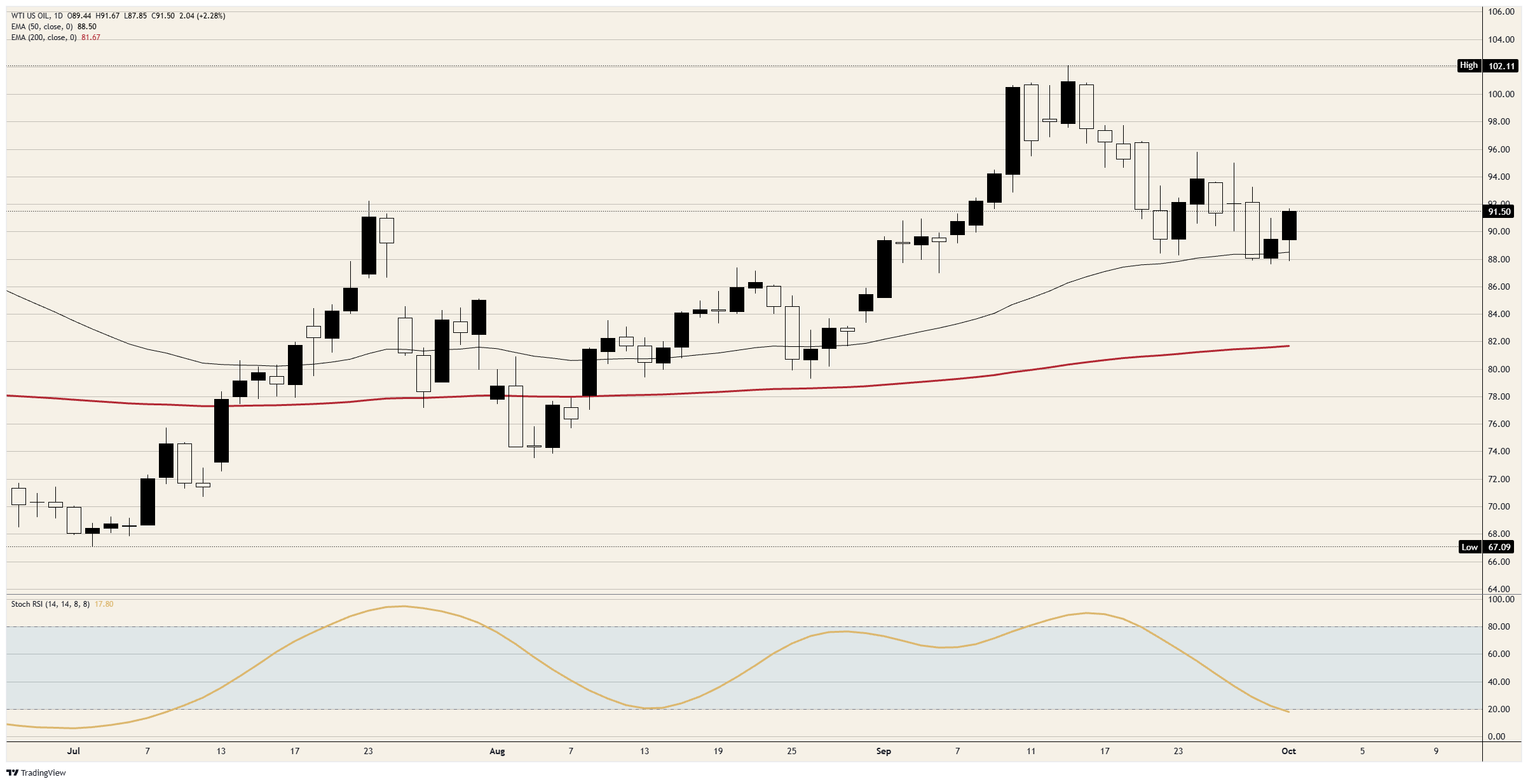
Resistance: Thursday's rally has stopped short of $92.00 so far. Friday and Tuesday both sold off from the $93.00-$93.50 area. Monday's spike to $95.00 fell short of the September 24 high near $96.00, itself well short of the September 15 peak near $102.00.
Support: Buyers stepped in just under $88.00 on Tuesday, Wednesday and Thursday. The 50-day Exponential Moving Average (EMA) near $88.50 sits just above that floor, and Tuesday's daily close beneath it lasted one session. The September 4 low near $87.00 comes next.
Bias: Lean long while buyers keep defending the $88.00 area, with $93.50 the first objective and Monday's $95.00 spike high the second. The daily Stochastic Relative Strength Index (Stoch RSI) is near 18 and still falling, at the bottom of its range without having turned up. The long is wrong on a daily close below $87.50, beneath the Tuesday-to-Thursday lows.
WTI daily chart
WTI Oil FAQs
WTI Oil is a type of Crude Oil sold on international markets. The WTI stands for West Texas Intermediate, one of three major types including Brent and Dubai Crude. WTI is also referred to as “light” and “sweet” because of its relatively low gravity and sulfur content respectively. It is considered a high quality Oil that is easily refined. It is sourced in the United States and distributed via the Cushing hub, which is considered “The Pipeline Crossroads of the World”. It is a benchmark for the Oil market and WTI price is frequently quoted in the media.
Like all assets, supply and demand are the key drivers of WTI Oil price. As such, global growth can be a driver of increased demand and vice versa for weak global growth. Political instability, wars, and sanctions can disrupt supply and impact prices. The decisions of OPEC, a group of major Oil-producing countries, is another key driver of price. The value of the US Dollar influences the price of WTI Crude Oil, since Oil is predominantly traded in US Dollars, thus a weaker US Dollar can make Oil more affordable and vice versa.
The weekly Oil inventory reports published by the American Petroleum Institute (API) and the Energy Information Agency (EIA) impact the price of WTI Oil. Changes in inventories reflect fluctuating supply and demand. If the data shows a drop in inventories it can indicate increased demand, pushing up Oil price. Higher inventories can reflect increased supply, pushing down prices. API’s report is published every Tuesday and EIA’s the day after. Their results are usually similar, falling within 1% of each other 75% of the time. The EIA data is considered more reliable, since it is a government agency.
OPEC (Organization of the Petroleum Exporting Countries) is a group of 12 Oil-producing nations who collectively decide production quotas for member countries at twice-yearly meetings. Their decisions often impact WTI Oil prices. When OPEC decides to lower quotas, it can tighten supply, pushing up Oil prices. When OPEC increases production, it has the opposite effect. OPEC+ refers to an expanded group that includes ten extra non-OPEC members, the most notable of which is Russia.
Top Articles
1Near Protocol slides below $5.00 after Near Intents $4M exploit2Japanese Yen recovers as intervention risk offsets US Dollar strength3Australian Dollar weakens as robust US data, rising US yields overshadow RBA rate hike4Crude Oil turns a loss into a rally as Chinese refiners stop exporting fuel5British Pound buckles as DXY nears 102 on US jobs, factory strength6Euro hits fresh yearly low as strong US data keeps Fed tightening in play7Ethereum Price Forecast: ETH ranges as Citi raises target to $3,0288Canadian Dollar steadies as Fed pause bets clash with resilient US economy9US ISM Manufacturing PMI fell to 54.5 in September
LIVE QUOTES


ALL ABOUT INDICES
The FTSE 100 Index Forecast for 2025: Insights for Investors
How to Invest in the S&P 500 for Beginners: A Step-by-Step Guide to Buying SPY
What is Index Trading? A Clear Guide to How to Trade Indices (SPX, Nasdaq, Dow Jones)
The Best FTSE 100 Dividend Stocks to Watch
How to Trade the Hang Seng Index (HSI)
Trading the CAC 40 Index: A Comprehensive Guide
Get Started!
Sign up and access the Global Markets in less than 3 minutes

Connect With Us









Contacts
Phone: +61 2 8036 8388
Fax: +61 2 8036 8388
Email: support@tmgm.com



The information provided on this website is of a general nature only and does not constitute personal financial advice. Before acting on any information on this website, you should consider the suitability of the information in relation to your objectives, financial situation and needs. Investing in CFDs and FX Margin Contracts carries significant risks and is not suitable for all investors. You may lose more than your initial deposit. You do not own, or have, any interest in the underlying asset. We recommend that you seek independent advice and ensure you fully understand the risks involved before trading. It is important that you read and consider the disclosure document before you acquire any product listed on the website. The information and advertisements offered on this website are not intended for use by any person in any country or jurisdiction where such use would be contrary to local laws and regulations. The Products and Services offered on this website are not intended for residents of the United States, Malaysia and Thailand.
TMGM is authorized and regulated in various jurisdictions.
Trademax Australia Limited, trading as TMGM, is regulated by the Australian Securities and Investments Commission (ASIC), AFSL no. 436416 and is located at Level 28, One International Tower, 100 Barangaroo Avenue, 2000 Sydney, NSW Australia.
Email: support@tmgm.com.au
Trademax Global Limited, trading as TMGM, is authorized and regulated by the Vanuatu Financial Services Commission (VFSC), registration number 40356 and registered at 1276, Kumul Highway, Port Vila, Vanuatu, Republic of Vanuatu.
Email: support@tmgm.com
Trademax Global Markets (SE) Limited, trading as TMGM, is authorized and regulated by the Financial Services Authority (FSA) of Seychelles, with license number SD224. The company is registered at Office No 13, Providence Estate ABIS Centre, Mahe, Seychelles.
Email: support@tmgm.com
Trademax Global Markets (International) Pty Ltd, trading as TMGM, is authorized and regulated by the Financial Services Commission, Mauritius (FSC) with license no. GB22201012, and registered at 33, Edith Cavell Street C/o IQ EQ Fund Services (Mauritius) Ltd Port Louis, 11324 Mauritius.
Email: support@tmgm.com
Copyright © TMGM. All rights reserved