

Trading
Explore a wide range of markets with competitive pricing, deep liquidity, and advanced trading tools.
Learn More 
Platform
Trade seamlessly with TMGM's powerful platform, built for speed, precision, and a superior trading experience.
Learn More Trading Platform
Academy
Learn the fundamentals of trading with beginner-friendly resources, including guides, webinars, and market insights.
Learn More News & Analysis
Get real-time market updates and expert analysis to stay ahead of trading opportunities
Learn More News & Analysis
About
Learn what sets TMGM apart — our global presence, regulatory strength, and commitment to innovation in trading.
Learn More Why Choose TMGM
Sponsorship
Ripple Price Forecast: XRP bulls gather recovery momentum amid returning ETF inflows
- XRP rebounds above $1.40 from weekly lows of $1.32, as bullish investors actively defend key support at the 100-day and 200-day EMAs.
- XRP spot ETFs recorded $8 million in ETF inflows on Thursday, signaling fresh institutional support.
- XRP risks deeper losses amid a weakening technical structure, with the RSI in bearish territory and a MACD sell signal.
Ripple (XRP) trades largely in bearish hands on Friday near $1.40. Although the remittance token has stabilized after a sharp sell-off from weekly highs of $1.53 to lows around $1.32, the path of least resistance remains downward, unless buyers affirm a daily close above the pivotal $1.40 level.

The prevailing technical outlook appears bearish in the short term but neutral to bullish in the medium term. Support remains relatively firm but sustained gains would require support across the board, from retail traders to institutional investors.
XRP attracts fresh capital inflows
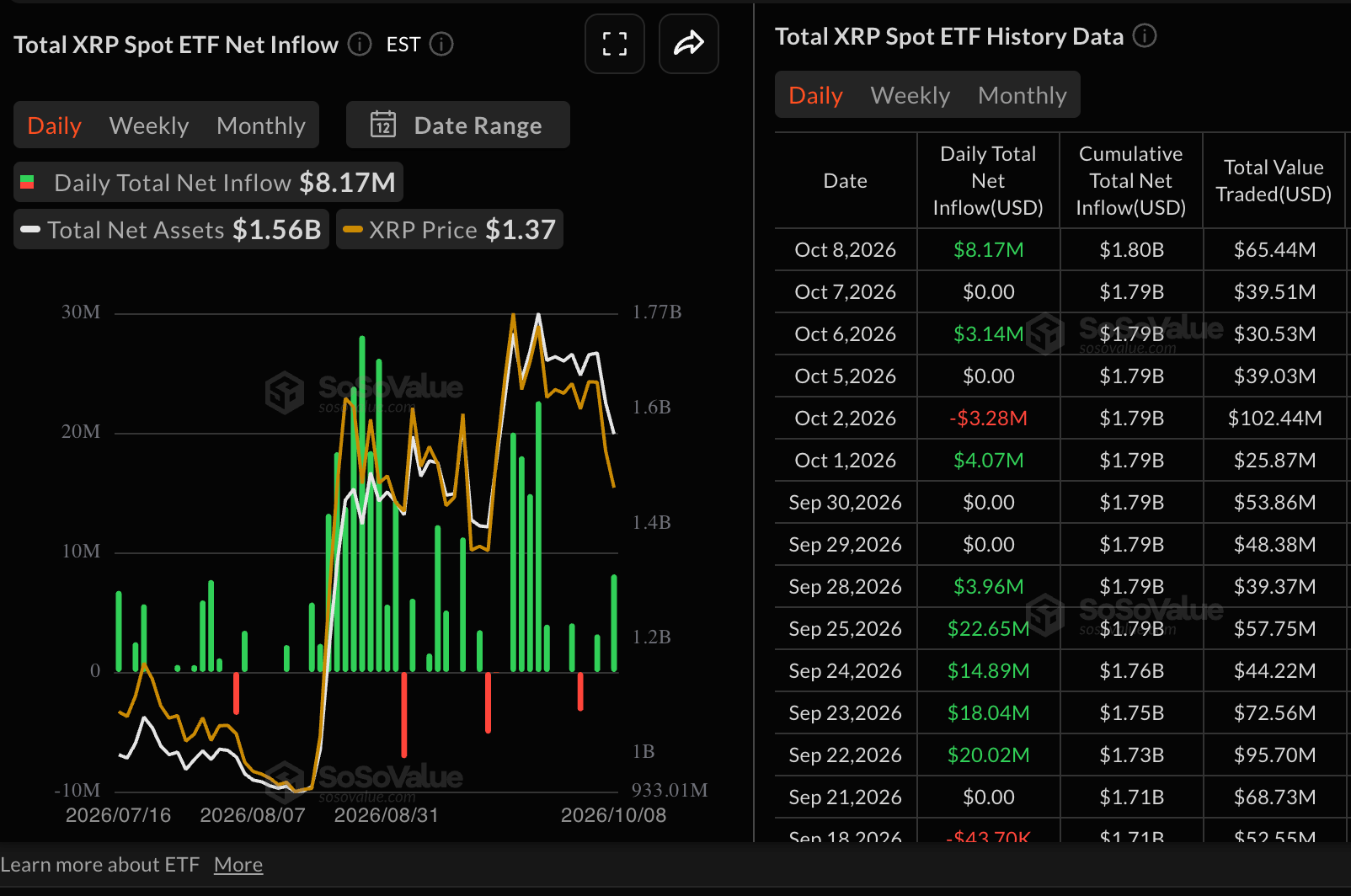
US-listed XRP spot Exchange-Traded Funds (ETFs) recorded $8 million in inflows on Thursday, drying headwinds in the broader crypto market. The token has $1.8 billion in cumulative inflows and $1.6 billion in net assets under management, according to SoSoValue. This underpins returning institutional support amid more volatile flows, helping cushion against prevailing losses.
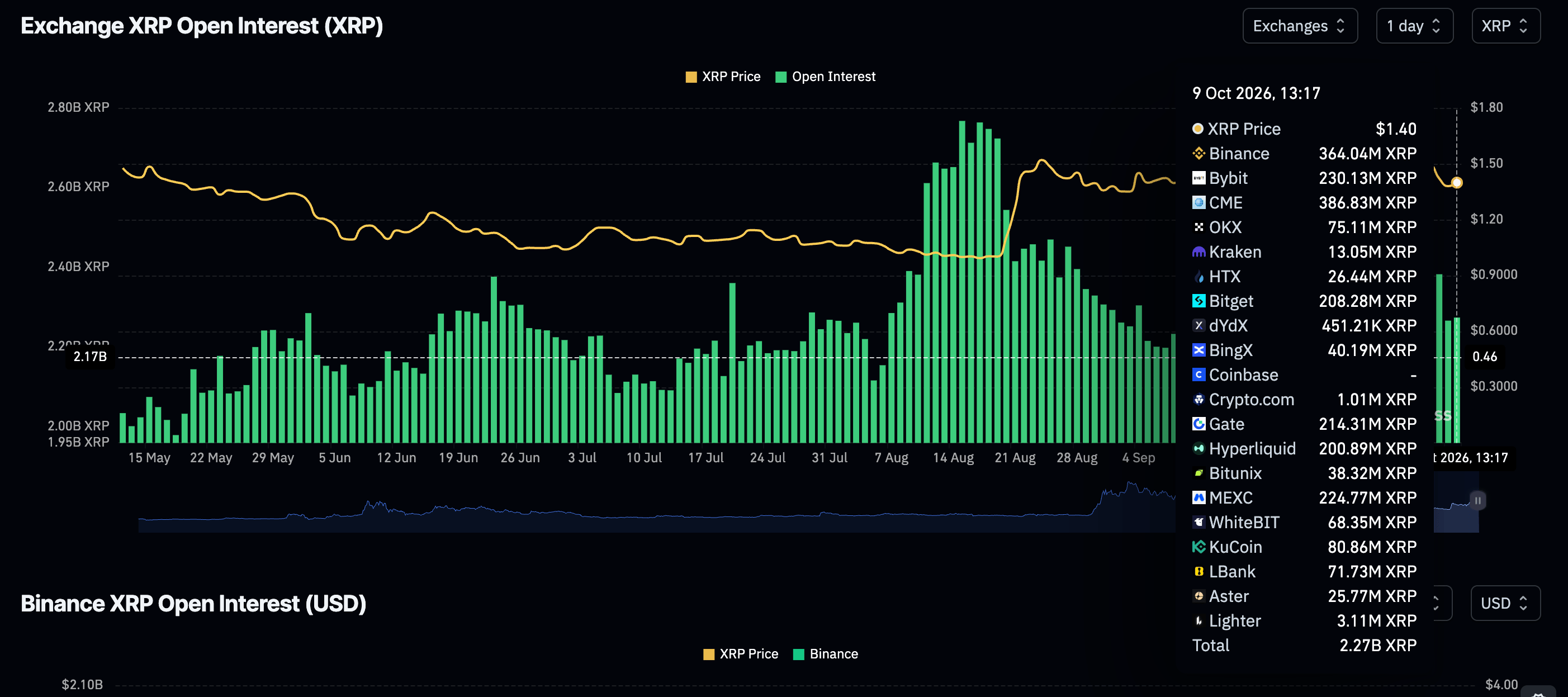
The derivatives market is facing cooling retail demand, as perpetual futures Open Interest (OI) drops to 2.3 billion XRP on Friday, from 2.4 billion the previous day. In comparison, OI pales next to the September peak of 2.5 billion XRP and the August high of 2.8 billion XRP. Diminishing retail demand implies a weaker tailwind to support a steady uptrend.
Technical analysis: XRP reclaims $1.40 demand area
XRP bulls are trying to take back control of the trend after this week's persistent pullback from highs around $1.53 to lows near $1.32. This recovery could be an uphill task, as investor focus shifts to next week's release of the United States (US) Consumer Price Index (CPI) report and the Federal Reserve (Fed) October monetary policy decision.
The pair holds above a dense cluster of Exponential Moving Averages (EMAs), while the SuperTrend at $1.30 reinforces the constructive backdrop. Despite this supportive structure, momentum is soft as the Relative Strength Index (RSI) near 44 drifts below midline and the Moving Average Convergence Divergence (MACD) remains negative with a weakly bearish tone, suggesting upside progress could be gradual rather than impulsive.
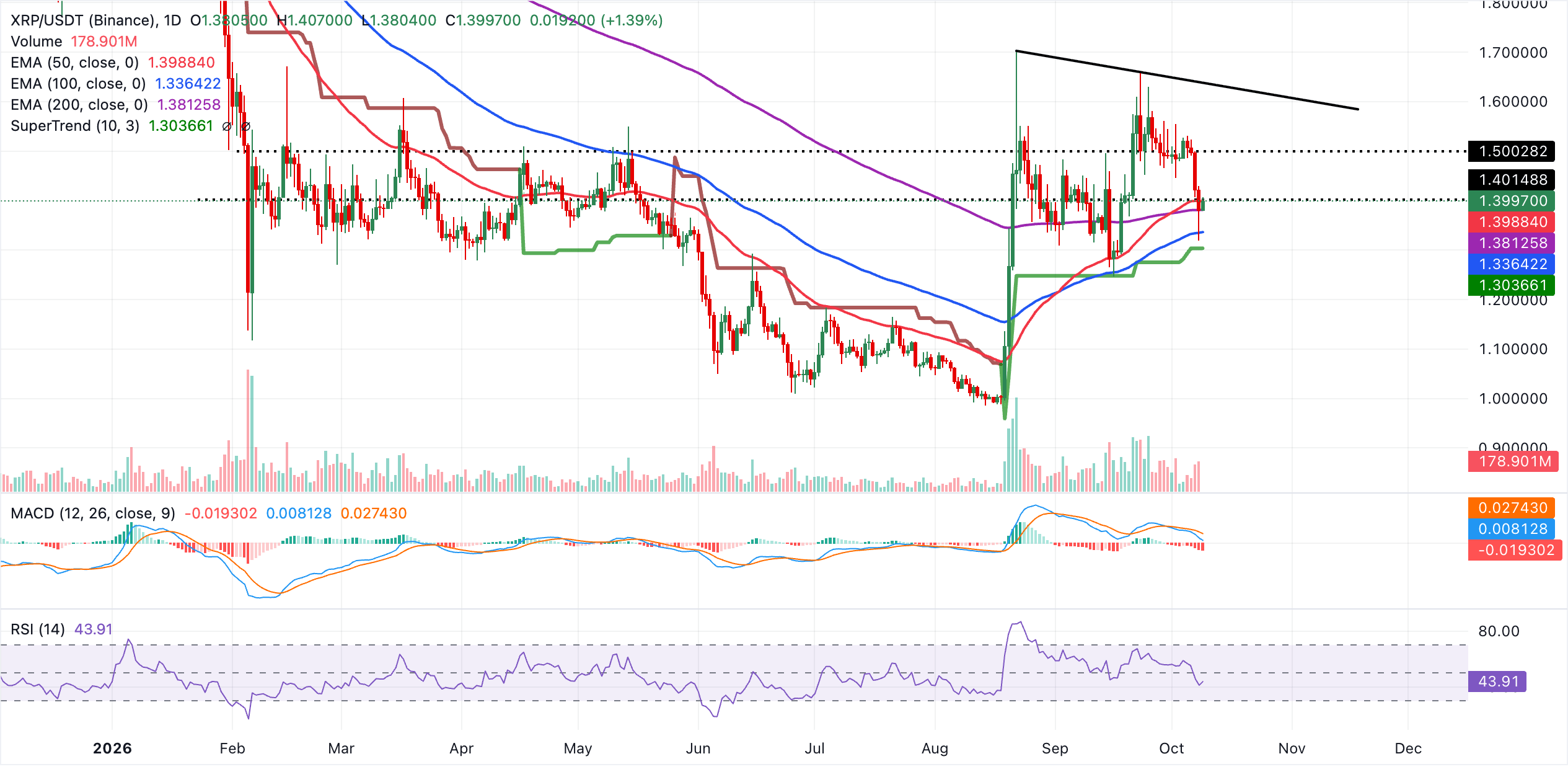
Immediate support is seen at the 50-day EMA near $1.40, followed by the 200-day EMA at $1.38 and then the 100-day EMA at $1.34, with the SuperTrend baseline around $1.30 marking a deeper bullish line in the sand. On the topside, the broader downtrend structure leaves the prior break zone near $1.64 as the first notable resistance, ahead of the higher trendline reference around $1.70, where sellers could reassert control if the rally extends.
XRP's outlook on the weekly timeframe remains neutral to bullish, with spot holding just above the 200-week EMA at $1.37 while capped by the 50-week EMA at $1.52 and the 100-week EMA at $1.58.
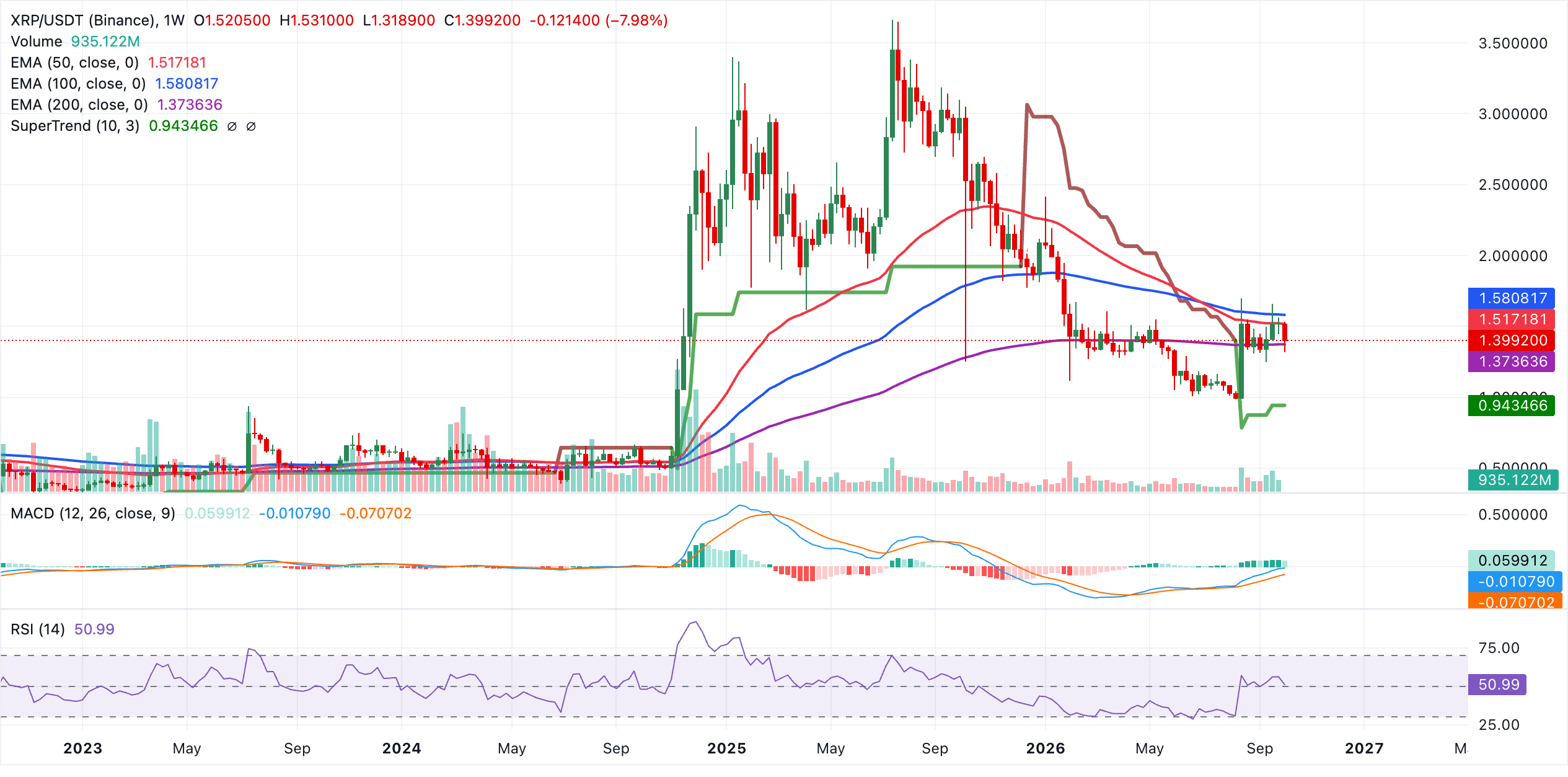
The SuperTrend line at $0.94 sits well below price and reinforces a medium-term floor, while the MACD indicator stays positive, hinting at mildly constructive momentum. The RSI around 51 underscores a balanced market, suggesting that bulls lack the conviction to reclaim the overhead trend EMAs for now.
(The technical analysis of this story was written with the help of an AI tool. Know more.)
Crypto ETF FAQs
An Exchange-Traded Fund (ETF) is an investment vehicle or an index that tracks the price of an underlying asset. ETFs can not only track a single asset, but a group of assets and sectors. For example, a Bitcoin ETF tracks Bitcoin’s price. ETF is a tool used by investors to gain exposure to a certain asset.
Yes. The first Bitcoin futures ETF in the US was approved by the US Securities & Exchange Commission in October 2021. A total of seven Bitcoin futures ETFs have been approved, with more than 20 still waiting for the regulator’s permission. The SEC says that the cryptocurrency industry is new and subject to manipulation, which is why it has been delaying crypto-related futures ETFs for the last few years.
Yes. The SEC approved in January 2024 the listing and trading of several Bitcoin spot Exchange-Traded Funds, opening the door to institutional capital and mainstream investors to trade the main crypto currency. The decision was hailed by the industry as a game changer.
The main advantage of crypto ETFs is the possibility of gaining exposure to a cryptocurrency without ownership, reducing the risk and cost of holding the asset. Other pros are a lower learning curve and higher security for investors since ETFs take charge of securing the underlying asset holdings. As for the main drawbacks, the main one is that as an investor you can’t have direct ownership of the asset, or, as they say in crypto, “not your keys, not your coins.” Other disadvantages are higher costs associated with holding crypto since ETFs charge fees for active management. Finally, even though investing in ETFs reduces the risk of holding an asset, price swings in the underlying cryptocurrency are likely to be reflected in the investment vehicle too.
Top Articles
1Norwegian Krone: Rate hike risks support currency – BBH2British Pound gains ground as Japanese Yen underperforms3Japanese Yen: Choppy trade inside defined range – UOB4Bitcoin Weekly Forecast: Uptober or Rektober?5Oil: Iran tensions keep crude prices elevated - Rabobank6Ripple Price Forecast: XRP bulls gather recovery momentum amid returning ETF inflows7EUR/USD Price Forecast: Rallies fail above 1.1200 amid high Oil prices, debt woes8Japanese Yen underperforms against its peers into the weekend9Canadian Dollar: Labor data may trigger dovish repricing – BBH
LIVE QUOTES


Get Started!
Sign up and access the Global Markets in less than 3 minutes

Connect With Us









Contacts
Phone: +61 2 8036 8388
Fax: +61 2 8036 8388
Email: support@tmgm.com



The information provided on this website is of a general nature only and does not constitute personal financial advice. Before acting on any information on this website, you should consider the suitability of the information in relation to your objectives, financial situation and needs. Investing in CFDs and FX Margin Contracts carries significant risks and is not suitable for all investors. You may lose more than your initial deposit. You do not own, or have, any interest in the underlying asset. We recommend that you seek independent advice and ensure you fully understand the risks involved before trading. It is important that you read and consider the disclosure document before you acquire any product listed on the website. The information and advertisements offered on this website are not intended for use by any person in any country or jurisdiction where such use would be contrary to local laws and regulations. The Products and Services offered on this website are not intended for residents of the United States, Malaysia and Thailand.
TMGM is authorized and regulated in various jurisdictions.
Trademax Australia Limited, trading as TMGM, is regulated by the Australian Securities and Investments Commission (ASIC), AFSL no. 436416 and is located at Level 28, One International Tower, 100 Barangaroo Avenue, 2000 Sydney, NSW Australia.
Email: support@tmgm.com.au
Trademax Global Limited, trading as TMGM, is authorized and regulated by the Vanuatu Financial Services Commission (VFSC), registration number 40356 and registered at 1276, Kumul Highway, Port Vila, Vanuatu, Republic of Vanuatu.
Email: support@tmgm.com
Trademax Global Markets (SE) Limited, trading as TMGM, is authorized and regulated by the Financial Services Authority (FSA) of Seychelles, with license number SD224. The company is registered at Office No 13, Providence Estate ABIS Centre, Mahe, Seychelles.
Email: support@tmgm.com
Trademax Global Markets (International) Pty Ltd, trading as TMGM, is authorized and regulated by the Financial Services Commission, Mauritius (FSC) with license no. GB22201012, and registered at 33, Edith Cavell Street C/o IQ EQ Fund Services (Mauritius) Ltd Port Louis, 11324 Mauritius.
Email: support@tmgm.com
Copyright © TMGM. All rights reserved