

Gold slides toward $4,880 as Fed hawkish hold crushes rate cut bets
- XAU/USD drops 2.40% to $4,880 as Fed projects only one rate cut in 2026.
- SEP lifts inflation outlook, with Core PCE revised up to 2.7%.
- Fed holds rates at 3.50%-3.75% citing resilient growth and sticky inflation.
Gold remains pressured on Wednesday after the Federal Reserve delivered a hawkish hold, with most Fed officials expecting just one rate cut in 2026, contrary to market expectations at the beginning of the year, which priced nearly 60 basis points of easing in mid-February. XAU/USD trades at around $4,880, down 2.40%.

Bullion pressured after Fed signals just one cut, defying earlier dovish expectations
The Federal Reserve's monetary policy statement indicated that economic growth remains strong. It noted that the labour market is stable, with neither significant hiring nor firing, while inflation remains "somewhat elevated." The Fed emphasised ongoing uncertainty about the economic outlook, noting that events in the Middle East could have uncertain effects on the US economy.
As a result, officials chose to maintain interest rates within the 3.50%-3.75% range, with the decision supported by an 11-to-1 vote. Fed Governor Stephen Miran was the sole dissenter, supporting a 25-basis-point rate reduction.
Federal Reserve officials project US economic growth of 2.4% in 2026 and 2.3% the year after, with unemployment steady at 4.4% and PCE inflation rising to 2.7% from December's 2.4%.
Core PCE for the full year is projected at 2.7%, up from 2.5% in the previous SEP report. Regarding monetary policy, Fed officials expect just a quarter of a percentage point rate cut in 2026 and an additional 25 basis points in 2027.
Gold price reaction
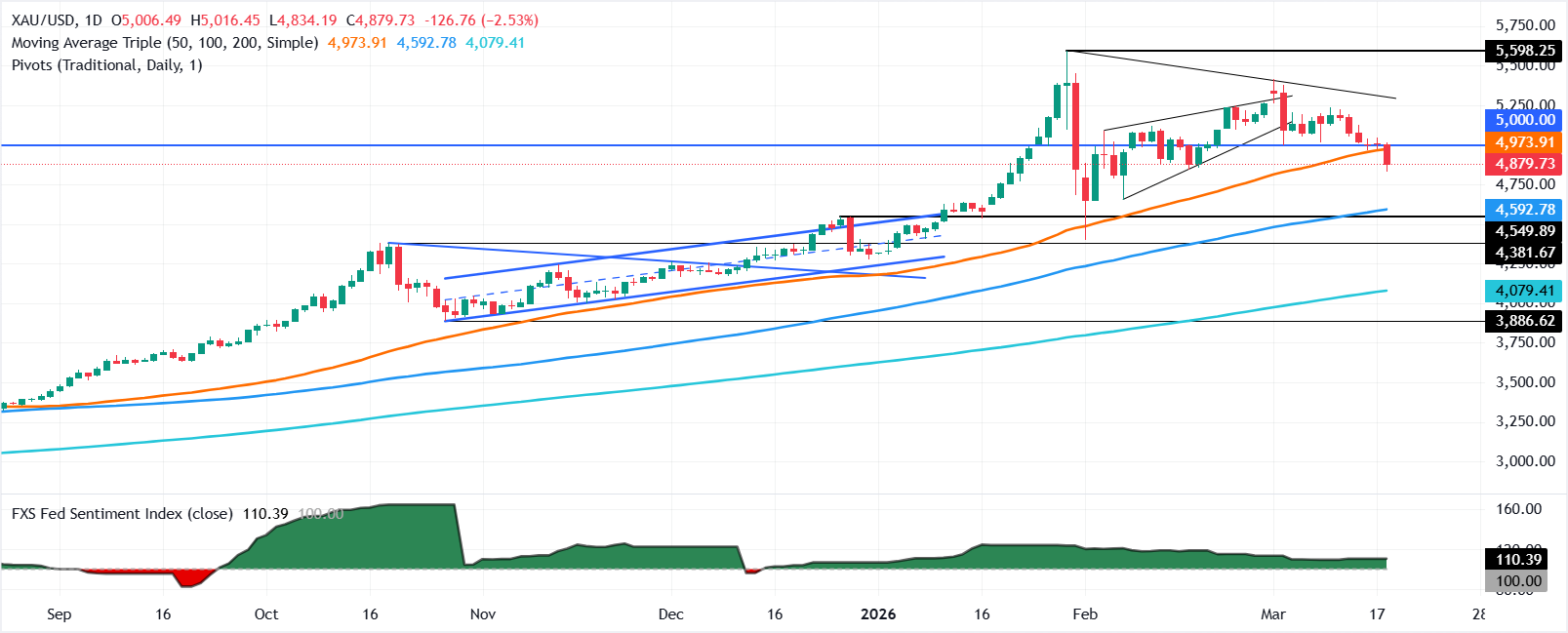
Gold price barely moved, yet it remained near the day's lows, reached earlier at $4,834. For a bullish recovery, buyers must clear $4,900 before testing the 50-day SMA at $4,961. A breach of the latter will expose $5,000.
On the downside, a drop below the day's low will open the door to $4,800, followed by the February 6 daily low of $4,655.
Fed FAQs
Monetary policy in the US is shaped by the Federal Reserve (Fed). The Fed has two mandates: to achieve price stability and foster full employment. Its primary tool to achieve these goals is by adjusting interest rates. When prices are rising too quickly and inflation is above the Fed’s 2% target, it raises interest rates, increasing borrowing costs throughout the economy. This results in a stronger US Dollar (USD) as it makes the US a more attractive place for international investors to park their money. When inflation falls below 2% or the Unemployment Rate is too high, the Fed may lower interest rates to encourage borrowing, which weighs on the Greenback.
The Federal Reserve (Fed) holds eight policy meetings a year, where the Federal Open Market Committee (FOMC) assesses economic conditions and makes monetary policy decisions. The FOMC is attended by twelve Fed officials – the seven members of the Board of Governors, the president of the Federal Reserve Bank of New York, and four of the remaining eleven regional Reserve Bank presidents, who serve one-year terms on a rotating basis.
In extreme situations, the Federal Reserve may resort to a policy named Quantitative Easing (QE). QE is the process by which the Fed substantially increases the flow of credit in a stuck financial system. It is a non-standard policy measure used during crises or when inflation is extremely low. It was the Fed’s weapon of choice during the Great Financial Crisis in 2008. It involves the Fed printing more Dollars and using them to buy high grade bonds from financial institutions. QE usually weakens the US Dollar.
Quantitative tightening (QT) is the reverse process of QE, whereby the Federal Reserve stops buying bonds from financial institutions and does not reinvest the principal from the bonds it holds maturing, to purchase new bonds. It is usually positive for the value of the US Dollar.













