

Trading
Explore a wide range of markets with competitive pricing, deep liquidity, and advanced trading tools.
Learn More 
Platform
Trade seamlessly with TMGM's powerful platform, built for speed, precision, and a superior trading experience.
Learn More Trading Platform
Academy
Learn the fundamentals of trading with beginner-friendly resources, including guides, webinars, and market insights.
Learn More News & Analysis
Get real-time market updates and expert analysis to stay ahead of trading opportunities
Learn More News & Analysis
About
Learn what sets TMGM apart — our global presence, regulatory strength, and commitment to innovation in trading.
Learn More Why Choose TMGM
Sponsorship
Bank of Japan set to keep interest rates unchanged at 1.25%
- Markets expect no change in the BoJ’s interest rate on Friday, with the rate set to stay at 1.25%.
- For investors, the focus will be on how the BoJ’s interest rate trajectory develops.
- Over the past six weeks, USD/JPY has remained in a consolidation range of 156-159.
With markets looking ahead to the policy outlook, the Bank of Japan (BoJ) is due to deliver its monetary policy decision at around 02:30 GMT on Friday.
Financial markets are confident of an unchanged-rate decision from the BoJ, as they are for the Federal Reserve (Fed). At its September policy meeting, the BoJ increased rates by 25 basis points (bps) to 1.25%, taking Japan’s interest rate to its highest level in 31 years. The central bank has implemented two quarter-percentage-point rate increases so far this year.

In a note, Commerzbank said markets foresee “the overnight rate remaining steady, and none of the economists surveyed by Bloomberg expects a hike on Friday”. With that consensus in place, investors will look more closely at the monetary policy statement, the central bank’s outlook report and Governor Kazuo Ueda’s press conference for guidance on policy through the year-end.
Does Ueda’s hawkish tilt reflect AI demand and inflation nearing BoJ goals?
Energy-related inflation risks have featured in BoJ Governor Ueda’s comments since the September policy meeting. Alongside repeatedly affirming that monetary tightening will continue, he has underlined the need to keep core inflation anchored near the 2% target.
FXStreet’s Speechtracker assigned Ueda’s October 16 speech a score of 8.2/10, above his average of 7.5 and pointing to a modest hawkish tilt. Describing underlying inflation as “quite close” to 2%, Ueda said developments in the economy and prices were broadly consistent with forecasts. His pledge to “continue to raise interest rates” while financial conditions stay accommodative, together with plans to consider adjusting the assessment of inflation nearing 2%, strengthened the bias towards gradual normalisation and a firmer Yen.
On AI-led inflation pressure, Ueda said there was “no big gap” between the Bank of Japan’s assessment and that of global policymakers, while acknowledging that some counterparts were more optimistic about AI demand. These remarks highlight upside price risks that warrant retaining the option of further tightening. The speech explicitly linked the timing and pace of subsequent rate increases to FX, AI demand and developments in the Middle East. That outlined a policy response sensitive to both data and risks, offering incremental support to the Japanese Yen, particularly if AI-related demand and external shocks keep inflation around the 2% target.
Taken together, the remarks suggest that the BoJ’s Ueda will retain a hawkish policy outlook and emphasise the need to anchor price pressures near the central bank’s 2% target.
Will the BoJ raise rates at December’s policy meeting?
Expectations centre on a further rate increase before the year-end. Reuters reported that its October 13-19 poll found nearly 70% of economists, or 54 of 78, expected the BoJ to lift its policy rate to 1.5% this quarter. That proportion was almost twice the share recorded in the preceding poll.
What could the BoJ decision mean for USD/JPY?
With market participants firmly expecting policy rates to stay unchanged, the BoJ’s rate announcement itself looks unlikely to move USD/JPY materially. Instead, the key drivers would be the tone of the central bank’s monetary policy outlook and any indications of its assessment of the terminal rate.
The Japanese Yen (JPY) would benefit from any BoJ signal that the terminal rate could be reached sooner. By contrast, indications that the central bank intends to tighten policy gradually may do little to move the currency. The balance of risks for USD/JPY is therefore moderately skewed to the downside.
USD/JPY Technical Outlook: Can the Range Hold as Volatility Narrows?
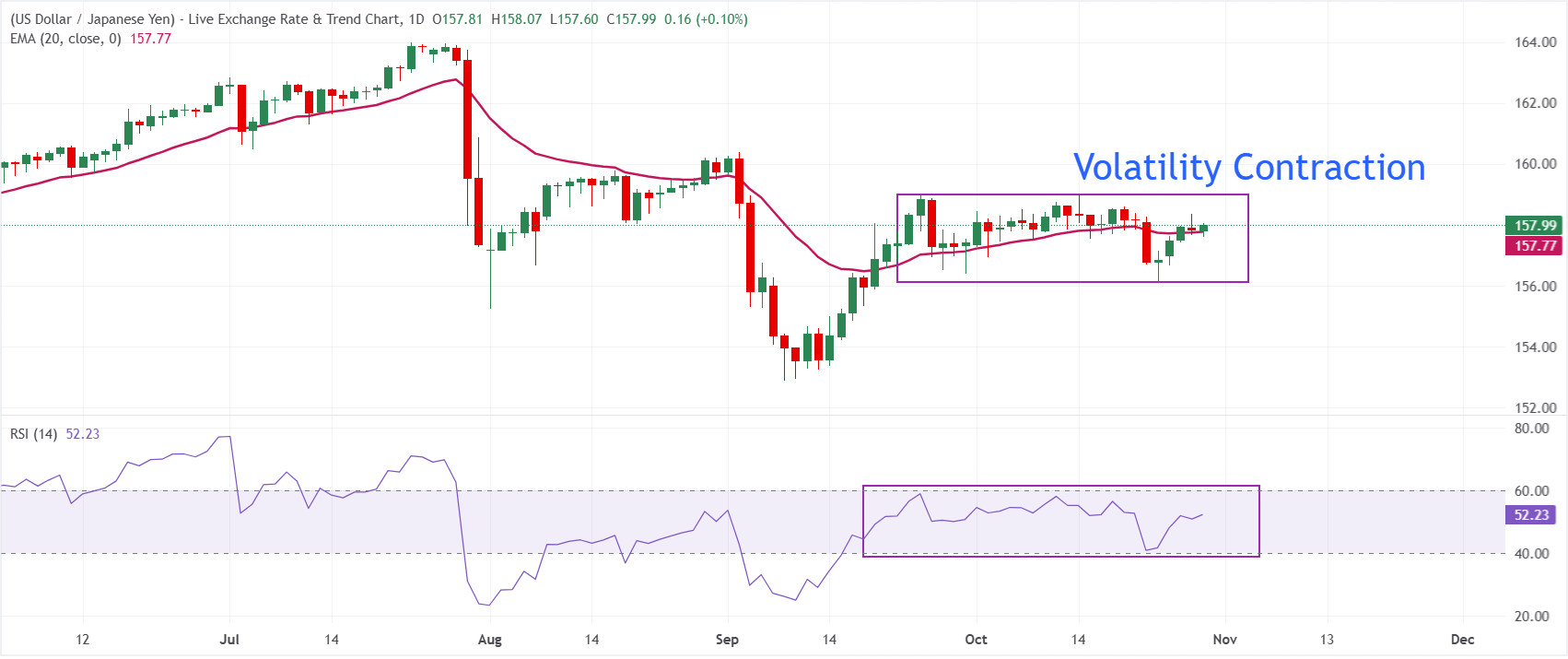
Trend: A sideways pattern remains evident in USD/JPY, which is trading around 157.80 at the time of writing. For over a month, the pair has been confined to a narrow 156.08-159.04 band. Its flat 20-day exponential moving average (EMA), at 157.77, also points to a range-bound overall trend.
Momentum: A month spent within the 40.00-60.00 band by the Relative Strength Index (RSI) signals a pronounced contraction in volatility, lending further weight to the ongoing consolidation.
Support: The range floor at 156.08 provides the nearest downside support. A failure to defend 156.08 would leave the September 14 high of 155.00 exposed.
Resistance: At the top of the consolidation range, 159.04 marks the first upside barrier. Clearing it decisively would raise the prospect of an advance towards 160.00, with the September high near 160.40 the next level to watch.
(The technical analysis of this story was written with the help of an AI tool. Know more.)
Bank of Japan: Frequently Asked Questions
As Japan’s central bank, the Bank of Japan (BoJ) determines the country’s monetary policy. Issuing banknotes and exercising currency and monetary control form part of its mandate to maintain price stability, defined by an inflation target of around 2%.
Against a backdrop of subdued inflation, the Bank of Japan adopted an ultra-loose monetary stance in 2013 to support economic activity and lift prices. Quantitative and Qualitative Easing (QQE) underpins this approach: the bank prints money to purchase assets, including government and corporate bonds, thereby supplying liquidity. It expanded the strategy in 2016, easing policy further by introducing negative interest rates before moving to direct control of the yield on its 10-year government bonds. A rate increase in March 2024 marked the BoJ’s effective retreat from its ultra-loose stance.
The Yen weakened against its major currency peers as a result of the Bank’s sizeable stimulus programme. The depreciation intensified in 2022 and 2023 as the policy gap widened between the Bank of Japan and other leading central banks, which raised rates sharply to combat inflation at multi-decade highs. By widening interest rate differentials with other currencies, the BoJ’s stance put downward pressure on the Yen. Some of that trend reversed in 2024 following the BoJ’s decision to move away from ultra-loose policy.
Inflation in Japan climbed above the BoJ’s 2% target as the Yen weakened and global energy prices surged. Expectations of higher domestic salaries, a key driver of inflation, also helped prompt the policy shift.
POPULAR ARTICLES
1Thai Baht: Does the double-top point to a potential reversal against the US Dollar? – OCBC2Bank of Japan set to keep interest rates unchanged at 1.25%3South Korean Won: Stronger equities offer no lift to KRW against US Dollar – OCBC4Breaking: Has Binance been hacked for $2.77 billion?5Why Is the Mexican Peso Falling as US Growth and Hot Inflation Revive Fed Rate Hike Bets?6Thai Baht: What Are the Curve-Steepening Risks as BoT Holds Rates? – DBS7Philippine Peso: Depreciation eases as officials jawbone – OCBC8Why is HYPE rallying 17% as ICE and Druckenmiller invest in tradeXYZ for US expansion?9ECB recap: Rates held steady as energy costs rise and financial conditions tighten


Get Started!
Sign up and access the Global Markets in less than 3 minutes

Connect With Us









Contacts
Phone: +61 2 8036 8388
Fax: +61 2 8036 8388
Email: support@tmgm.com



The information provided on this website is of a general nature only and does not constitute personal financial advice. Before acting on any information on this website, you should consider the suitability of the information in relation to your objectives, financial situation and needs. Investing in CFDs and FX Margin Contracts carries significant risks and is not suitable for all investors. You may lose more than your initial deposit. You do not own, or have, any interest in the underlying asset. We recommend that you seek independent advice and ensure you fully understand the risks involved before trading. It is important that you read and consider the disclosure document before you acquire any product listed on the website. The information and advertisements offered on this website are not intended for use by any person in any country or jurisdiction where such use would be contrary to local laws and regulations. The Products and Services offered on this website are not intended for residents of the United States, Malaysia and Thailand.
TMGM is authorized and regulated in various jurisdictions.
Trademax Australia Limited, trading as TMGM, is regulated by the Australian Securities and Investments Commission (ASIC), AFSL no. 436416 and is located at Level 28, One International Tower, 100 Barangaroo Avenue, 2000 Sydney, NSW Australia.
Email: support@tmgm.com.au
Trademax Global Limited, trading as TMGM, is authorized and regulated by the Vanuatu Financial Services Commission (VFSC), registration number 40356 and registered at 1276, Kumul Highway, Port Vila, Vanuatu, Republic of Vanuatu.
Email: support@tmgm.com
Trademax Global Markets (SE) Limited, trading as TMGM, is authorized and regulated by the Financial Services Authority (FSA) of Seychelles, with license number SD224. The company is registered at Office No 13, Providence Estate ABIS Centre, Mahe, Seychelles.
Email: support@tmgm.com
Trademax Global Markets (International) Pty Ltd, trading as TMGM, is authorized and regulated by the Financial Services Commission, Mauritius (FSC) with license no. GB22201012, and registered at 33, Edith Cavell Street C/o IQ EQ Fund Services (Mauritius) Ltd Port Louis, 11324 Mauritius.
Email: support@tmgm.com
Copyright © TMGM. All rights reserved