

Trading
Explore a wide range of markets with competitive pricing, deep liquidity, and advanced trading tools.
Learn More 
Platform
Trade seamlessly with TMGM's powerful platform, built for speed, precision, and a superior trading experience.
Learn More Trading Platform
Academy
Learn the fundamentals of trading with beginner-friendly resources, including guides, webinars, and market insights.
Learn More News & Analysis
Get real-time market updates and expert analysis to stay ahead of trading opportunities
Learn More News & Analysis
About
Learn what sets TMGM apart — our global presence, regulatory strength, and commitment to innovation in trading.
Learn More Why Choose TMGM
Sponsorship
BoJ policy moves into focus as Japanese Yen trades flat against US Dollar
- Range-bound trading keeps the Japanese Yen near 157.80 against the US Dollar as the BoJ’s policy decision approaches.
- Expectations point to the BoJ leaving interest rates unchanged at 1.25%.
- Key US economic releases and Tokyo CPI figures are also on investors’ radar.
Consolidation in USD/JPY leaves the Japanese Yen (JPY) largely unchanged against the US Dollar (USD), near 157.80 in Thursday’s European session. Investors are turning their attention to Friday’s monetary policy announcement from the Bank of Japan (BoJ).
Could December policy signals matter more for the Yen than this BoJ meeting?

With little change expected at this week’s meeting, investors are looking towards the policy path through year-end. Commerzbank analysts say markets expect “the overnight rate remaining at 1.25%, and none of the economists surveyed by Bloomberg expects a hike this week,” reinforcing that focus.
December’s policy signals will carry greater weight for currency markets, according to Commerzbank, which argues that “the more important question will therefore be what the BoJ signals about December.” The analysts point out that “markets currently price an around 80% probability of a rate hike by then, in line with our own expectation that the BoJ will raise the policy rate to 1.5%.” Their assessment is that “recent BoJ communication, alongside the economic backdrop, increasingly suggests that the next step towards policy normalization is approaching.”
An unusual source reinforces this assessment: the BoJ’s semi-annual report on financial-system risks. Commerzbank identifies it as providing “additional support for this view”, despite being “hardly the most obvious source of monetary policy signals.” The bank nevertheless emphasises that “the report suggests that higher rates should remain manageable for Japan's financial system.” More specifically, it notes that “in its stress test, the BoJ finds that even a rise in the policy rate to 2% should not pose major problems for Japanese banks and companies.” The analysts also observe that “the increase to 1.25% has already been absorbed without significant disruption, as has the rise in longer-term government bond yields.”
That stress-test assumption should not be read as policy guidance, Commerzbank cautions, noting that “the BoJ stresses that the 2% assumption is not a forecast but merely part of the stress test scenario.” Even with that qualification, its analysts believe that “the message for FX markets is noteworthy: financial stability does not appear to be a binding constraint on further policy normalization.” Their conclusion is therefore that “our structurally constructive view on the Japanese currency remains intact.” This is despite their assessment that “Friday itself may therefore provide only limited fresh momentum for the yen,” given the limited impetus expected from the meeting itself.
Before Friday’s BoJ decision, investors will receive Tokyo’s Consumer Price Index (CPI) figures for October. The Tokyo CPI excluding fresh food is expected to ease to 2.6% year-on-year (YoY), compared with September’s 2.7%.
A modestly firmer US Dollar also reflects the market’s wait for the United States (US) flash Q3 Gross Domestic Product (GDP) figures and September’s Personal Consumption Expenditure (PCE) Price Index. Both releases are due at 12:30 GMT.
At the time of writing, a 0.1% gain has taken the US Dollar Index (DXY) to around 102.20. The index measures the Greenback against a basket of six major currencies.
Resilient underlying activity is expected to underpin the incoming figures, according to TD Securities, which says the data should confirm that "Q3 GDP [will] show robust underlying growth," adding that "GDP growth [having] picked up in Q3 to 2.5% from 2.2% previously with underlying activity remaining robust." Its assessment is that "consumption likely remained resilient while decelerating slightly," alongside the observation that "fixed investment [was] also strong in large part due to AI." Against those supports, TD Securities believes that "net exports likely acted as a major drag on GDP growth while being partially offset by a rebound in inventories," suggesting solid headline growth with an uneven underlying composition.
Wednesday saw a correction in the US Dollar following the Federal Reserve’s (Fed) monetary policy announcement. As anticipated, the Fed left interest rates unchanged within the 3.75%-4.00% range.
USD/JPY Technical Analysis: Can Moving-Average Support Sustain the Upside Bias?
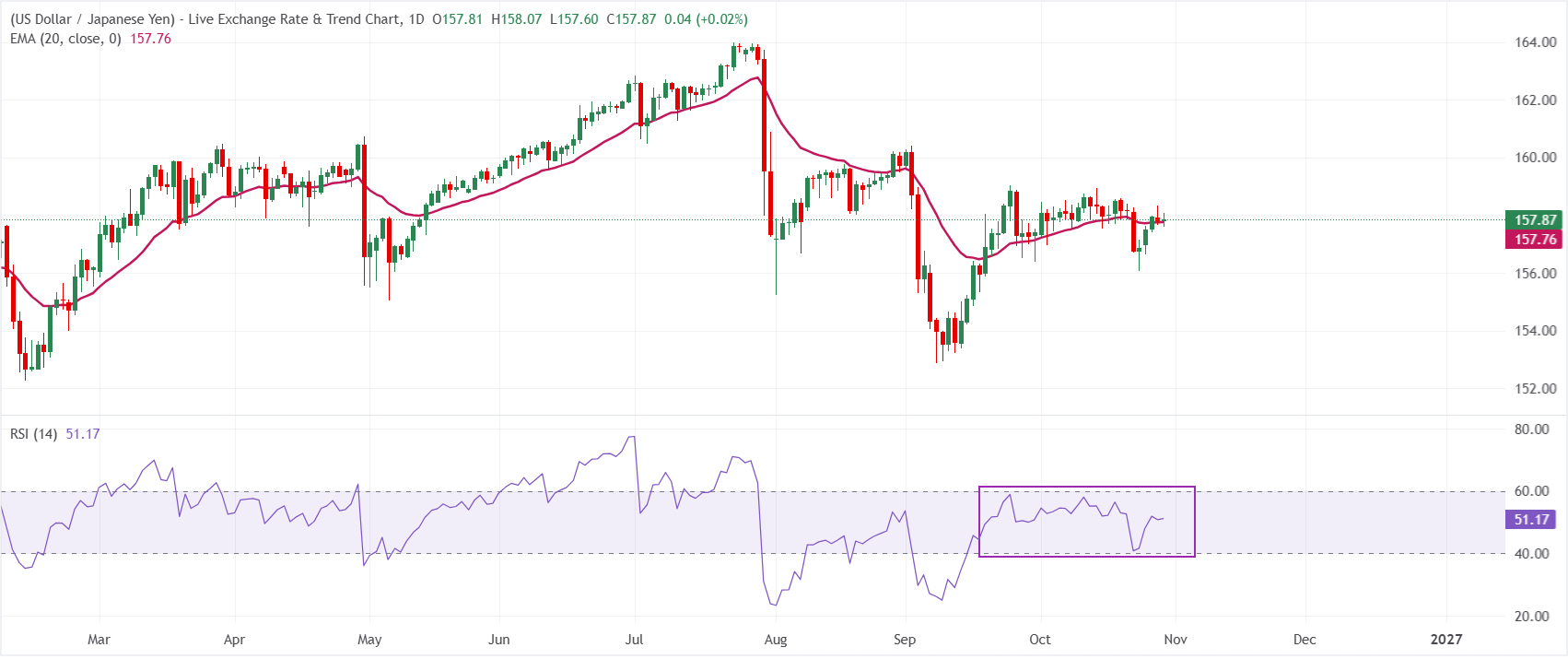
A mildly bullish near-term bias remains in place on the daily chart, with USD/JPY at 157.87, above its 20-period exponential moving average (EMA) of 157.76. That average provides immediate trend support. Meanwhile, the Relative Strength Index (RSI), at around 51, points to neutral to slightly positive momentum. Buyers therefore retain a small edge, without the pair entering overbought territory.
The first downside support lies around 157.76, where the 20-day EMA is clustered. A daily close beneath it would signal the possibility of a deeper correction towards recent lows. Holding above this moving average on a closing basis would, by contrast, likely preserve the broader positive tone and allow USD/JPY to test higher levels, with no nearby technical resistance yet defining those levels.
(The technical analysis of this story was written with the help of an AI tool. Know more.)
Economic Data in Focus
What Does the BoJ Interest Rate Decision Signal?
After each of its eight scheduled meetings a year, the Bank of Japan (BoJ) releases its interest rate decision. A rate increase accompanied by a hawkish assessment of the economy’s inflation outlook is generally positive for the Japanese Yen (JPY). Conversely, a dovish assessment of Japan’s economy, coupled with unchanged or lower interest rates, is usually negative for JPY.
Learn more.Upcoming release: Fri 30 Oct 2026 03:00
Release frequency: Irregular
Consensus estimate: 1.25%
Previous reading: 1.25%
Data source: Bank of Japan
POPULAR ARTICLES
1New Zealand Dollar: Is downside limited following the RBNZ surprise? – OCBC2What underpins Bitwise’s view that Bitcoin could reach $1.6M by 2036?3AUD/USD Price Forecast: Can the pair break out of consolidation near 0.7040?4US Dollar Index Price Forecast: Bullish bias stays intact as gains hold above 102.005US Dollar: Why is the Fed meeting keeping the Dollar steady? – Commerzbank6Euro: Is 1.1110 key to downside risk against US Dollar? – UOB7BoJ policy moves into focus as Japanese Yen trades flat against US Dollar8Pi Network Price Forecast: Could PI face another leg down as the broader crypto market retreats?9Higher oil prices keep Indian Rupee under pressure as it slips to two-week low


Get Started!
Sign up and access the Global Markets in less than 3 minutes

Connect With Us









Contacts
Phone: +61 2 8036 8388
Fax: +61 2 8036 8388
Email: support@tmgm.com



The information provided on this website is of a general nature only and does not constitute personal financial advice. Before acting on any information on this website, you should consider the suitability of the information in relation to your objectives, financial situation and needs. Investing in CFDs and FX Margin Contracts carries significant risks and is not suitable for all investors. You may lose more than your initial deposit. You do not own, or have, any interest in the underlying asset. We recommend that you seek independent advice and ensure you fully understand the risks involved before trading. It is important that you read and consider the disclosure document before you acquire any product listed on the website. The information and advertisements offered on this website are not intended for use by any person in any country or jurisdiction where such use would be contrary to local laws and regulations. The Products and Services offered on this website are not intended for residents of the United States, Malaysia and Thailand.
TMGM is authorized and regulated in various jurisdictions.
Trademax Australia Limited, trading as TMGM, is regulated by the Australian Securities and Investments Commission (ASIC), AFSL no. 436416 and is located at Level 28, One International Tower, 100 Barangaroo Avenue, 2000 Sydney, NSW Australia.
Email: support@tmgm.com.au
Trademax Global Limited, trading as TMGM, is authorized and regulated by the Vanuatu Financial Services Commission (VFSC), registration number 40356 and registered at 1276, Kumul Highway, Port Vila, Vanuatu, Republic of Vanuatu.
Email: support@tmgm.com
Trademax Global Markets (SE) Limited, trading as TMGM, is authorized and regulated by the Financial Services Authority (FSA) of Seychelles, with license number SD224. The company is registered at Office No 13, Providence Estate ABIS Centre, Mahe, Seychelles.
Email: support@tmgm.com
Trademax Global Markets (International) Pty Ltd, trading as TMGM, is authorized and regulated by the Financial Services Commission, Mauritius (FSC) with license no. GB22201012, and registered at 33, Edith Cavell Street C/o IQ EQ Fund Services (Mauritius) Ltd Port Louis, 11324 Mauritius.
Email: support@tmgm.com
Copyright © TMGM. All rights reserved