

Trading
Explore a wide range of markets with competitive pricing, deep liquidity, and advanced trading tools.
Learn More 
Platform
Trade seamlessly with TMGM's powerful platform, built for speed, precision, and a superior trading experience.
Learn More Trading Platform
Academy
Learn the fundamentals of trading with beginner-friendly resources, including guides, webinars, and market insights.
Learn More News & Analysis
Get real-time market updates and expert analysis to stay ahead of trading opportunities
Learn More News & Analysis
About
Learn what sets TMGM apart — our global presence, regulatory strength, and commitment to innovation in trading.
Learn More Why Choose TMGM
Sponsorship
Will Canada’s Unemployment Rate hold at the expected 6.5% as hiring rebounds?
- Markets expect Canada's Unemployment Rate to hold at 6.5% in October.
- Following September's loss of 68.3K jobs, Canada's economy is forecast to add 13.6K positions.
- Expectations of additional Bank of Canada interest rate increases could shift with the employment report.
The Canadian Dollar (CAD) could take its cue from Friday's October Labour Force Survey, as markets look for a modest employment rebound after September's steep fall. Statistics Canada is scheduled to publish the report at 13:30 GMT, with the Unemployment Rate also in focus. Uncertainty over United States (US) tariffs continues to cloud Canada's labour market, weighing on hiring prospects in industries sensitive to trade. After nearly 110K jobs were lost across August and September, investors will scrutinise the data for evidence that employment conditions are stabilising.

According to Royal Bank of Canada (RBC), public-sector roles, notably in education and healthcare, accounted for most of September's employment losses, rather than industries with direct exposure to US tariffs. Pointing to early indications of stronger hiring demand in October, RBC suggests that trade restrictions may have interrupted the labour market's recovery without causing a wider deterioration.
The Bank of Canada's (BoC) benchmark interest rate increase on 28 October, its first in more than three years, adds to the significance of the employment data. Further monetary tightening remains an option, although the central bank's next decisions will be guided by incoming figures on economic growth and inflation.
A jobs report that beats expectations could therefore strengthen the case for further BoC interest rate increases, especially alongside resilient wage growth. A fresh disappointment, however, could prompt doubts over the Canadian economy's capacity to weather persistent trade tensions and encourage greater caution among policymakers.
Will Canada's October jobs report keep the Unemployment Rate at 6.5%?
An October employment gain of around 13.6K is the consensus forecast among analysts, which would recover part of September's substantial 68.3K loss. Analysts also project an unchanged Unemployment Rate of 6.5%.
A somewhat firmer outcome is expected by RBC: 15K additional jobs and a slight easing in the Unemployment Rate to 6.4%. In the bank's view, US tariffs continue to affect mainly the sectors directly exposed to them. It also notes that more than 80% of Canada's exports to the US retain duty-free access under the United States-Mexico-Canada Agreement (USMCA).
To judge whether Canada's labour market is stabilising, investors will look beyond the headline numbers. Manufacturing jobs, full-time employment, wage growth and the participation rate will be key areas of scrutiny.
How could Canada's October Unemployment Rate release move USD/CAD, and when is it due?
The Canadian Dollar could draw support from an above-forecast employment reading, particularly if unemployment falls and wage growth strengthens, bolstering expectations of additional BoC monetary tightening. Statistics Canada's October employment report is due on Friday at 13:30 GMT.
A further employment disappointment, on the other hand, could weaken the Loonie as expectations for more interest rate increases recede. That risk would be particularly relevant if job losses spread beyond industries directly exposed to US trade restrictions.
With the US employment report arriving at the same time, USD/CAD could see heightened volatility. Investors will compare the strength of the two labour markets and weigh the resulting monetary policy implications.
Caution ahead of both countries' jobs reports is supporting a firmer US Dollar (USD), leaving USD/CAD trading with an upward bias around 1.4070 on Friday.
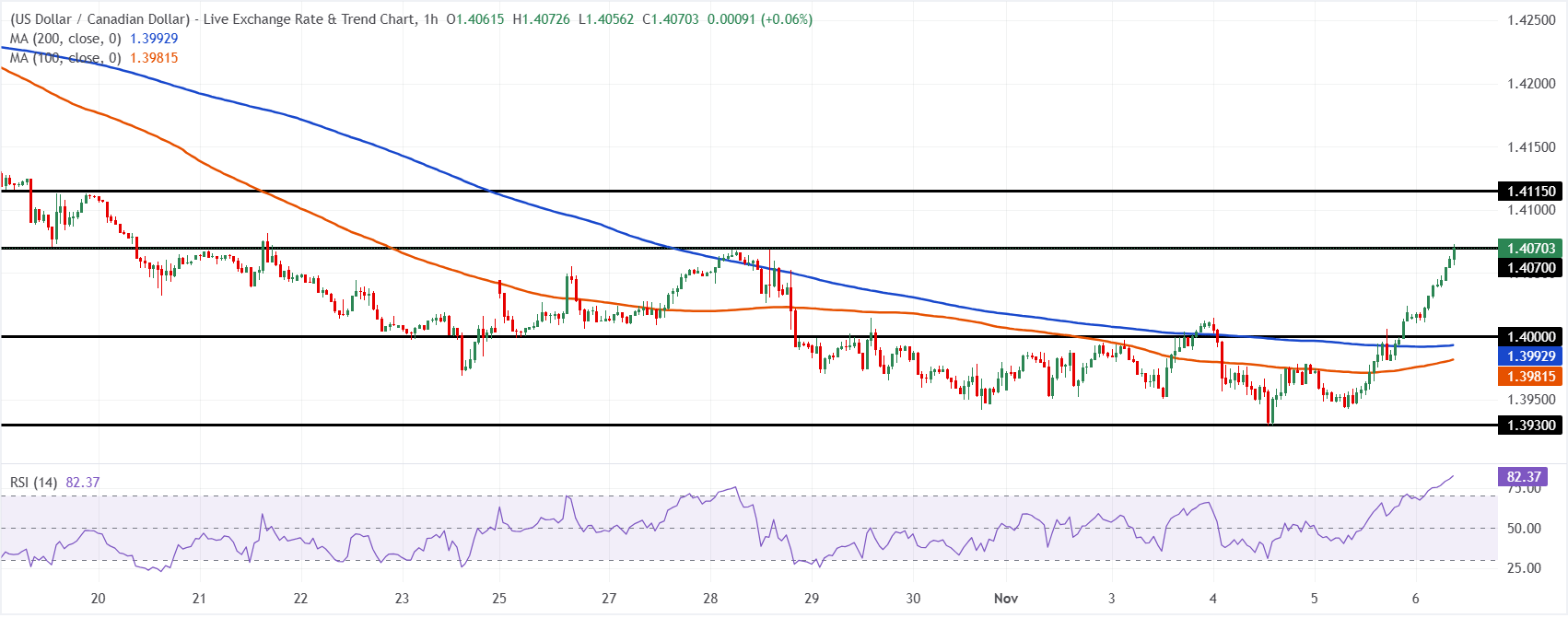
A test of horizontal pivot resistance at 1.4070 is under way on the one-hour USD/CAD chart. The near-term outlook retains a positive bias, with the pair above its 100-period and 200-period Simple Moving Averages (SMAs), which are grouped just below 1.4000. Meanwhile, the Relative Strength Index (14), near 82 and well into overbought territory, points to robust but increasingly stretched upward momentum as the pair advances.
If USD/CAD breaks decisively above 1.4070, attention would turn to the next resistance at 1.4115. The horizontal barrier there could limit further advances should buyers be unable to sustain the breakout. Any retreat would first encounter psychological support around 1.4000, ahead of the 200-period SMA near 1.3993. A deeper corrective pullback would bring the 100-period SMA around 1.3981 and horizontal support at 1.3930 into view as a further zone of demand.
(The technical analysis of this story was written with the help of an AI tool. Know more.)
Economic Data Indicator
What Does the Net Change in Employment Show?
Statistics Canada's Net Change in Employment tracks changes in the number of employed people in Canada. An increase generally signals economic growth and has positive implications for consumer spending. Accordingly, a strong reading is regarded as bullish for the Canadian Dollar (CAD), whereas a weak reading is considered bearish.
Find out more.Upcoming release: Fri 06 Nov 2026 13:30
Release frequency: Monthly
Consensus estimate: 13.6K
Prior reading: -68.3K
Data source: Statistics Canada
The Canadian dollar often responds significantly to Canada’s labour market data, particularly the Employment Change figure. Employment levels are closely correlated with consumption, which influences inflation and the Bank of Canada’s interest rate decisions, thereby moving the C$. When actual readings exceed consensus estimates, they tend to support CAD, with currency markets generally responding to the release in a steady and consistent manner.
Employment: Frequently Asked Questions
Currency valuations are strongly influenced by labour market conditions, which provide a key measure of an economy’s health. By supporting consumer spending and, consequently, economic growth, high employment or low unemployment strengthens the domestic currency. A particularly tight labour market, where too few workers are available to fill vacancies, can also affect inflation and monetary policy: strong demand for workers combined with limited supply pushes wages higher.
For policymakers, the rate of salary increases across an economy is an important consideration. Rapid wage growth gives households more money to spend and typically pushes up consumer goods prices. Since salary increases are unlikely to be reversed, wage growth is regarded as a key contributor to underlying, persistent inflation, unlike more volatile inflation drivers such as energy prices. This is why central banks worldwide closely monitor wage growth figures when setting monetary policy.
A central bank’s objectives determine how much importance it places on labour market conditions. For some, explicit employment-related mandates sit alongside the goal of controlling inflation. For instance, promoting maximum employment and stable prices forms the dual mandate of the US Federal Reserve (Fed). By contrast, keeping inflation under control is the sole mandate of the European Central Bank (ECB). Regardless of these differences, policymakers consider labour market conditions important because they indicate the economy’s health and are directly linked to inflation.
POPULAR ARTICLES
1Pi Network Price Forecast: How is the market sell-off after US midterm elections weighing on PI?2Crypto Today: Reversal of post-midterm elections rally deepens losses in Bitcoin, Ethereum and XRP3How does a Democratic Congress affect Bitcoin and crypto
regulation?4Democrats win House and Senate in US midterms: Why might crypto still find positives?5Eurozone Retail Sales (YoY) below expectations (0.6%) in September: Actual (0.4%)6Eurozone Retail Sales (MoM) registered at -0.7%, below expectations (-0.1%) in September7ECB's Lane: Wage negotiations set to be shaped by energy inflation8Fed's Williams: Now Is an Appropriate Time to Gather More Information9Czech Koruna: CZK remains under pressure as CNB tightening stays limited - Commerzbank

Get Started!
Sign up and access the Global Markets in less than 3 minutes

Connect With Us









Contacts
Phone: +61 2 8036 8388
Fax: +61 2 8036 8388
Email: support@tmgm.com



The information provided on this website is of a general nature only and does not constitute personal financial advice. Before acting on any information on this website, you should consider the suitability of the information in relation to your objectives, financial situation and needs. Investing in CFDs and FX Margin Contracts carries significant risks and is not suitable for all investors. You may lose more than your initial deposit. You do not own, or have, any interest in the underlying asset. We recommend that you seek independent advice and ensure you fully understand the risks involved before trading. It is important that you read and consider the disclosure document before you acquire any product listed on the website. The information and advertisements offered on this website are not intended for use by any person in any country or jurisdiction where such use would be contrary to local laws and regulations. The Products and Services offered on this website are not intended for residents of the United States, Malaysia and Thailand.
TMGM is authorized and regulated in various jurisdictions.
Trademax Australia Limited, trading as TMGM, is regulated by the Australian Securities and Investments Commission (ASIC), AFSL no. 436416 and is located at Level 28, One International Tower, 100 Barangaroo Avenue, 2000 Sydney, NSW Australia.
Email: support@tmgm.com.au
Trademax Global Limited, trading as TMGM, is authorized and regulated by the Vanuatu Financial Services Commission (VFSC), registration number 40356 and registered at 1276, Kumul Highway, Port Vila, Vanuatu, Republic of Vanuatu.
Email: support@tmgm.com
Trademax Global Markets (SE) Limited, trading as TMGM, is authorized and regulated by the Financial Services Authority (FSA) of Seychelles, with license number SD224. The company is registered at Office No 13, Providence Estate ABIS Centre, Mahe, Seychelles.
Email: support@tmgm.com
Trademax Global Markets (International) Pty Ltd, trading as TMGM, is authorized and regulated by the Financial Services Commission, Mauritius (FSC) with license no. GB22201012, and registered at 33, Edith Cavell Street C/o IQ EQ Fund Services (Mauritius) Ltd Port Louis, 11324 Mauritius.
Email: support@tmgm.com
Copyright © TMGM. All rights reserved