

Trading
Explore a wide range of markets with competitive pricing, deep liquidity, and advanced trading tools.
Learn More 
Platform
Trade seamlessly with TMGM's powerful platform, built for speed, precision, and a superior trading experience.
Learn More Trading Platform
Academy
Learn the fundamentals of trading with beginner-friendly resources, including guides, webinars, and market insights.
Learn More News & Analysis
Get real-time market updates and expert analysis to stay ahead of trading opportunities
Learn More News & Analysis
About
Learn what sets TMGM apart — our global presence, regulatory strength, and commitment to innovation in trading.
Learn More Why Choose TMGM
Sponsorship
Euro ticks higher as Fed stands pat, with ECB a day away
- EUR/USD gains modestly after the Fed holds rates, remaining short of its high just above 1.1150.
- A gap of 1.25-1.50 percentage points remains between the Fed's rate and the ECB's 2.50% deposit rate.
- Thursday brings the ECB's decision, with rates also expected to remain unchanged ahead of December.
EUR/USD recovered some of its losses from the session peak just above 1.1150 as the Fed's statement lifted the pair. It remains below that peak but is trading in the upper half of Wednesday's range. With the Fed leaving rates unchanged, Thursday's European Central Bank (ECB) decision offers the final opportunity this week to alter the interest-rate differential driving EUR/USD. The ECB is also expected to keep rates steady.

The interest-rate differential has remained at 1.25-1.50 percentage points since mid-September, shaping trading in EUR/USD. On 10 September, the ECB approved its second increase this year, taking the deposit rate to 2.50%. That increase became effective on 16 September, when the Fed moved to 3.75%-4.00%. Neither central bank has changed rates since.
An unchanged rate on Thursday, followed by an increase in December, is the view held by most economists on the ECB. Before the Fed's decision, traders had assigned roughly an 80% probability to a Fed hike in December as well. Should each central bank raise rates by a quarter-point, the differential influencing EUR/USD would close the year at exactly the level in place since 16 September.
Which releases and events are next?
Growth figures from both sides of EUR/USD's interest-rate differential will be available before the weekend. Thursday's releases at 12:30 GMT comprise September's Personal Consumption Expenditures Price Index (PCE) and US third-quarter Gross Domestic Product (GDP). The ECB announces its decision at 13:15 GMT, followed by President Lagarde's press conference at 13:45 GMT. On Friday, the euro area's initial third-quarter GDP estimate is scheduled for 10:00 GMT.
Before the ECB's decision, the final word on US rates comes from Fed Chair Warsh, who takes questions at 18:30 GMT on Wednesday. Warsh said on 16 October that stronger inflation had not altered his assessment of the economy. Any further comments on December would feed into EUR/USD through the US side of the rate differential.
What do the charts show?
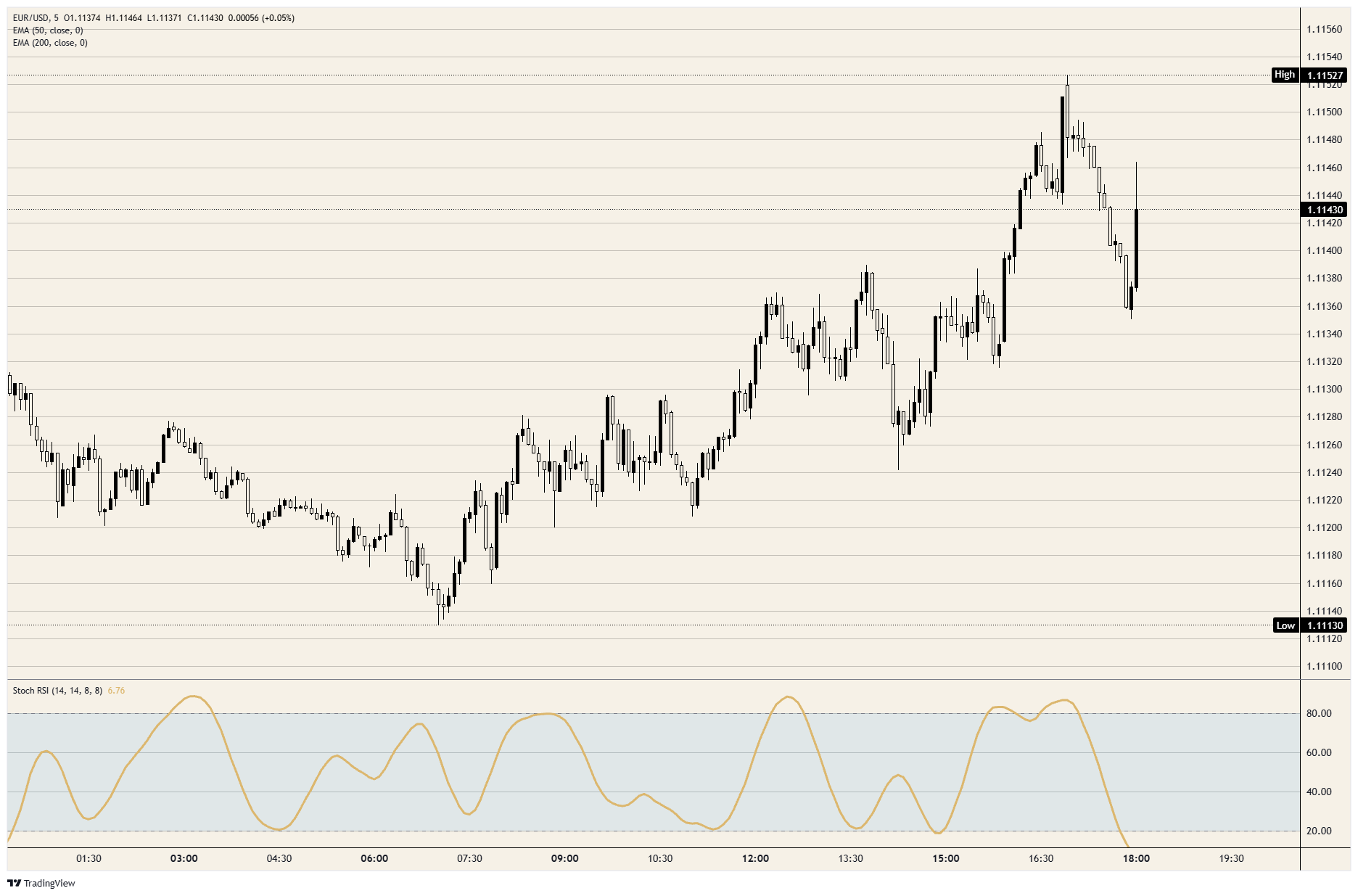
Intraday momentum was already oversold when the decision candle formed. Earlier, EUR/USD had fallen from its opening level to a session low just above 1.1100 before recovering. In the candles preceding the statement, the pair surrendered almost half of that rebound.
EUR/USD chart: 5-minute timeframe
Fed: frequently asked questions
Responsibility for US monetary policy rests with the Federal Reserve (Fed), whose dual mandate is price stability and full employment. Adjusting interest rates is its main means of pursuing these objectives. If prices climb too rapidly and inflation exceeds its 2% target, the Fed increases interest rates. Higher borrowing costs across the economy make the US more attractive to international investors seeking a place for their funds, strengthening the US Dollar (USD). Conversely, inflation below 2% or an excessively high unemployment rate may prompt the Fed to cut interest rates to stimulate borrowing, putting pressure on the dollar.
Economic conditions are reviewed and monetary policy decisions taken by the Federal Open Market Committee (FOMC) at the Federal Reserve's (Fed) eight policy meetings each year. Twelve Fed officials participate: all seven members of the Board of Governors, the president of the Federal Reserve Bank of New York and four of the other eleven regional Reserve Bank presidents. Those four positions rotate, with each president serving a one-year term.
A substantial expansion in credit flowing through a stalled financial system is the aim of Quantitative Easing (QE), a policy the Federal Reserve may adopt in extreme circumstances. Used in crises or periods of exceptionally low inflation, this unconventional measure was the Fed's preferred response during the Great Financial Crisis in 2008. Under QE, the Fed prints additional Dollars to purchase high-grade bonds from financial institutions. The policy generally weakens the US Dollar.
Usually supportive of the US Dollar's value, Quantitative Tightening (QT) reverses QE. The Federal Reserve ceases bond purchases from financial institutions and, as bonds in its portfolio mature, does not use the repaid principal to buy new bonds.
POPULAR ARTICLES
1Fed pause reveals inflation divide as Australian Dollar holds its ground2Why is the Japanese Yen weakening as the Fed’s hold exposes a hawkish split?3British Pound regains ground as Fed keeps rates unchanged amid hawkish divisions4Crude Oil sees little change after Fed hold as Iran considers a Qatari deal5Canadian Dollar Sees Little Change as Fed Holds Rates After BoC Hike6Euro ticks higher as Fed stands pat, with ECB a day away7Dollar Index recovers from a dip as Fed holds rates, with two votes for a hike8WTI ends two-day run of losses as fresh developments unfold in the Middle East9Silver Price Forecast: Is $50 Back in Focus After Rejection at $55?
LIVE QUOTES

ALL ABOUT FOREX
What Is a Stop Loss, How Does It Work and How Do You Set One?
Margin Call Meaning: What It Is, What Triggers It, and How to Avoid One
What Is an Islamic Account in Forex?
Best Indicators for Forex Trading and How to Use Them
The Top 10 Most Traded Currency Pairs in the World
What are the Major Forex Pairs? 7 Major Currency Pairs in the World
5 Best Forex Trading Apps In India In 2026
Top 15 Weakest Currencies in the World
Best Time to Trade Forex
Get Started!
Sign up and access the Global Markets in less than 3 minutes

Connect With Us









Contacts
Phone: +61 2 8036 8388
Fax: +61 2 8036 8388
Email: support@tmgm.com



The information provided on this website is of a general nature only and does not constitute personal financial advice. Before acting on any information on this website, you should consider the suitability of the information in relation to your objectives, financial situation and needs. Investing in CFDs and FX Margin Contracts carries significant risks and is not suitable for all investors. You may lose more than your initial deposit. You do not own, or have, any interest in the underlying asset. We recommend that you seek independent advice and ensure you fully understand the risks involved before trading. It is important that you read and consider the disclosure document before you acquire any product listed on the website. The information and advertisements offered on this website are not intended for use by any person in any country or jurisdiction where such use would be contrary to local laws and regulations. The Products and Services offered on this website are not intended for residents of the United States, Malaysia and Thailand.
TMGM is authorized and regulated in various jurisdictions.
Trademax Australia Limited, trading as TMGM, is regulated by the Australian Securities and Investments Commission (ASIC), AFSL no. 436416 and is located at Level 28, One International Tower, 100 Barangaroo Avenue, 2000 Sydney, NSW Australia.
Email: support@tmgm.com.au
Trademax Global Limited, trading as TMGM, is authorized and regulated by the Vanuatu Financial Services Commission (VFSC), registration number 40356 and registered at 1276, Kumul Highway, Port Vila, Vanuatu, Republic of Vanuatu.
Email: support@tmgm.com
Trademax Global Markets (SE) Limited, trading as TMGM, is authorized and regulated by the Financial Services Authority (FSA) of Seychelles, with license number SD224. The company is registered at Office No 13, Providence Estate ABIS Centre, Mahe, Seychelles.
Email: support@tmgm.com
Trademax Global Markets (International) Pty Ltd, trading as TMGM, is authorized and regulated by the Financial Services Commission, Mauritius (FSC) with license no. GB22201012, and registered at 33, Edith Cavell Street C/o IQ EQ Fund Services (Mauritius) Ltd Port Louis, 11324 Mauritius.
Email: support@tmgm.com
Copyright © TMGM. All rights reserved