

Trading
Explorez une large gamme de marchés avec des prix compétitifs, une liquidité profonde et des outils de trading avancés.
En savoir plus 
Plateforme
Tradez en toute fluidité avec la plateforme puissante de TMGM, conçue pour la vitesse, la précision et une expérience de trading supérieure.
En savoir plus Plateforme de trading
Outils de trading
Académie
Apprenez les fondamentaux du trading avec des ressources adaptées aux débutants, incluant des guides, des webinaires et des analyses de marché.
En savoir plus Actualités et analyses
Obtenez des mises à jour de marché en temps réel et des analyses d'experts pour anticiper les opportunités de trading
En savoir plus Actualités et analyses
À propos
Découvrez ce qui distingue TMGM — notre présence mondiale, notre solidité réglementaire et notre engagement envers l'innovation dans le trading.
En savoir plus Pourquoi choisir TMGM
Dow Jones Industrial Average gives back a 500-point earnings jump
- DJIA hits its highest since September 22 on bank results, then finishes lower.
- Goldman Sachs beats by 30% and still slips, and Caterpillar and J&J sink.
Goldman Sachs (GS) earned $17.01 a share in the third quarter against a forecast near $13.00. JPMorgan Chase (JPM) missed on profit and revenue but raised its 2026 forecast for net interest income, what it earns on loans minus what it pays on deposits. Both stocks finished lower, so the reward for beating forecasts by 30% was a smaller loss than JPMorgan's.

The Dow Jones Industrial Average is weighted by share price, so a $1 move in any member is worth about 6 index points. Goldman, at about $890, is its most expensive stock. At their highs Goldman and UnitedHealth (UNH), which beat forecasts and raised its outlook, were adding about 350 points between them, and none of it was left by the final bell.
Falls in Caterpillar (CAT) and Johnson & Johnson (JNJ) subtracted about 250 points from the Dow, more than the index lost. Citi cut the share price it expects for Caterpillar by $150 to $950, doubting that data-centre spending for artificial intelligence justifies the current one. Johnson & Johnson beat forecasts and raised its outlook, but a $5.5 billion charge to resolve talc lawsuits left its quarterly profit at $0.09 a share.
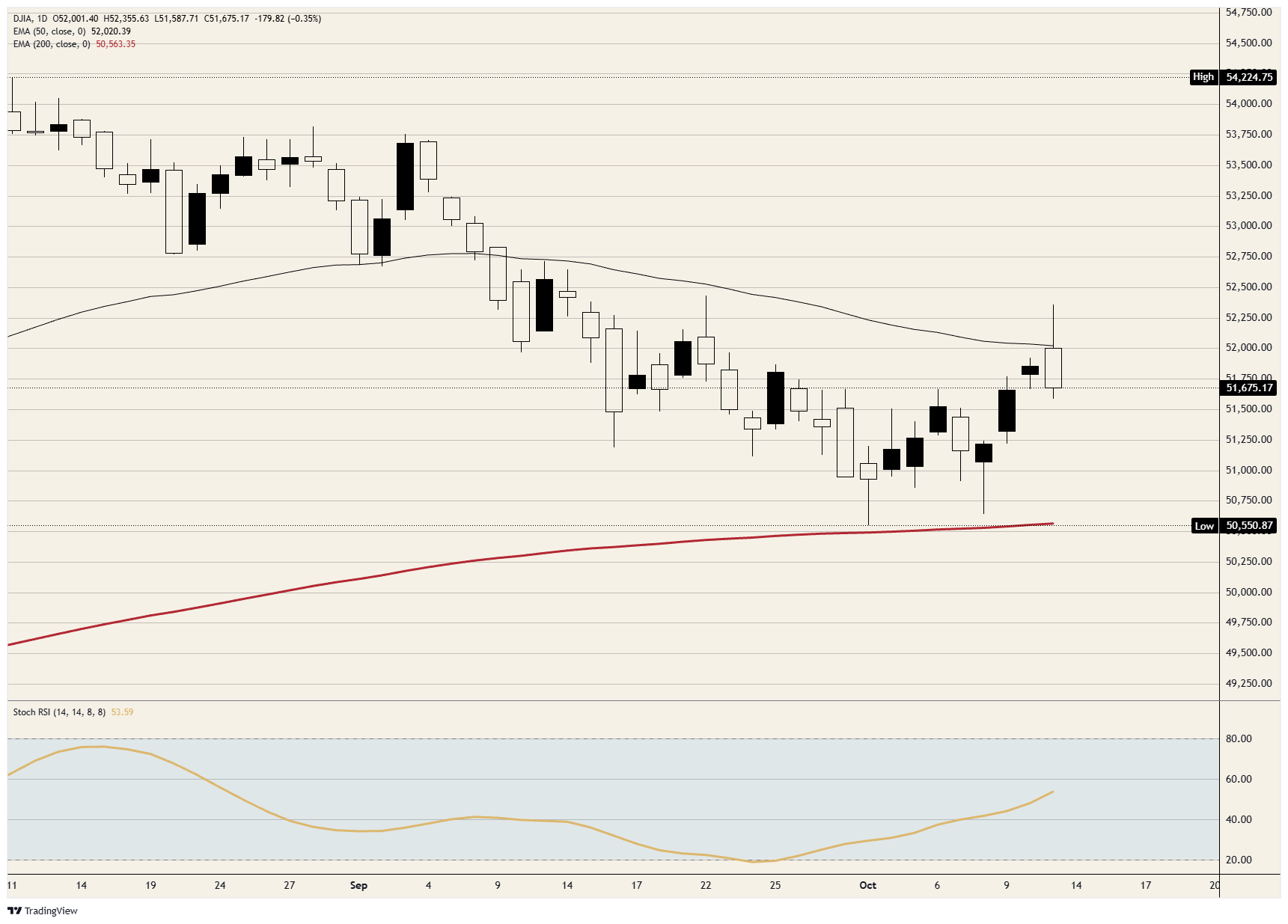
The Dow reached just above 52,300 before the opening bell, about 500 points above Monday's close and its highest since September 22. It fell through 52,000 to the 51,750 area in the first nine five-minute bars after the bell, then made its low near 51,600 and finished just under 51,700.
On the charts
The Dow traded above its 50-day Exponential Moving Average (EMA) near 52,000 for the first time in more than a month and finished back below it. The index has now given back more than a third of its climb from the October 1 low just above 50,500, which held just above the 200-day EMA.
Dow Jones daily chart
Dow Jones FAQs
The Dow Jones Industrial Average, one of the oldest stock market indices in the world, is compiled of the 30 most traded stocks in the US. The index is price-weighted rather than weighted by capitalization. It is calculated by summing the prices of the constituent stocks and dividing them by a factor, currently 0.152. The index was founded by Charles Dow, who also founded the Wall Street Journal. In later years it has been criticized for not being broadly representative enough because it only tracks 30 conglomerates, unlike broader indices such as the S&P 500.
Many different factors drive the Dow Jones Industrial Average (DJIA). The aggregate performance of the component companies revealed in quarterly company earnings reports is the main one. US and global macroeconomic data also contributes as it impacts on investor sentiment. The level of interest rates, set by the Federal Reserve (Fed), also influences the DJIA as it affects the cost of credit, on which many corporations are heavily reliant. Therefore, inflation can be a major driver as well as other metrics which impact the Fed decisions.
Dow Theory is a method for identifying the primary trend of the stock market developed by Charles Dow. A key step is to compare the direction of the Dow Jones Industrial Average (DJIA) and the Dow Jones Transportation Average (DJTA) and only follow trends where both are moving in the same direction. Volume is a confirmatory criteria. The theory uses elements of peak and trough analysis. Dow’s theory posits three trend phases: accumulation, when smart money starts buying or selling; public participation, when the wider public joins in; and distribution, when the smart money exits.
There are a number of ways to trade the DJIA. One is to use ETFs which allow investors to trade the DJIA as a single security, rather than having to buy shares in all 30 constituent companies. A leading example is the SPDR Dow Jones Industrial Average ETF (DIA). DJIA futures contracts enable traders to speculate on the future value of the index and Options provide the right, but not the obligation, to buy or sell the index at a predetermined price in the future. Mutual funds enable investors to buy a share of a diversified portfolio of DJIA stocks thus providing exposure to the overall index.
ARTICLES POPULAIRES
1Mexican Peso buckles as Fed inflation fears overshadow dovish Williams2Ethereum Price Forecast: ETH holds $2,500 as open interest drops to lowest level since February3Pound gains and stays inside its range for a third week4Dow Jones Industrial Average gives back a 500-point earnings jump5Taiwan: AI-driven growth and inflation outlook – DBS6Chinese Yuan: Outlook stays mildly positive against US Dollar – UOB7Fed's Collins backs September hike, sees Oil and AI driving inflation8GBP/JPY Price Forecast: Bulls challenge 210.00 as breakout looms9Japanese Yen: Choppy trade after JPY-supportive comments – Scotiabank
COTATIONS EN DIRECT

TOUT SUR INDICATORS
Commencez !
Inscrivez-vous et accédez aux Marchés Mondiaux en moins de 3 minutes

Connectez-vous avec Nous









Contacts
Téléphone: +61 2 8036 8388
Fax: +61 2 8036 8388
Email: support@tmgm.com



Les informations fournies sur ce site web sont de nature générale uniquement et ne constituent pas un conseil financier personnalisé. Avant d’agir sur la base de toute information figurant sur ce site web, vous devez évaluer la pertinence de ces informations au regard de vos objectifs, de votre situation financière et de vos besoins. Investir dans les CFD et les contrats de marge sur le Forex comporte des risques importants et ne convient pas à tous les investisseurs. Vous pouvez perdre plus que votre dépôt initial. Vous ne détenez pas, et n’avez, aucun droit de propriété ou intérêt sur l’actif sous-jacent. Nous vous recommandons de solliciter un avis indépendant et de vous assurer que vous comprenez pleinement les risques encourus avant de trader. Il est important que vous lisiez et preniez en considération le document d’information avant d’acquérir tout produit présenté sur le site web. Les informations et publicités proposées sur ce site web ne sont pas destinées à être utilisées par toute personne dans tout pays ou toute juridiction où une telle utilisation serait contraire aux lois et réglementations locales. Les Produits et Services proposés sur ce site web ne sont pas destinés aux résidents des États-Unis, de la Malaisie et de la Thaïlande.
TMGM est autorisé et réglementé dans diverses juridictions.
Trademax Australia Limited, opérant sous le nom de TMGM, est réglementé par l'Australian Securities and Investments Commission (ASIC), AFSL no. 436416 et est situé au Level 28, One International Tower, 100 Barangaroo Avenue, 2000 Sydney, NSW Australie.
Email: support@tmgm.com.au
Trademax Global Limited, opérant sous le nom de TMGM, est autorisé et réglementé par la Vanuatu Financial Services Commission (VFSC), numéro d'enregistrement 40356 et enregistré au 1276, Kumul Highway, Port Vila, Vanuatu, République de Vanuatu.
Email: support@tmgm.com
Trademax Global Markets (SE) Limited, exerçant sous le nom TMGM, est autorisée et régulée par la Financial Services Authority (FSA) des Seychelles, sous le numéro de licence SD224. La société est enregistrée au bureau n° 13, Providence Estate ABIS Centre, Mahé, Seychelles.
Email: support@tmgm.com
Trademax Global Markets (International) Pty Ltd, opérant sous le nom de TMGM, est autorisé et réglementé par la Financial Services Commission, Maurice (FSC) avec la licence no. GB22201012, et enregistré au 33, Edith Cavell Street C/o IQ EQ Fund Services (Mauritius) Ltd Port Louis, 11324 Maurice.
Email: support@tmgm.com
Copyright © TMGM. Tous droits réservés